
• Skip to primary navigation
  • Skip to main content
Dean Dorton – CPAs and Advisors
  • Services
        • Audit & Assurance
          • Audits, Reviews & Compilations
          • ESG Programs & Reporting
          • Internal Audit
          • International Financial Reporting
          • Lease Accounting Managed Services
          • Peer Review Services
          • SOC Reporting
        • Family Office
        • Consulting & Advisory
          • Business Valuation Services
          • Forensic Accounting
          • Fractional CFO
          • Litigation Support
          • Matrimonial Dissolution
          • Merger & Acquisition
          • SEC Services
          • Succession Planning
          • Transaction Advisory Services
          • Whistleblower Hotline
        • Outsourced Accounting
        • Private Wealth
        • Healthcare Consulting
          • Finance
          • Health Systems Operational Transformation
          • Medical Billing and Credentialing
          • Risk Management & Compliance
          • Strategic Growth for Private Practices
          • Strategy and Strategy Implementation
          • Technology & Data Analytics
        • Tax
          • Business Tax
          • Cost Segregation Studies
          • Credits and Incentives
          • Estates and Trusts
          • Individual Tax
          • International Tax
          • SEC Provision and Compliance
          • State and Local Tax
        • Technology & Cybersecurity
          • Accounting Software
          • Cybersecurity
            • Cybersecurity Assessments
            • Cybersecurity Scorecard Assessment
            • Security Awareness Training
            • Virtual Information Security Office
          • Data Analytics & AI
          • IT Audit & Compliance
            • Cybersecurity Maturity Model Certification (CMMC)
            • Data Privacy Laws
            • SOC Reporting
          • IT Infrastructure & Cloud Solutions
            • Automation
            • Backup and Disaster Recovery
            • Cloud Strategy
            • Data Center
            • Enterprise Network
            • Network Security
            • Phone and Video Conferencing
            • User Identity Management Solutions
            • Webex
          • Managed IT Services
  • Industries
        • Construction
        • Distilleries and Craft Breweries
        • Energy and Natural Resources
        • Equine
        • Financial Institutions
        • Government
        • Healthcare
        • Higher Education
        • Life Sciences
        • Manufacturing and Distribution
        • Nonprofit
        • Real Estate
  • Insights
    • Articles
    • Guides
    • Case Studies
  • Events
  • Company
        • News
        • Our Team
        • Experiences
        • Careers
          • College Students
          • Experienced Professionals
        • Locations
        • Lexington, KY

          250 West Main Street
          Suite 1400
          Lexington, KY 40507
          859-255-2341

        • Louisville, KY

          435 North Whittington Parkway
          Suite 400
          Louisville, KY 40222
          502-589-6050

        • Louisville, KY

          700 North Hurstbourne Parkway
          Suite 115
          Louisville, KY 40222
          502-589-6050

        • Ft. Wright, KY

          810 Wright’s Summit Parkway
          Suite 300
          Fort Wright, KY 41011
          859-331-3300

        • Cincinnati, OH

          312 Walnut Street
          Suite 3330
          Cincinnati, OH 45202
          859-331-3300

        • Blue Ash, OH

          9987 Carver Rd
          Suite 120
          Blue Ash, OH 45242
          513-891-5911

        • West Chester, OH

          9025 Centre Pointe Drive
          Suite 310
          West Chester, OH 45069
          513-985-6240

        • Indianapolis, IN

          5975 Castle Crk Pkwy Dr N
          Suite 400
          Indianapolis, IN 46250
          317-469-0169

        • Raleigh, NC

          4130 Parklake Avenue
          Suite 400
          Raleigh, NC 27612
          919-782-9265

  • Contact Us

Profit

Article 08.7.2017 Dean Dorton

On August 3, 2017, the Financial Accounting Standards Board (FASB) issued an exposure draft of a proposed new Accounting Standards Update (ASU) titled Clarifying the Scope and the Accounting Guidance for Contributions Received and Contributions Made. The FASB is accepting comments on the exposure draft through November 1, 2017.

The FASB has identified that many entities have had difficulty in characterizing grants and similar contracts with resource providers as either exchange transactions or contributions and in distinguishing between conditional and unconditional contributions. Therefore, the proposed ASU is designed to clarify and improve the accounting guidance for contributions received and contributions made.

The amendments in the proposed ASU would assist entities to:

  1. Evaluate whether transactions should be accounted for as contributions (nonreciprocal transactions) or as exchange (reciprocal) transactions; and
  2. Distinguish between conditional and unconditional contributions.

Distinguishing between contributions and exchange transactions determines which guidance is applied. For contributions, an entity should follow the guidance in Subtopic 958-605 of the Accounting Standards Codification (ASC), whereas for exchange transactions, an entity should follow other guidance, such as the new revenue recognition guidance that will be effective in the next couple of years.

Once a transaction is deemed to be a contribution, entities have noted that it can be difficult in practice to distinguish between conditional and unconditional contributions, particularly when an entity receives assets accompanied by certain stipulations but with no specified return policy for when the stipulations are not met.

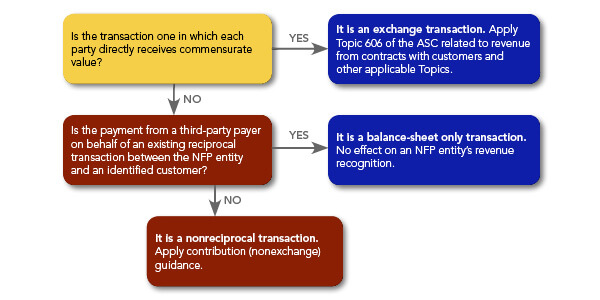
The proposed ASU would require a Not For Profit (NFP) entity to evaluate whether the resource provider is receiving direct commensurate value in return for the resources transferred (i.e. undertaking an exchange or reciprocal transaction). The proposed ASU notes the following:

  1. A resource provider (including a private foundation, a government agency, or other) is not synonymous with the general public. Indirect benefit received by the public as a result of the assets transferred is not equivalent to commensurate value received by the resource provider.
  2. Execution of a resource providers’ mission or the positive sentiment from acting as a donor would not constitute commensurate value received by a resource provider for purposes of determining whether a transfer of assets is a contribution or an exchange.

Consistent with current accounting principles generally accepted in the United States (GAAP), if the resource provider is not receiving direct value for the resources provided, the transaction will be considered a contribution (or nonreciprocal transaction), unless it can be shown that the resource provider is making the payment on behalf of an existing exchange transaction between the NFP entity and an identified customer.
The ASU also provides guidance on whether a contribution is conditional or unconditional. This decision is based on whether a barrier that must be overcome and either a right of return of assets transferred or a right of release of a promisor’s obligation to transfer assets is determinable from the agreement (or another document referenced in the agreement). The presence of both a barrier and a right of return or a right of release indicates that a recipient NFP entity is not entitled to the transferred assets (or a future transfer of assets) until it has overcome the barriers in the agreement. Prior to overcoming those barriers, the contribution would be considered conditional.

After a contribution has been deemed unconditional, an entity would then consider whether the contribution is restricted on the basis of the current definition of the term donor-imposed restriction, which includes a consideration of how broad or narrow the purpose of the agreement is, and whether the resources are available for use only after a specified date.
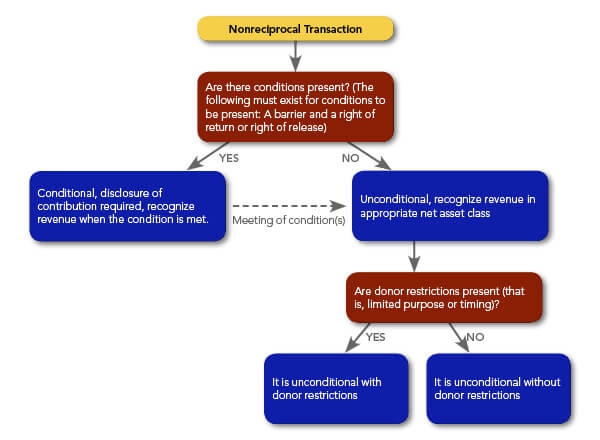
The FASB believes that the proposed ASU could result in more grants and contracts being accounted for as contributions (often conditional contributions) than under current GAAP. For this reason, clarifying the guidance about whether a contribution is conditional or unconditional is important because such classification affects the timing of contribution revenue recognition. Recipients of conditional promises to give would be required to comply with current disclosure requirements in paragraph 958-310-50-4 of the ASC. Contributions are only recognized within the financial statements once they are considered unconditional.

For more information, please contact your Dean Dorton advisor or Simon Keemer at skeemer@deandorton.com.

Filed Under: Industries, Nonprofit & Government Tagged With: asu, Contribution, FASB, grant, keemer, nonprofit, Profit, simon

Article 11.8.2016 Dean Dorton

Hurricane Matthew has been an unfortunate reminder of natural disasters reaching close to home. During and immediately after a natural disaster, the focus is always on the safety of communities, friends, family, and colleagues. The clean-up and recovery can take months with the insurance industry heavily involved in the process.

According to CoreLogic, the damage from Hurricane Matthew is estimated to result in over 100,000 insurance claims and damages up to $6 billion in the U.S. The replacement and repair of damaged physical property will cover the bulk of insurance claims. Business interruption claims will result from the severe impact to business operations ― financial damage which cannot be easily calculated or shown on the news and social media.

Employee salaries and rent obligations do not stop because of an extraordinary event such as a natural disaster, fire, or flood. Business interruption insurance coverage protects the cash flow impact to the business during the incident and subsequent recovery. Business interruption insurance is designed to return the business to the same financial standing as if the extraordinary event had never happened.

Every insurance policy is different and must be read closely to understand the coverage. In general, a business interruption claim will cover the lost “business income”.

Business income is comprised of:

  1. Net profit before income taxes and
  2. Continuing operating expenses (e.g. employee salaries).

In addition, policies will often cover “extra expenses” incurred (e.g. temporary office rent).

Determining net profit before income taxes requires forecasting business operating results assuming the extraordinary event never occurred and comparing to the actual results during the period of interruption. The subjectivity involved in forecasting and understanding the complete financial impact to the business often results in a complex analysis. Significant judgment and understanding of the business is often needed to determine a business interruption claim.

We work with businesses and insurance companies to prepare and review business interruption claims to help ensure the business is made “whole”. If you encounter an unfortunate event, Dean Dorton’s forensic accounting and valuation professionals are available to assist with the business interruption claim.

Contact your Dean Dorton advisor or David Angelucci at dangelucci@deandorton.com to learn more.

Filed Under: Accounting & Tax, Forensic Accounting, Services Tagged With: Angelucci, Business, Claim, David, Hurricane, Insurance, Interruption, Matthew, Profit

Article 01.22.2016 Dean Dorton

The convenience store (“c-store”) industry continues to show positive returns. The decline in fuel prices has allowed higher margin instore items to have a bigger impact on the overall gross profit. Please take a look at your numbers and see how you compare to this public company group.

2015*

2014

Fuel gross profit %

8.6%

5.9%

Fuel margin $ (per gallon)

$0.21

$0.20

Non-fuel gross profit %

36.6%

33.2%

Overall gross profit %

17.6%

12.4%

% of sales from fuel

68.4%

75.7%

Overall revenue growth

-10.7%

2.7%

12 month return

33.3%

23.8%


Note: The group in this study consisted of five publicly traded c-store companies.

* Estimate based on results through September 30, 2015.

For more information, contact Bill Kohm at bkohm@deandorton.com or 859-425-7625.


View Bill Kohm’s Bio

Filed Under: Energy & Natural Resources, Industries Tagged With: Bill Kohm, C-store, Convenience, Fuel, Profit

  • Services
    • Outsourced Accounting
    • Audit & Assurance
    • Tax
    • Consulting & Advisory
    • Technology & Cybersecurity
    • Family Office
    • Wealth Management
  • Industries
  • Company
  • Locations
  • Careers
  • Insights
  • Events
  • Contact Us
facebook Dean Dorton - CPAs And Advisors On Facebook twitter twitter linkedin Dean Dorton - CPAs And Advisors On LinkedIn youtube Dean Dorton - CPAs And Advisors On YouTube

The matters discussed on this website provide general information only. The information is neither tax nor legal advice. You should consult with a qualified professional advisor about your specific situation before undertaking any action.

© 2026 Dean Dorton Allen Ford, PLLC. All Rights Reserved