
• Skip to primary navigation
  • Skip to main content
Dean Dorton – CPAs and Advisors
  • Services
        • Audit & Assurance
          • Audits, Reviews & Compilations
          • ESG Programs & Reporting
          • Internal Audit
          • International Financial Reporting
          • Lease Accounting Managed Services
          • Peer Review Services
          • SOC Reporting
        • Family Office
        • Consulting & Advisory
          • Business Valuation Services
          • Forensic Accounting
          • Fractional CFO
          • Litigation Support
          • Matrimonial Dissolution
          • Merger & Acquisition
          • SEC Services
          • Succession Planning
          • Transaction Advisory Services
          • Whistleblower Hotline
        • Outsourced Accounting
        • Private Wealth
        • Healthcare Consulting
          • Finance
          • Health Systems Operational Transformation
          • Medical Billing and Credentialing
          • Risk Management & Compliance
          • Strategic Growth for Private Practices
          • Strategy and Strategy Implementation
          • Technology & Data Analytics
        • Tax
          • Business Tax
          • Cost Segregation Studies
          • Credits and Incentives
          • Estates and Trusts
          • Individual Tax
          • International Tax
          • SEC Provision and Compliance
          • State and Local Tax
        • Technology & Cybersecurity
          • Accounting Software
          • Cybersecurity
            • Cybersecurity Assessments
            • Cybersecurity Scorecard Assessment
            • Security Awareness Training
            • Virtual Information Security Office
          • Data Analytics & AI
          • IT Audit & Compliance
            • Cybersecurity Maturity Model Certification (CMMC)
            • Data Privacy Laws
            • SOC Reporting
          • IT Infrastructure & Cloud Solutions
            • Automation
            • Backup and Disaster Recovery
            • Cloud Strategy
            • Data Center
            • Enterprise Network
            • Network Security
            • Phone and Video Conferencing
            • User Identity Management Solutions
            • Webex
          • Managed IT Services
  • Industries
        • Construction
        • Distilleries and Craft Breweries
        • Energy and Natural Resources
        • Equine
        • Financial Institutions
        • Government
        • Healthcare
        • Higher Education
        • Life Sciences
        • Manufacturing and Distribution
        • Nonprofit
        • Real Estate
  • Insights
    • Articles
    • Guides
    • Case Studies
  • Events
  • Company
        • News
        • Our Team
        • Experiences
        • Careers
          • College Students
          • Experienced Professionals
        • Locations
        • Lexington, KY

          250 West Main Street
          Suite 1400
          Lexington, KY 40507
          859-255-2341

        • Louisville, KY

          435 North Whittington Parkway
          Suite 400
          Louisville, KY 40222
          502-589-6050

        • Louisville, KY

          700 North Hurstbourne Parkway
          Suite 115
          Louisville, KY 40222
          502-589-6050

        • Ft. Wright, KY

          810 Wright’s Summit Parkway
          Suite 300
          Fort Wright, KY 41011
          859-331-3300

        • Cincinnati, OH

          312 Walnut Street
          Suite 3330
          Cincinnati, OH 45202
          859-331-3300

        • Blue Ash, OH

          9987 Carver Rd
          Suite 120
          Blue Ash, OH 45242
          513-891-5911

        • West Chester, OH

          9025 Centre Pointe Drive
          Suite 310
          West Chester, OH 45069
          513-985-6240

        • Indianapolis, IN

          5975 Castle Crk Pkwy Dr N
          Suite 400
          Indianapolis, IN 46250
          317-469-0169

        • Raleigh, NC

          4130 Parklake Avenue
          Suite 400
          Raleigh, NC 27612
          919-782-9265

  • Contact Us

FASB

Article 03.15.2022 Dean Dorton

In 2016, the Financial Accounting Standards Board (FASB) issued Accounting Standards Update (ASU) 2016-02 changing the way companies account for leases.  In 2020, the FASB issued ASU 2020-05 that delayed the effective date of the new leasing standard.  As a result of this delay, most private companies will be implementing the new leasing standard starting with calendar 2022 year ends.  For many private companies, especially those within the construction industry, the new leasing standard will require significant analysis of operations and transactions to identify the agreements that will be classified as leases under the new standard.  Of particular interest is the impact that the standard has on related party leases.

It has become normal within the construction industry for the buildings, and even the equipment, used by the operating construction company to be held by a separate, related entity in order to mitigate risk and provide for certain tax strategies.  The use of these related real estate and equipment companies will likely result in significant lease transactions between them and the construction company being evaluated under the new leasing standard.  The recognition of lease liabilities and right-of-use assets on the balance sheet of the construction company, as a result of the new leasing standard, could have a significant financial impact, and may impact working capital ratios thereby impacting debt covenants and bonding capacity.

Key areas which need to be considered when performing the evaluation of leases under the new leasing standard include the following:

1. Use of written lease agreements – All lease agreements, including those with related parties, should be formalized with a written agreement between the lessor and lessee.  This will make determinations under the new leasing standard easier to perform.

2. Lease terms – The new leasing standard requires that a related-party lease be classified and accounted for based on its legally enforceable terms and conditions. In other words, the classification and accounting for a lease with a related-party lessor should be the same as what the classification and accounting would have been if that lease were with an unrelated lessor.

There are two critical areas that should be considered when it comes to the length of all leases, but especially a related party lease:

a. Understanding the legally enforceable terms and conditions – A lease will be recognized under the new leasing standard based upon its legally enforceable terms and conditions.  The lessee is required to consider whether there are any implicit legally enforceable terms and conditions in addition to the terms and conditions in the written agreement.

For example, if the construction company leases a facility to perform pre-fabrication work and the lease has a term of one year with no option to renew, but the construction company has incurred significant costs related to leasehold improvements that will retain significant value over their useful life of 20 years, consideration will need to be given to whether there are implicit legally enforceable terms and conditions that would cause the lease term to be evaluated as 20 years instead of one year.

Another example would be if the construction company leases construction equipment on a month-to-month basis from a related party and that equipment is going to be used throughout the period of construction of a project that is expected to take two years to complete, consideration should be given to whether there are implicit legally enforceable terms and conditions that would cause the lease term to be evaluated as two years instead of one month.

b. Impact on capitalized leasehold/tenant improvements – Leasehold/tenant improvements should be depreciated over the shorter of the useful life of the asset or the term of the lease.

For example, using the example in 2(a) above, if the construction company determines that the lease for the pre-fabrication workshop is truly a one year lease, then the leasehold improvements related to the workshop would have a maximum depreciable life of one year (i.e. the lease term of one year is shorter than the useful life of the assets).  The treatment of the lease as a one year lease would likely result in significant depreciation charges/write downs of the leasehold improvements.

This treatment could also flow through to any leasehold or tenant improvements within the lessor entity in any GAAP financial statements they issue. For example, if the lessor entity has capitalized improvements made on behalf of the construction company and those improvements are specific to the construction company and would likely be unwanted/useless to any alternative lessee (for example signage), there could be the need to recognize impairment charges on those improvements to write them off over the one year term of the lease.

3. Lease payments – Companies will need to analyze lease payments within the agreements to determine if they are fixed, in-substance fixed, variable based upon a rate or index or variable based upon other than a rate or index.  This analysis is critical in order to correctly identify the lease payments that are used in classifying the lease and measuring the related lease liability and right-of-use (ROU) asset.

a. Fixed lease payments – Fixed lease payments are included in the calculation of the ROU asset and lease liability.   Payments that vary solely based on the passage of time (e.g. escalating rents) are not considered variable lease payments, and would be included in the calculation of the ROU asset and lease liability.

Example: Lessee is a private company with a calendar year end. Lessee enters into a lease with Lessor on January 1, 20X6, which is also the lease’s commencement date. The noncancellable term of the lease is three years. Lessee must pay Lessor $100,000 on January 1, 20X7. The lease payments on January 1, 20X8 and 20X9 are increased by 2% each year.

The amount of the lease payments that should be included in classifying the lease and measuring the related lease liability and ROU asset are $100,000 for year 1, $102,000 (i.e. $100,000 increased by 2%) for year 2 and $104,040 (i.e. $102,000 increased by a further 2%) for year 3.

b. In-substance fixed payments – A lease agreement may describe a payment as a variable payment, but upon closer look it is apparent there is an amount that must be paid (e.g. a minimum amount that cannot be avoided) or there is an amount that will be paid because the variability lacks economic substance. These types of variable lease payments are in-substance fixed payments and are treated as fixed payments when determining lease payments for the calculation of the lease liability and ROU asset.

Example: A lease requires a lessee to pay rent equal to 1% of its sales, subject to a minimum sales figure of $5 million. The in-substance fixed payment is the minimum amount the lessee will be required to pay of $50,000 ($5 million × 1%), which should be included in lease payments on the commencement date to calculate the ROU asset and lease liability. Any potential payments above the minimum amount are based on the lessee’s sales and should be accounted for as variable lease payments based on other than an index or rate (see below). Another way that this payment term could be worded in the lease agreement, but still result in the same outcome, would be if the lessee was required to make a payment of $50,000 or 1% of its sales, whichever is greater. In this situation, there is an in-substance fixed payment of $50,000 that will be required of the lessee.

c. Variable based upon a rate or index – Variable lease payments that depend on an index or rate are initially measured and included in lease payments by reference to the index or rate at the commencement date of the lease. Any additional lease costs arising from subsequent changes to the index or rate are recognized in the period those costs are incurred (i.e. similar to variable lease payments based on other than an index or rate as discussed below). Common examples of indexes and rates on which variable lease payments are based include: the Consumer price index (CPI), the prime or LIBOR interest rate, interest rates on direct Treasury obligations of the U.S. government (with or without a spread) and market rental rates.

Example 1: Lessee is a private company with a calendar year end. Lessee enters into a lease with Lessor on January 1, 20X6, which is also the lease’s commencement date. The noncancellable term of the lease is three years. Lessee must pay Lessor $100,000 on January 1, 20X7. The lease payments on January 1, 20X8 and 20X9 are $100,000 adjusted for the cumulative increase in the Consumer Price Index (CPI) since January 1, 20X7. No refunds are provided if the CPI decreases.

There is a fixed lease payment of $100,000 per year paid in arrears. The amount of the variable lease payment that should be included in the lease payments used in classifying the lease and measuring the related lease liability and ROU asset should be determined initially by reference to the CPI at the commencement date, and assuming that it will not change over the term of the lease. Given that the variable lease payment is based on the increase in the CPI after January 1, 20X7, the variable lease payment on that date is zero. As such, the amount of lease payments used in the classification and measurement of the lease on January 1, 20X6 is $300,000 (annual payments of $100,000 over the lease term of three years).

Example 2: Lessee is a private company with a calendar year end. Lessee enters into a lease with Lessor on January 1, 20X6, which is also the lease’s commencement date. The noncancellable term of the lease is three years. Lessee must pay Lessor $100,000 on January 1, 20X7. The lease payments on January 1, 20X8 and 20X9 are $100,000 increased each year by the 1-month LIBOR rate. At the commencement date of the lease the 1-month LIBOR rate is 2%.

The amount of the variable lease payment that should be included in the lease payments used in classifying the lease and measuring the related lease liability and ROU asset should be determined by reference to the 1-month LIBOR rate at the commencement date of the lease (and again assuming it will not change over the term of the lease). As the rate on January 1, 20X6 was 2%, then the lease payment for year 1 would be $100,000, for year 2 would be estimated as $102,000 (i.e. $100,000 increased by 2%) and for year 3 would be estimated as $104,040 (i.e. $102,000 increased by a further 2%) for the classification and measurement of the lease on January 1, 20X6. Any difference in the lease costs arising from differences between the actual LIBOR rate and 2% (the LIBOR rate at lease commencement) in years 2 and 3 are recognized in the period those costs are incurred (i.e. similar to variable lease payments based on other than an index or rate as discussed below).

d. Variable based upon other than a rate or index – Variable lease payments that vary after the commencement date for reasons other than an index or rate are not included in the lease payments used for classification or measurement purposes. When the only payments in a lease are variable based on other than an index or rate, there are no lease payments on which to base the recognition and measurement of a lease liability and ROU asset.  Therefore, there would be no recognition of a lease liability or ROU asset.

Example: Lessee is a private company with a calendar year end and has no interim financial reporting requirements. Lessee enters into a lease for the exclusive right to use a specifically identified production printer. Lessor does not have substantive substitution rights related to the production printer. The lease is entered into on July 1, 20X6, which is also the lease’s commencement date. The noncancellable term of the lease is three years. There are no purchase, renewal or termination options. On a monthly basis, Lessee must pay Lessor $0.10 per page printed by the production printer in the previous month. For example, in August 20X6, Lessee pays Lessor $0.10 per page printed by the production printer in July 20X6.

The only payments required under the lease are variable lease payments based on other than an index or rate. As a result, there are no lease payments that give rise to recognition of a lease liability or ROU asset. The variable lease payments are included in lease costs as the printer is used. For example, if Lessee used the production printer to print 2,720 pages in July 20X6, it should recognize lease expense of $272 for that month. This same example would apply for construction equipment being leased based upon an hourly usage rate.

Much like the previous changes to revenue recognition, the new leasing standard can be a complex accounting standard to navigate.

Learn about Construction Services

Simon Keemer, CPA, CGMA, ACA
Assurance Director
skeemer@deandortonstg.wpenginepowered.com • 502.566.1036
Filed Under: Audit and Assurance, Construction, Industries, Services Tagged With: asu, Construction, FASB, Lease accounting, leases, standard

Article 10.5.2021 Dean Dorton

Are you ready for the new lease accounting standard – known as FASB Accounting Standards Codification (ASC) 842, Leases?

What is changing?

The new lease standard requires a lessee to record all leases on the balance sheet, unless the lease term is 12 months or less. This represents a significant change from historical lease accounting rules, which only required assets and liabilities to be recorded for capital leases, but not for operating leases. Overall, the new standard should not change a company’s income statement or cash flow statement, but it may have material impacts to the balance sheet.

The intent of the new standard is to reduce the amount of off-balance sheet activity, providing financial statement users with greater transparency regarding the leasing activity and associated rights and obligations of lessees. Unintended consequences may include significantly impacting financial ratios and compliance with loan covenants.

When are the lease accounting changes effective?

The new standard will be effective for non-public business entities beginning with calendar year 2022. Many implementation lessons can be learned from public entities, as they implemented the leasing standard prior to private companies being required to implement the standard. To ease adoption, companies can elect a transition method whereby a cumulative-effect adjustment is recorded to opening retained earnings in the period of adoption, thus precluding restatement of prior periods.

Gathering the lease portfolio can be extremely difficult

Identification of a complete lease population is the first, and often most challenging, step in implementation, due to:

  • Decentralization of agreements and data for leases historically classified as operating leases
  • The requirement to search for embedded leases in service agreements and other contracts

An embedded lease could be present if a contract contains an explicitly or implicitly identified asset, and the company controls the use of this asset. For example, transportation and delivery service agreements could contain an embedded lease if a specific vehicle must be used to transport your company’s inventory. Cloud computing service agreements could contain embedded leases if specific IT servers are dedicated to your company.

Additional implementation challenges

Other common issues include:

  • Extent of effort required to adopt – Implementation frequently requires 6 – 12 months of cross-functional involvement, which can be a significant burden coming on the heels of the new revenue recognition standard.
  • Developing an IT solution to manage compliance – Spreadsheet-based lease management tools often are no longer sufficient, given the increase in the volume of leases on the balance sheet and the complexity of measuring such assets and liabilities. Lease accounting software may be required to successfully manage all lease data.

Preparation for the new lease accounting standard should start now.  Dean Dorton welcomes any questions about how the new standard will impact your business. Learn more about us, and our services at the link below:

Learn more

Filed Under: Accounting & Tax, Audit and Assurance, Biotechnology, Construction, Dental Practices, Energy & Natural Resources, Equine, Franchises, Healthcare, Higher Education, Industries, Manufacturing & Distribution, Nonprofit & Government, Professional Services, Professional Sports, Real Estate, SaaS, Services Tagged With: accounting standards, ASC 842, FASB, GASB 87, lease, Lease accounting

Article 02.21.2018 Dean Dorton

Complex by nature, subscription-based businesses have a lot on their plates when it comes to revenue recognition. For them, complicated customer contracts paired with the new ASC 606 and IFRS 15 guidelines pile on mountains of work and create legendary reallocation headaches for SaaS companies everywhere.

This is because SaaS businesses have more complicated revenue recognition requirements to follow, not just for new contracts, but for existing ones as well. For subscription-based businesses, add-on’s, renewals, and complex subscription modifications, pauses, and cancellations, all add into the revenue recognition scope.

This means a lot more work to track varying revenues in order for financial teams to keep the company compliant, and a lot more work as a result of all the new subscriptions coming in.

Subscription-based businesses need a best-in-class financial management solution like Sage Intacct, that takes compliance seriously, to offer strong revenue recognition support for SaaS companies, to help them meet the ever-changing accounting compliance guidelines.

Sage Intacct speeds, automates and simplifies compliance in four ways:

1) Sage Intacct’s ASC 606 and IFRS 15 compliance built into the software. This helps SaaS companies manage their contracts, and control deferred revenue transactions more effectively in order to adhere to new recognition, reallocation, and expense amortization changes.

2) Customizable dashboards with real-time visibility offer deep, drill-down options showcasing SaaS metrics to see revenue transactions, and data related to changing subscriptions and renewals to calculate the impact they have on reporting.

3) Deep automation and product options mean Sage Intacct picks up where spreadsheets leave off. All in one place, SaaS teams can speed month-end closings, simplify reallocations, track subscriptions and make changes, simplify and streamline the auditing process, and strengthen compliance to adhere to the new guidelines more easily.

4) Sage Intacct uses VSOE and full FAS 52 support so SaaS companies can stay current with ever-changing accounting rules. This means Sage Intacct users always have the most up-to-date accounting guidelines at work in the software solutions, so they can feel confident in their financial compliance.

When you consider the volume of SaaS industry challenges and then add in rapid growth, it can almost feel like too much to handle.  A financial management tool with the right kind of options, however, can support SaaS teams, and ease the pains of subscription complexities.

Put the aspirin away and contact us instead. We want to help you find the best management solution to free you so you can focus on your customers and your growth.

In the Meantime

If you’re a SaaS company and aren’t aware of the risks that come with not complying with the new ASC 606 guidelines, check out our free eBook.

why compliance can’t wait

Filed Under: Accounting Software, Industries, SaaS, Sage Intacct, Services Tagged With: ASC 606, Compliance, FASB, financial management, IFRS 15, revenue recognition, SaaS, Sage Intacct, subscription-based accounting

Article 01.25.2018 Dean Dorton

Will Your Organization Be Ready For The Deadlines? 

With 2017 almost behind us, a sense of anticipation pervades the air. All eyes are on the IASB (International Accounting Standards Board) and FASB (Financial Accounting Standards Board), the two regulatory organizations premiering new standards for contract revenue reporting in 2018 and 2019. The formidable ASC 606 and IFRS 15 regulations are fast becoming the nemesis of C-level executives and finance departments everywhere.

Private companies that report under GAAP (Generally Accepted Accounting Principles) need to adopt the new rules after December 15, 2018. So, if your reporting period begins on January 1, 2019, your company will need to show compliance by 1/1/2019. Public entities that report under GAAP need to be in compliance after December 15, 2017. If your reporting period starts in January, your company will need to be compliant by 1/1/2018.

Entities that report under IFRS must comply with the new revenue reporting standards on or after January 1, 2018.

It is worthy of note, however, that CFOs and CIOs demonstrate a significant difference of opinion regarding their industry’s compliance progress. According to Ernst & Young’s Revenue Recognition Survey, 85% of CIOs feel confident that the IT team is successfully facilitating the shift to the new standards. However, only 60% of CFOs share the same confidence in their IT teams’ ability to lead the transition successfully.

In the same survey, 71% of CFOs report that their companies have yet to implement the ASC 606 or IFRS 15 standards. Another 34% of CFOs report that their organizations are at risk of missing the deadline for compliance altogether. The consequences of non-compliance, however, may prove costly in terms of reduced stakeholder and shareholder confidence.

Based on the new standards, investors will be privy to revenue backlog disclosures, a metric that provides further clarification regarding a company’s business operations. By extrapolation, investor reliance on revenue backlog metrics as an ROI gauge will likely increase, especially for SaaS-based businesses. So, compliance is imperative, sooner rather than later.

Why The FASB & IASB Created The New Rules.

Because the GAAP standard allows different industries to follow their own procedures in complying with reporting regulations, there is a wide discrepancy in accounting measures used for similar economic transactions.
So, the FASB and IASB created the new ASC 606 and IFRS 15 standards to:

  • provide a more substantive framework to address complex revenue issues. provide improved disclosure requirements to users of financial statements.
  • reduce the number of regulations companies must comply with during the financial reporting process.
  • remove inaccuracies and flaws in the existing revenue reporting framework.
  • reform and standardize revenue recognition practices across industries.

Which Industries Will The ASC 606 and IFRS 15 Impact?

The ASC 606 and IFRS 15 establishes a five-step process to govern the revenue recognition process. Meanwhile, the AICPA (American Institute of Certified Public Accountants) has formed 16 industry task forces to address how these different industries can comply with the new standards. Each of the task forces highlights implementation issues related to the compliance process and dedicates a period to informal commenting regarding those issues.

Industries represented on the task forces include those that will be impacted by the new standards, especially the airline, healthcare, software, finance, insurance, construction, and utility industries. The best way to comply with the new standards is to deploy a contract management system that, among other things, provides for dual reporting to highlight the new standards’ impact on a business, automatic reallocation of revenue and expenses to match contract changes, and dual treatment capabilities in applying the standards to each transaction.

How Sage Intacct Can Facilitate The Compliance Process.

Sage Intacct is the premier contract management system that will make compliance a reality, not an existential nightmare. Its Cloud ERP solution can handle the requirements of subscription-based operations and comply with new revenue recognition and expense amortization requirements.

Sage Intacct’s comprehensive automated system spares you the challenges associated with spreadsheets. You won’t need to make manual adjustments or navigate complex business reports. The Intacct SaaS dashboard shows key business metrics such as customer churn, revenue churn, and customer acquisition costs. Intacct effectively puts control of the compliance process back into the hands of CFOs.

If you are interested in how Sage Intacct can make the transition to the new standards error-free and timely, contact us at Massey Consulting. We will answer your questions and provide the definitive solutions you seek.

In the Meantime, Download our Free eBook

Discover more ways to scale your business by checking out “5 Essential Financial Management Practices of Biotech Companies Poised for Growth”

download now

Filed Under: Accounting Software, Industries, SaaS, Sage Intacct, Services Tagged With: Accounting Software, ASC 606, automation, Contract Management, FASB, IFRS 15, revenue recognition, SaaS, Sage Intacct

Article 08.7.2017 Dean Dorton

On August 3, 2017, the Financial Accounting Standards Board (FASB) issued an exposure draft of a proposed new Accounting Standards Update (ASU) titled Clarifying the Scope and the Accounting Guidance for Contributions Received and Contributions Made. The FASB is accepting comments on the exposure draft through November 1, 2017.

The FASB has identified that many entities have had difficulty in characterizing grants and similar contracts with resource providers as either exchange transactions or contributions and in distinguishing between conditional and unconditional contributions. Therefore, the proposed ASU is designed to clarify and improve the accounting guidance for contributions received and contributions made.

The amendments in the proposed ASU would assist entities to:

  1. Evaluate whether transactions should be accounted for as contributions (nonreciprocal transactions) or as exchange (reciprocal) transactions; and
  2. Distinguish between conditional and unconditional contributions.

Distinguishing between contributions and exchange transactions determines which guidance is applied. For contributions, an entity should follow the guidance in Subtopic 958-605 of the Accounting Standards Codification (ASC), whereas for exchange transactions, an entity should follow other guidance, such as the new revenue recognition guidance that will be effective in the next couple of years.

Once a transaction is deemed to be a contribution, entities have noted that it can be difficult in practice to distinguish between conditional and unconditional contributions, particularly when an entity receives assets accompanied by certain stipulations but with no specified return policy for when the stipulations are not met.

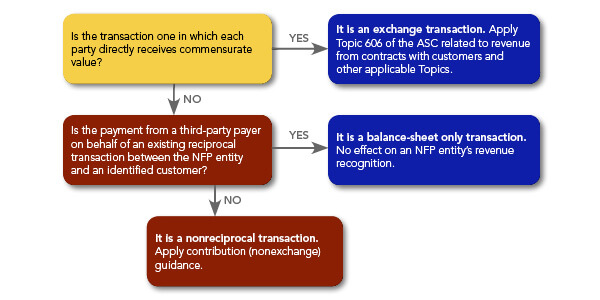
The proposed ASU would require a Not For Profit (NFP) entity to evaluate whether the resource provider is receiving direct commensurate value in return for the resources transferred (i.e. undertaking an exchange or reciprocal transaction). The proposed ASU notes the following:

  1. A resource provider (including a private foundation, a government agency, or other) is not synonymous with the general public. Indirect benefit received by the public as a result of the assets transferred is not equivalent to commensurate value received by the resource provider.
  2. Execution of a resource providers’ mission or the positive sentiment from acting as a donor would not constitute commensurate value received by a resource provider for purposes of determining whether a transfer of assets is a contribution or an exchange.

Consistent with current accounting principles generally accepted in the United States (GAAP), if the resource provider is not receiving direct value for the resources provided, the transaction will be considered a contribution (or nonreciprocal transaction), unless it can be shown that the resource provider is making the payment on behalf of an existing exchange transaction between the NFP entity and an identified customer.

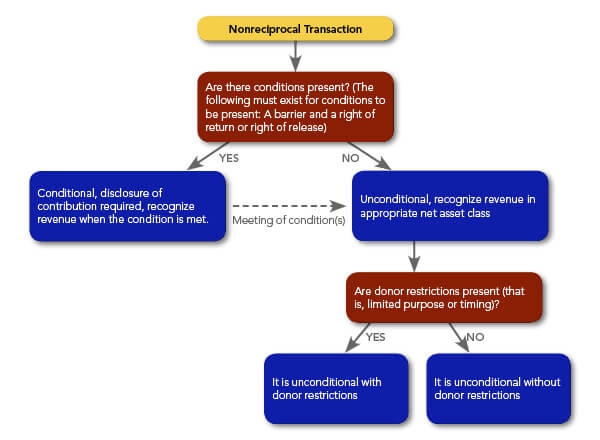
The ASU also provides guidance on whether a contribution is conditional or unconditional. This decision is based on whether a barrier that must be overcome and either a right of return of assets transferred or a right of release of a promisor’s obligation to transfer assets is determinable from the agreement (or another document referenced in the agreement). The presence of both a barrier and a right of return or a right of release indicates that a recipient NFP entity is not entitled to the transferred assets (or a future transfer of assets) until it has overcome the barriers in the agreement. Prior to overcoming those barriers, the contribution would be considered conditional.

After a contribution has been deemed unconditional, an entity would then consider whether the contribution is restricted on the basis of the current definition of the term donor-imposed restriction, which includes a consideration of how broad or narrow the purpose of the agreement is, and whether the resources are available for use only after a specified date.

The FASB believes that the proposed ASU could result in more grants and contracts being accounted for as contributions (often conditional contributions) than under current GAAP. For this reason, clarifying the guidance about whether a contribution is conditional or unconditional is important because such classification affects the timing of contribution revenue recognition. Recipients of conditional promises to give would be required to comply with current disclosure requirements in paragraph 958-310-50-4 of the ASC. Contributions are only recognized within the financial statements once they are considered unconditional.

For more information, please contact your Dean Dorton advisor or Simon Keemer at skeemer@deandortonstg.wpenginepowered.com.

Filed Under: Industries, Nonprofit & Government Tagged With: asu, Contribution, FASB, grant, keemer, nonprofit, Profit, simon

Article 09.29.2016 Dean Dorton

It’s been talked about for many months now and the new FASB guidelines for nonprofit organizations are here – or at least the first phase.
We sat in on the FASB webcast “IN FOCUS: Accounting Standards Update on Not-for-Profit Financial Statements (ASU 2016-14)” and here are the key takeaways from the presentation.

The key objectives recommended by FASB’s NFP Advisory Committee (NAC) are as follows:

• Update, not overhaul, the current model
• Improve net asset classification scheme
• Improve information in financial statements and notes about:

  • Financial performance
  • Cash flows
  • Liquidity

• Better enable NFPs to “tell their financial story”

So, what has changed?

Phase 1 ASU 2016-14 issued in August 2016 has five areas requiring change.

Net Asset Classes – New FASB Guidelines for Nonprofit Organizations

The first area covered is Net Asset Classes, specifically the classification scheme, disclosure of board designated net assets, underwater endowments, and expirations of capital restrictions.

Another net asset classes change requires disclosure of board designated net assets.

“Underwater” Endowments with revised net asset classification and enhanced disclosures and was defined this way:

Revised net asset classification: to be reflected in net assets with donor restrictions rather than in net assets without donor restrictions.

Enhanced disclosures: in addition to aggregate amounts by which funds are underwater (current GAAP), also disclose aggregate of original gift amounts (or level required by donor or law) for such funds, fair value, and any governing board policy, or actions taken, concerning appropriation from such funds.
 

Expiration of Capital Restrictions is the final area impacted by net asset classes requirements. When it comes to gifts of cash restricted for acquisition or construction of PP&E (property, plant, and equipment), in the absence of explicit donor restrictions, NFPs would be required to use the placed-in-service approach (no more implied time restrictions). This is something nonprofit healthcare organizations are already required to do.

Expenses/Investment Return – New FASB Guidelines for Nonprofit Organizations

Expense Reporting

The new guidelines are looking to create better, more consistent information about expenses. Nonprofits are required to report expenses, either on the face of the financial statements or in the notes by Function (currently required in GAAP), Natural classification, and Analysis (disaggregate function by nature).

Nonprofit organizations are required to provide qualitative disclosures about methods used to allocate costs among program and support function. ASU also provides enhanced guidance on allocations from M&G expenses.

Reporting of Investment Return

Net presentation of investment expenses against investment return on the face of the statement of activities:

• Netting limited to external and direct internal expenses
• May report net return in multiple, appropriately labeled lines. For example, from different portfolios, in different net asset classes, or in operation versus non-operating

Disclosure of investment expenses no longer required (if reported, carefully label and don’t include in expense analysis). Also, it is no longer required to disclose investment return components.

Operating Measures – New FASB Guidelines for Nonprofit Organizations

Reinforcing current GAAP requirement about transparency of components of any operating measures presented:

Nonprofit organizations utilizing an operating measure that reflects governing board designations, appropriations, and similar actions (internal transfers) must report these types of internal transfers appropriately disaggregated and described by type (either on the face of the statement of activities or in the notes).

Liquidity/Availability – New FASB Guidelines for Nonprofit Organizations

When it comes to liquidity and availability of resources, nonprofit organizations are required to provide:

Qualitative information on how the organization manages its liquid available resources and its liquidity risk (in the notes).

Quantitative information that communicates the availability of an organization’s financial assets at the balance sheet date to meet cash needs for general expenditures within one year (on the face and/or in the notes).

Statement of Cash Flows – New FASB Guidelines for Nonprofit Organizations

Cash flow statement guidelines will continue to allow a choice between the Direct Method and the Indirect Method in presenting operating cash flows. However, indirect reconciliation is no longer required for Direct Method.

Summary – New FASB Guidelines for Nonprofit Organizations

The effective date for Phase I Accounting Standards Update on Not-for-Profit Financial Statements (ASU 2016-14) will be for organizations with fiscal years beginning after December 15, 2017 (for example calendar year 2018, fiscal year 2018-19) with interim financials the following year.

The rollout of Phase II is still to be determined. Some of the issues under consideration for Phase II include: whether to require a measure of operations; how to define a measure of operations; potential realignment within the statement of cash flows; and segment reporting for nonprofit health care entities.
 

Filed Under: Accounting Software, Industries, Nonprofit & Government, Sage Intacct, Services Tagged With: FASB, Net Asset Classes, nonprofit

  • Page 1
  • Page 2
  • Page 3
  • Go to Next Page »
  • Services
    • Outsourced Accounting
    • Audit & Assurance
    • Tax
    • Consulting & Advisory
    • Technology & Cybersecurity
    • Family Office
    • Wealth Management
  • Industries
  • Company
  • Locations
  • Careers
  • Insights
  • Events
  • Contact Us
facebook Dean Dorton - CPAs And Advisors On Facebook twitter twitter linkedin Dean Dorton - CPAs And Advisors On LinkedIn youtube Dean Dorton - CPAs And Advisors On YouTube

The matters discussed on this website provide general information only. The information is neither tax nor legal advice. You should consult with a qualified professional advisor about your specific situation before undertaking any action.

© 2026 Dean Dorton Allen Ford, PLLC. All Rights Reserved