
• Skip to primary navigation
  • Skip to main content
Dean Dorton – CPAs and Advisors
  • Services
        • Audit & Assurance
          • Audits, Reviews & Compilations
          • ESG Programs & Reporting
          • Internal Audit
          • International Financial Reporting
          • Lease Accounting Managed Services
          • Peer Review Services
          • SOC Reporting
        • Family Office
        • Consulting & Advisory
          • Business Valuation Services
          • Forensic Accounting
          • Fractional CFO
          • Litigation Support
          • Matrimonial Dissolution
          • Merger & Acquisition
          • SEC Services
          • Succession Planning
          • Transaction Advisory Services
          • Whistleblower Hotline
        • Outsourced Accounting
        • Private Wealth
        • Healthcare Consulting
          • Finance
          • Health Systems Operational Transformation
          • Medical Billing and Credentialing
          • Risk Management & Compliance
          • Strategic Growth for Private Practices
          • Strategy and Strategy Implementation
          • Technology & Data Analytics
        • Tax
          • Business Tax
          • Cost Segregation Studies
          • Credits and Incentives
          • Estates and Trusts
          • Individual Tax
          • International Tax
          • SEC Provision and Compliance
          • State and Local Tax
        • Technology & Cybersecurity
          • Accounting Software
          • Cybersecurity
            • Cybersecurity Assessments
            • Cybersecurity Scorecard Assessment
            • Security Awareness Training
            • Virtual Information Security Office
          • Data Analytics & AI
          • IT Audit & Compliance
            • Cybersecurity Maturity Model Certification (CMMC)
            • Data Privacy Laws
            • SOC Reporting
          • IT Infrastructure & Cloud Solutions
            • Automation
            • Backup and Disaster Recovery
            • Cloud Strategy
            • Data Center
            • Enterprise Network
            • Network Security
            • Phone and Video Conferencing
            • User Identity Management Solutions
            • Webex
          • Managed IT Services
  • Industries
        • Construction
        • Distilleries and Craft Breweries
        • Energy and Natural Resources
        • Equine
        • Financial Institutions
        • Government
        • Healthcare
        • Higher Education
        • Life Sciences
        • Manufacturing and Distribution
        • Nonprofit
        • Real Estate
  • Insights
    • Articles
    • Guides
    • Case Studies
  • Events
  • Company
        • News
        • Our Team
        • Experiences
        • Careers
          • College Students
          • Experienced Professionals
        • Locations
        • Lexington, KY

          250 West Main Street
          Suite 1400
          Lexington, KY 40507
          859-255-2341

        • Louisville, KY

          435 North Whittington Parkway
          Suite 400
          Louisville, KY 40222
          502-589-6050

        • Louisville, KY

          700 North Hurstbourne Parkway
          Suite 115
          Louisville, KY 40222
          502-589-6050

        • Ft. Wright, KY

          810 Wright’s Summit Parkway
          Suite 300
          Fort Wright, KY 41011
          859-331-3300

        • Cincinnati, OH

          312 Walnut Street
          Suite 3330
          Cincinnati, OH 45202
          859-331-3300

        • Blue Ash, OH

          9987 Carver Rd
          Suite 120
          Blue Ash, OH 45242
          513-891-5911

        • West Chester, OH

          9025 Centre Pointe Drive
          Suite 310
          West Chester, OH 45069
          513-985-6240

        • Indianapolis, IN

          5975 Castle Crk Pkwy Dr N
          Suite 400
          Indianapolis, IN 46250
          317-469-0169

        • Raleigh, NC

          4130 Parklake Avenue
          Suite 400
          Raleigh, NC 27612
          919-782-9265

  • Contact Us

asu

Article 03.15.2022 Dean Dorton

In 2016, the Financial Accounting Standards Board (FASB) issued Accounting Standards Update (ASU) 2016-02 changing the way companies account for leases.  In 2020, the FASB issued ASU 2020-05 that delayed the effective date of the new leasing standard.  As a result of this delay, most private companies will be implementing the new leasing standard starting with calendar 2022 year ends.  For many private companies, especially those within the construction industry, the new leasing standard will require significant analysis of operations and transactions to identify the agreements that will be classified as leases under the new standard.  Of particular interest is the impact that the standard has on related party leases.

It has become normal within the construction industry for the buildings, and even the equipment, used by the operating construction company to be held by a separate, related entity in order to mitigate risk and provide for certain tax strategies.  The use of these related real estate and equipment companies will likely result in significant lease transactions between them and the construction company being evaluated under the new leasing standard.  The recognition of lease liabilities and right-of-use assets on the balance sheet of the construction company, as a result of the new leasing standard, could have a significant financial impact, and may impact working capital ratios thereby impacting debt covenants and bonding capacity.

Key areas which need to be considered when performing the evaluation of leases under the new leasing standard include the following:

1. Use of written lease agreements – All lease agreements, including those with related parties, should be formalized with a written agreement between the lessor and lessee.  This will make determinations under the new leasing standard easier to perform.

2. Lease terms – The new leasing standard requires that a related-party lease be classified and accounted for based on its legally enforceable terms and conditions. In other words, the classification and accounting for a lease with a related-party lessor should be the same as what the classification and accounting would have been if that lease were with an unrelated lessor.

There are two critical areas that should be considered when it comes to the length of all leases, but especially a related party lease:

a. Understanding the legally enforceable terms and conditions – A lease will be recognized under the new leasing standard based upon its legally enforceable terms and conditions.  The lessee is required to consider whether there are any implicit legally enforceable terms and conditions in addition to the terms and conditions in the written agreement.

For example, if the construction company leases a facility to perform pre-fabrication work and the lease has a term of one year with no option to renew, but the construction company has incurred significant costs related to leasehold improvements that will retain significant value over their useful life of 20 years, consideration will need to be given to whether there are implicit legally enforceable terms and conditions that would cause the lease term to be evaluated as 20 years instead of one year.

Another example would be if the construction company leases construction equipment on a month-to-month basis from a related party and that equipment is going to be used throughout the period of construction of a project that is expected to take two years to complete, consideration should be given to whether there are implicit legally enforceable terms and conditions that would cause the lease term to be evaluated as two years instead of one month.

b. Impact on capitalized leasehold/tenant improvements – Leasehold/tenant improvements should be depreciated over the shorter of the useful life of the asset or the term of the lease.

For example, using the example in 2(a) above, if the construction company determines that the lease for the pre-fabrication workshop is truly a one year lease, then the leasehold improvements related to the workshop would have a maximum depreciable life of one year (i.e. the lease term of one year is shorter than the useful life of the assets).  The treatment of the lease as a one year lease would likely result in significant depreciation charges/write downs of the leasehold improvements.

This treatment could also flow through to any leasehold or tenant improvements within the lessor entity in any GAAP financial statements they issue. For example, if the lessor entity has capitalized improvements made on behalf of the construction company and those improvements are specific to the construction company and would likely be unwanted/useless to any alternative lessee (for example signage), there could be the need to recognize impairment charges on those improvements to write them off over the one year term of the lease.

3. Lease payments – Companies will need to analyze lease payments within the agreements to determine if they are fixed, in-substance fixed, variable based upon a rate or index or variable based upon other than a rate or index.  This analysis is critical in order to correctly identify the lease payments that are used in classifying the lease and measuring the related lease liability and right-of-use (ROU) asset.

a. Fixed lease payments – Fixed lease payments are included in the calculation of the ROU asset and lease liability.   Payments that vary solely based on the passage of time (e.g. escalating rents) are not considered variable lease payments, and would be included in the calculation of the ROU asset and lease liability.

Example: Lessee is a private company with a calendar year end. Lessee enters into a lease with Lessor on January 1, 20X6, which is also the lease’s commencement date. The noncancellable term of the lease is three years. Lessee must pay Lessor $100,000 on January 1, 20X7. The lease payments on January 1, 20X8 and 20X9 are increased by 2% each year.

The amount of the lease payments that should be included in classifying the lease and measuring the related lease liability and ROU asset are $100,000 for year 1, $102,000 (i.e. $100,000 increased by 2%) for year 2 and $104,040 (i.e. $102,000 increased by a further 2%) for year 3.

b. In-substance fixed payments – A lease agreement may describe a payment as a variable payment, but upon closer look it is apparent there is an amount that must be paid (e.g. a minimum amount that cannot be avoided) or there is an amount that will be paid because the variability lacks economic substance. These types of variable lease payments are in-substance fixed payments and are treated as fixed payments when determining lease payments for the calculation of the lease liability and ROU asset.

Example: A lease requires a lessee to pay rent equal to 1% of its sales, subject to a minimum sales figure of $5 million. The in-substance fixed payment is the minimum amount the lessee will be required to pay of $50,000 ($5 million × 1%), which should be included in lease payments on the commencement date to calculate the ROU asset and lease liability. Any potential payments above the minimum amount are based on the lessee’s sales and should be accounted for as variable lease payments based on other than an index or rate (see below). Another way that this payment term could be worded in the lease agreement, but still result in the same outcome, would be if the lessee was required to make a payment of $50,000 or 1% of its sales, whichever is greater. In this situation, there is an in-substance fixed payment of $50,000 that will be required of the lessee.

c. Variable based upon a rate or index – Variable lease payments that depend on an index or rate are initially measured and included in lease payments by reference to the index or rate at the commencement date of the lease. Any additional lease costs arising from subsequent changes to the index or rate are recognized in the period those costs are incurred (i.e. similar to variable lease payments based on other than an index or rate as discussed below). Common examples of indexes and rates on which variable lease payments are based include: the Consumer price index (CPI), the prime or LIBOR interest rate, interest rates on direct Treasury obligations of the U.S. government (with or without a spread) and market rental rates.

Example 1: Lessee is a private company with a calendar year end. Lessee enters into a lease with Lessor on January 1, 20X6, which is also the lease’s commencement date. The noncancellable term of the lease is three years. Lessee must pay Lessor $100,000 on January 1, 20X7. The lease payments on January 1, 20X8 and 20X9 are $100,000 adjusted for the cumulative increase in the Consumer Price Index (CPI) since January 1, 20X7. No refunds are provided if the CPI decreases.

There is a fixed lease payment of $100,000 per year paid in arrears. The amount of the variable lease payment that should be included in the lease payments used in classifying the lease and measuring the related lease liability and ROU asset should be determined initially by reference to the CPI at the commencement date, and assuming that it will not change over the term of the lease. Given that the variable lease payment is based on the increase in the CPI after January 1, 20X7, the variable lease payment on that date is zero. As such, the amount of lease payments used in the classification and measurement of the lease on January 1, 20X6 is $300,000 (annual payments of $100,000 over the lease term of three years).

Example 2: Lessee is a private company with a calendar year end. Lessee enters into a lease with Lessor on January 1, 20X6, which is also the lease’s commencement date. The noncancellable term of the lease is three years. Lessee must pay Lessor $100,000 on January 1, 20X7. The lease payments on January 1, 20X8 and 20X9 are $100,000 increased each year by the 1-month LIBOR rate. At the commencement date of the lease the 1-month LIBOR rate is 2%.

The amount of the variable lease payment that should be included in the lease payments used in classifying the lease and measuring the related lease liability and ROU asset should be determined by reference to the 1-month LIBOR rate at the commencement date of the lease (and again assuming it will not change over the term of the lease). As the rate on January 1, 20X6 was 2%, then the lease payment for year 1 would be $100,000, for year 2 would be estimated as $102,000 (i.e. $100,000 increased by 2%) and for year 3 would be estimated as $104,040 (i.e. $102,000 increased by a further 2%) for the classification and measurement of the lease on January 1, 20X6. Any difference in the lease costs arising from differences between the actual LIBOR rate and 2% (the LIBOR rate at lease commencement) in years 2 and 3 are recognized in the period those costs are incurred (i.e. similar to variable lease payments based on other than an index or rate as discussed below).

d. Variable based upon other than a rate or index – Variable lease payments that vary after the commencement date for reasons other than an index or rate are not included in the lease payments used for classification or measurement purposes. When the only payments in a lease are variable based on other than an index or rate, there are no lease payments on which to base the recognition and measurement of a lease liability and ROU asset.  Therefore, there would be no recognition of a lease liability or ROU asset.

Example: Lessee is a private company with a calendar year end and has no interim financial reporting requirements. Lessee enters into a lease for the exclusive right to use a specifically identified production printer. Lessor does not have substantive substitution rights related to the production printer. The lease is entered into on July 1, 20X6, which is also the lease’s commencement date. The noncancellable term of the lease is three years. There are no purchase, renewal or termination options. On a monthly basis, Lessee must pay Lessor $0.10 per page printed by the production printer in the previous month. For example, in August 20X6, Lessee pays Lessor $0.10 per page printed by the production printer in July 20X6.

The only payments required under the lease are variable lease payments based on other than an index or rate. As a result, there are no lease payments that give rise to recognition of a lease liability or ROU asset. The variable lease payments are included in lease costs as the printer is used. For example, if Lessee used the production printer to print 2,720 pages in July 20X6, it should recognize lease expense of $272 for that month. This same example would apply for construction equipment being leased based upon an hourly usage rate.

Much like the previous changes to revenue recognition, the new leasing standard can be a complex accounting standard to navigate.

Learn about Construction Services

Simon Keemer, CPA, CGMA, ACA
Assurance Director
skeemer@deandortonstg.wpenginepowered.com • 502.566.1036
Filed Under: Audit and Assurance, Construction, Industries, Services Tagged With: asu, Construction, FASB, Lease accounting, leases, standard

Article 01.16.2018 Dean Dorton

Here are the key risks and opportunities for 2018:

Cybersecurity and Big Data

Co-operatives can be proactive by implementing effective controls to prevent and detect cyber-crime. A successful cybersecurity campaign includes educating employees of potential phishing schemes. Potential effects of a co-op network infiltration can include shut down of an energy grid, re-direction of energy to a particular location, or theft of customer payment information. Management can use simple software applications to create data analytics which help in identifying trends in business and ultimately help make informed decisions.

Power Supply Costs

Even though a proposal exists to repeal the EPA Clean Power Plan, continue to investigate alternative sources of energy, such as wind, solar, and biomass, to further diversify power sources as well as work with communities to deploy energy storage and efficiency technologies. Explore wholesale power markets as a way to obtain reliable electricity at an effective cost.

Safety, Including Overtime Management

Safety is a major concern for co-operatives as their employees routinely work in dangerous conditions (i.e. downed power line in a thunderstorm) that, if not taken seriously, can expose the co-operative. Monitor overtime hours to help protect the safety of employees; this important oversight role is a vital way to control costs.

Community and Environmental Responsibility

As an electric co-operative, you have to balance providing affordable electricity to your community, while protecting it from environmental degradation. You can launch conservation programs in your community by providing information and resources to members about how they can individually reduce their energy costs. This not only saves the members money but also keeps you from wasting energy resources and protects the environment. The enhanced use of social media and technology will facilitate great success in this area.

Succession Planning

As co-operative executives continue to grow older and retire in larger numbers than in the past, there must be a greater emphasis on succession planning and staff development. This risk flows all the way down to recruitment of top talent as urbanization continues to increase in the U.S. and competition from other industry sectors for talent intensifies. Whether you decide to use an internal or external hire to replace key top management, take the necessary steps to ensure a smooth transition.

Adoption of the New Revenue Standard

Co-operatives will need to adopt ASU 2014-09 (Revenue from Contracts with Customers) in 2019 or 2020, depending on fiscal year end. This standard focuses on a five-step process to assess revenue recognition for products and services. The concept of transfer of control is used to dictate when revenue is recognized. Identify your significant revenue streams and apply the new revenue criteria to each stream. In addition to potential changes in revenue recognition, expanded disclosures will be required. Management should use 2018 to assess this standard appropriately.

Adoption of the New Lease Standard

Co-operatives will need to adopt ASU 2016-02 (Leases) in 2020 or 2021, depending on fiscal year end. This standard focuses on placing almost all leases on the balance sheet through a right of use asset and liability. The concept of transfer of control is used to define a lease. The most important step for management in 2018 is to start building an inventory of leases. After the inventory is built, determine the need for investing in lease software to properly track the new accounting requirements.Sources: America’s Electric Cooperatives, Ernst & Young, Coop News, Cooperative Energy, Vanderbilt UniversityElectric Co-operative Key Performance IndicatorsNote: Group consists of various Kentucky-based electric co-operatives.

Measurement Trend 2016 2015 2014 2013
Debt to equity Positive 1.18 1.29 1.40 1.49
Equity to total assets Positive 43% 41% 38% 37%
Current ratio Stable 1.00 0.99 1.05 0.97
AP turnover Stable 15.48 17.72 16.58 15.59
AR turnover Stable 13.10 16.13 14.60 16.19
Operating margin %* Decline 4.2% 6.0% 6.2% 5.6%
Cost of purchase %* Stable 70% 70% 71% 72%
Capital expenditures %* Stable 9.7% 8.3% 7.3% 7.6%

* Percent of revenue

Overall, the results are positive and show the stability that exists in the electric co-operative industry in Kentucky. Operating margin slipped in 2016 due to a decline in revenue, attributed to weather patterns and increased energy efficiency programs.

Filed Under: Energy & Natural Resources, Industries Tagged With: asu, Bill, Co-operative, Cooperative, Cybersecurity, Electric, EPA, Kohm, revenue standard

Article 12.19.2017 Dean Dorton

When do you recognize revenue from contracts with customers? What was once an easy question to answer is now one that will soon require a multi-step analysis. For private entities, Accounting Standards Update (ASU) 2014-09 will be required for annual reporting periods beginning after December 15, 2018. Although we are one full year from implementation, there is various information that needs to be gathered and organized in order to implement ASU 2014-09 correctly.

The core principle behind ASU 2014-09 is that “an entity should recognize revenue to depict the transfer of goods or services to customers in an amount that reflects the consideration to which the entity expects to be entitled in exchange for those goods or services.” Simply stated, entities must recognize revenue as performance obligations are satisfied. In order to identify such performance obligations, the following process should be followed:

First, contracts with customers must be identified. Applicable contracts under the new standards are those that have approval of both parties, have commercial substance, and have probable collectability of substantially all the consideration to which the entity is entitled. In addition, the contract must have approval of both parties, along with corresponding payment terms. Once applicable contracts are determined, performance obligations need to be identified therein.

A performance obligation is a promise within a contract to transfer a good or service to a customer. This good or service should be distinct, meaning it is readily identifiable from other goods or services outlined in the contract. Contracts may have one or more performance obligations. The corresponding transaction price of the contract must then be determined.

The transaction price is the amount of consideration the entity expects to receive in return for the transfer of goods or services to the customer. This transaction price should take into consideration payables to the customer, existing financing components, non-cash, and variable considerations. Keep in mind the terms of the contract, as well as your standard business practices in determining the transaction cost. Once the transaction cost is determined, it can then be allocated to the performance obligations previously identified.

Each performance obligation is allocated a portion of the transaction price based on the standalone selling price of the goods or services being transferred. If a standalone selling price is not easily identifiable, then one should be estimated. One item to note is that reallocation of the transaction price based upon a change in standalone selling price is not permitted under this new standard. Now that each performance obligation is assigned a transaction price, revenue can be recognized accordingly as the obligation is satisfied.

As the implementation date for ASU 2014-09 draws near, it is imperative that data and information for all contracts with customers be gathered and analyzed based upon this five-step process. For further guidance, please reach out to your external CPA and AICPA’s Financial Reporting Center (FRC). The FRC includes a list of conferences, webcasts, and other publications to keep you updated on the most recent developments regarding the standard’s implementation.

Filed Under: Accounting & Tax, Construction, Industries Tagged With: 2014-09, accounting standards, asu, Contract, financial reporting center, frc, hunter, Hunter Stout, keemer, revenue recognition, simon, stout

Article 10.5.2017 Dean Dorton

Have you recently attended an accounting update or read an article about the new revenue recognition accounting standard (ASU 2014-09) which is impacting companies in 2018-2020 depending on fiscal year end and public company status? Hopefully, these items are triggering action steps if not already started. We can help with:

  1. Updating revenue process documentation
  2. Updating of revenue policies and selection of practical expedients
  3. Selection of transition method
  4. Drafting of financial statement disclosures
  5. Designing new controls
  6. Quantifying the impact to your revenues and net income

We are currently helping other clients navigate through this major change with our revenue and industry knowledge. We will remove this stress point from your task list and let you focus on your company’s strategic goals.

Please contact your Dean Dorton advisor to help you with your adoption of the new revenue standard (ASU 2014-09). Do not wait to the last minute and create stress and potential surprising results for your stakeholders.

Filed Under: Accounting & Tax Tagged With: asu, ASU 2014-09, revenue recognition

Article 08.7.2017 Dean Dorton

On August 3, 2017, the Financial Accounting Standards Board (FASB) issued an exposure draft of a proposed new Accounting Standards Update (ASU) titled Clarifying the Scope and the Accounting Guidance for Contributions Received and Contributions Made. The FASB is accepting comments on the exposure draft through November 1, 2017.

The FASB has identified that many entities have had difficulty in characterizing grants and similar contracts with resource providers as either exchange transactions or contributions and in distinguishing between conditional and unconditional contributions. Therefore, the proposed ASU is designed to clarify and improve the accounting guidance for contributions received and contributions made.

The amendments in the proposed ASU would assist entities to:

  1. Evaluate whether transactions should be accounted for as contributions (nonreciprocal transactions) or as exchange (reciprocal) transactions; and
  2. Distinguish between conditional and unconditional contributions.

Distinguishing between contributions and exchange transactions determines which guidance is applied. For contributions, an entity should follow the guidance in Subtopic 958-605 of the Accounting Standards Codification (ASC), whereas for exchange transactions, an entity should follow other guidance, such as the new revenue recognition guidance that will be effective in the next couple of years.

Once a transaction is deemed to be a contribution, entities have noted that it can be difficult in practice to distinguish between conditional and unconditional contributions, particularly when an entity receives assets accompanied by certain stipulations but with no specified return policy for when the stipulations are not met.

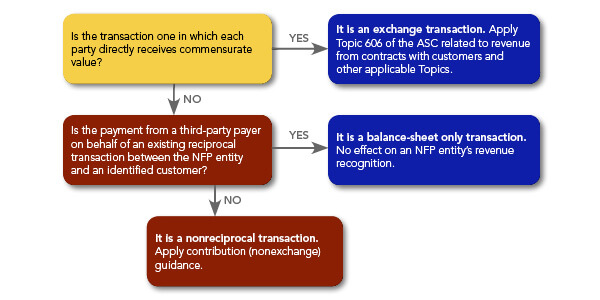
The proposed ASU would require a Not For Profit (NFP) entity to evaluate whether the resource provider is receiving direct commensurate value in return for the resources transferred (i.e. undertaking an exchange or reciprocal transaction). The proposed ASU notes the following:

  1. A resource provider (including a private foundation, a government agency, or other) is not synonymous with the general public. Indirect benefit received by the public as a result of the assets transferred is not equivalent to commensurate value received by the resource provider.
  2. Execution of a resource providers’ mission or the positive sentiment from acting as a donor would not constitute commensurate value received by a resource provider for purposes of determining whether a transfer of assets is a contribution or an exchange.

Consistent with current accounting principles generally accepted in the United States (GAAP), if the resource provider is not receiving direct value for the resources provided, the transaction will be considered a contribution (or nonreciprocal transaction), unless it can be shown that the resource provider is making the payment on behalf of an existing exchange transaction between the NFP entity and an identified customer.

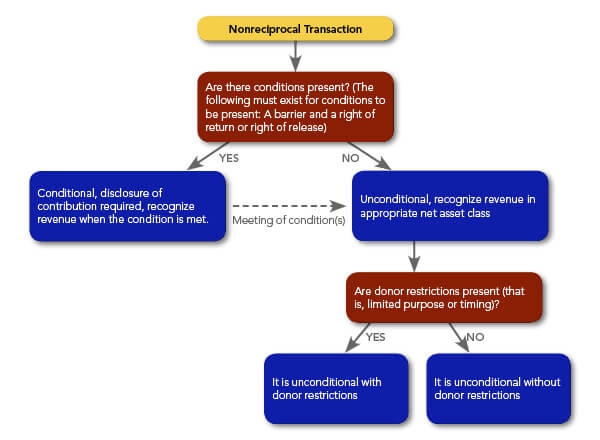
The ASU also provides guidance on whether a contribution is conditional or unconditional. This decision is based on whether a barrier that must be overcome and either a right of return of assets transferred or a right of release of a promisor’s obligation to transfer assets is determinable from the agreement (or another document referenced in the agreement). The presence of both a barrier and a right of return or a right of release indicates that a recipient NFP entity is not entitled to the transferred assets (or a future transfer of assets) until it has overcome the barriers in the agreement. Prior to overcoming those barriers, the contribution would be considered conditional.

After a contribution has been deemed unconditional, an entity would then consider whether the contribution is restricted on the basis of the current definition of the term donor-imposed restriction, which includes a consideration of how broad or narrow the purpose of the agreement is, and whether the resources are available for use only after a specified date.

The FASB believes that the proposed ASU could result in more grants and contracts being accounted for as contributions (often conditional contributions) than under current GAAP. For this reason, clarifying the guidance about whether a contribution is conditional or unconditional is important because such classification affects the timing of contribution revenue recognition. Recipients of conditional promises to give would be required to comply with current disclosure requirements in paragraph 958-310-50-4 of the ASC. Contributions are only recognized within the financial statements once they are considered unconditional.

For more information, please contact your Dean Dorton advisor or Simon Keemer at skeemer@deandortonstg.wpenginepowered.com.

Filed Under: Industries, Nonprofit & Government Tagged With: asu, Contribution, FASB, grant, keemer, nonprofit, Profit, simon

Article 03.1.2016 Dean Dorton

On February 25, 2016, the Financial Accounting Standards Board (FASB) issued its new lease accounting guidance in Accounting Standards Update (ASU) No. 2016-02, Leases (Topic 842).

The ASU will require organizations that lease assets to recognize on the balance sheet the assets and liabilities for the rights and obligations created by those leases, unless the lease is a short term lease.

Short term leases
A short term lease is defined in the ASU as “a lease that, at the commencement date, has a lease term of 12 months or less and does not include an option to purchase the underlying asset that the lessee is reasonably certain to exercise”.  The lease term is defined as the noncancellable period for which a lessee has the right to use an underlying asset, together with all of the following:

  • Periods covered by an option to extend the lease if the lessee is reasonably certain to exercise that option.
  • Periods covered by an option to terminate the lease if the lessee is reasonably certain not to exercise that option.
  • Periods covered by an option to extend (or not to terminate) the lease in which exercise of the option is controlled by the lessor.

For short term leases, a lessee is permitted to make an accounting policy election by class of underlying asset not to recognize lease assets and lease liabilities. If a lessee makes this election, it should recognize lease expense for such leases generally on a straight-line basis over the lease term.

Leases not considered short term
For all other leases, the lessee will be required to recognize the following at the commencement date of the lease:

  • A lease liability, which is a lessee‘s obligation to make lease payments arising from a lease, measured on a discounted basis; and
  • A right-of-use asset, which is an asset that represents the lessee’s right to use, or control the use of, a specified asset for the lease term.

When measuring assets and liabilities arising from a lease, a lessee (and a lessor) should include payments to be made in optional periods only if the lessee is reasonably certain to exercise an option to extend the lease.  Similarly, optional payments to purchase the underlying asset should be included in the measurement of lease assets and lease liabilities only if the lessee is reasonably certain to exercise that purchase option. Reasonably certain is a high threshold. In addition, a lessee (and a lessor) should exclude most variable lease payments in measuring lease assets and lease liabilities, other than those that depend on an index or a rate or are in substance fixed payments.

Consistent with current Generally Accepted Accounting Principles (GAAP), the recognition, measurement, and presentation in the statements of income and cash flows will depend on the lease’s classification as a finance or operating lease.

  • For finance leases, a lessee is required to:
    • Recognize interest on the lease liability separately from amortization of the right-of-use asset in the statement of income.
    • Classify repayments of the principal portion of the lease liability within financing activities and payments of interest on the lease liability and variable lease payments within operating activities in the statement of cash flows
  • For operating leases, a lessee is required to:
    • Recognize a single lease cost in the statement of income (which will include both the amortization of the right-of-use asset and the “interest” element associated with the lease liability), calculated so that the cost of the lease is allocated over the lease term on a generally straight-line basis.
    • Classify all cash payments within operating activities in the statement of cash flows.

The ASU also will require disclosures to help investors and other financial statement users better understand the amount, timing, and uncertainty of cash flows arising from leases. These disclosures include qualitative and quantitative requirements, providing additional information about the amounts recorded in the financial statements.

Lessor accounting
Under the new guidance, lessor accounting is largely unchanged. Certain targeted improvements were made to align, where necessary, lessor accounting with the lessee accounting model and Topic 606, Revenue from Contracts with Customers.

Sale and leaseback transactions
The new lease guidance also simplified the accounting for sale and leaseback transactions primarily because lessees must recognize lease assets and lease liabilities. Lessees will no longer be provided with a source of off-balance sheet financing.

Effective dates
Public business entities should apply the amendments in ASU 2016-02 for fiscal years beginning after December 15, 2018, including interim periods within those fiscal years. Nonpublic business entities should apply the amendments for fiscal years beginning after December 15, 2019 (i.e., year ending December 31, 2020 for a calendar year entity), and interim periods within fiscal years beginning after December 15, 2020. Early application is permitted for all public business entities and all nonpublic business entities upon issuance.

Lessees (for capital and operating leases) and lessors (for sales-type, direct financing, and operating leases) must apply a modified retrospective transition approach for leases existing at, or entered into after, the beginning of the earliest comparative period presented in the financial statements. The modified retrospective approach would not require any transition accounting for leases that expired before the earliest comparative period presented. Lessees and lessors may not apply a full retrospective transition approach.

If you have any questions regarding this new standard or would like assistance in implementing the new standard, please contact your Dean Dorton advisor, or:

David Richard, Director of Assurance Services: drichard@deandortonstg.wpenginepowered.com
Simon Keemer, Director of Assurance Services: skeemer@deandortonstg.wpenginepowered.com


View David Richard’s Bio

View Simon Keemer’s Bio

Filed Under: Accounting & Tax, Accounting and Financial Outsourcing, Audit and Assurance, Forensic Accounting, Outsourced Accounting Tagged With: Accounting, accounting standards, asu, David Richard, FASB, Finance, lease, Lessor, Simon Keemer

  • Services
    • Outsourced Accounting
    • Audit & Assurance
    • Tax
    • Consulting & Advisory
    • Technology & Cybersecurity
    • Family Office
    • Wealth Management
  • Industries
  • Company
  • Locations
  • Careers
  • Insights
  • Events
  • Contact Us
facebook Dean Dorton - CPAs And Advisors On Facebook twitter twitter linkedin Dean Dorton - CPAs And Advisors On LinkedIn youtube Dean Dorton - CPAs And Advisors On YouTube

The matters discussed on this website provide general information only. The information is neither tax nor legal advice. You should consult with a qualified professional advisor about your specific situation before undertaking any action.

© 2026 Dean Dorton Allen Ford, PLLC. All Rights Reserved