
• Skip to primary navigation
  • Skip to main content
Dean Dorton – CPAs and Advisors
  • Services
        • Audit & Assurance
          • Audits, Reviews & Compilations
          • ESG Programs & Reporting
          • Internal Audit
          • International Financial Reporting
          • Lease Accounting Managed Services
          • Peer Review Services
          • SOC Reporting
        • Family Office
        • Consulting & Advisory
          • Business Valuation Services
          • Forensic Accounting
          • Fractional CFO
          • Litigation Support
          • Matrimonial Dissolution
          • Merger & Acquisition
          • SEC Services
          • Succession Planning
          • Transaction Advisory Services
          • Whistleblower Hotline
        • Outsourced Accounting
        • Private Wealth
        • Healthcare Consulting
          • Finance
          • Health Systems Operational Transformation
          • Medical Billing and Credentialing
          • Risk Management & Compliance
          • Strategic Growth for Private Practices
          • Strategy and Strategy Implementation
          • Technology & Data Analytics
        • Tax
          • Business Tax
          • Cost Segregation Studies
          • Credits and Incentives
          • Estates and Trusts
          • Individual Tax
          • International Tax
          • SEC Provision and Compliance
          • State and Local Tax
        • Technology & Cybersecurity
          • Accounting Software
          • Cybersecurity
            • Cybersecurity Assessments
            • Cybersecurity Scorecard Assessment
            • Security Awareness Training
            • Virtual Information Security Office
          • Data Analytics & AI
          • IT Audit & Compliance
            • Cybersecurity Maturity Model Certification (CMMC)
            • Data Privacy Laws
            • SOC Reporting
          • IT Infrastructure & Cloud Solutions
            • Automation
            • Backup and Disaster Recovery
            • Cloud Strategy
            • Data Center
            • Enterprise Network
            • Network Security
            • Phone and Video Conferencing
            • User Identity Management Solutions
            • Webex
          • Managed IT Services
  • Industries
        • Construction
        • Distilleries and Craft Breweries
        • Energy and Natural Resources
        • Equine
        • Financial Institutions
        • Government
        • Healthcare
        • Higher Education
        • Life Sciences
        • Manufacturing and Distribution
        • Nonprofit
        • Real Estate
  • Insights
    • Articles
    • Guides
    • Case Studies
  • Events
  • Company
        • News
        • Our Team
        • Experiences
        • Careers
          • College Students
          • Experienced Professionals
        • Locations
        • Lexington, KY

          250 West Main Street
          Suite 1400
          Lexington, KY 40507
          859-255-2341

        • Louisville, KY

          435 North Whittington Parkway
          Suite 400
          Louisville, KY 40222
          502-589-6050

        • Louisville, KY

          700 North Hurstbourne Parkway
          Suite 115
          Louisville, KY 40222
          502-589-6050

        • Ft. Wright, KY

          810 Wright’s Summit Parkway
          Suite 300
          Fort Wright, KY 41011
          859-331-3300

        • Cincinnati, OH

          312 Walnut Street
          Suite 3330
          Cincinnati, OH 45202
          859-331-3300

        • Blue Ash, OH

          9987 Carver Rd
          Suite 120
          Blue Ash, OH 45242
          513-891-5911

        • West Chester, OH

          9025 Centre Pointe Drive
          Suite 310
          West Chester, OH 45069
          513-985-6240

        • Indianapolis, IN

          5975 Castle Crk Pkwy Dr N
          Suite 400
          Indianapolis, IN 46250
          317-469-0169

        • Raleigh, NC

          4130 Parklake Avenue
          Suite 400
          Raleigh, NC 27612
          919-782-9265

  • Contact Us

University

Article 09.16.2016 Dean Dorton

Colleges and universities across the nation are being monitored closely amidst closings of high-profile institutions such as ITT Technical Institute and St. Catharine College, to name a few.

Join us for a webinar in conjunction with Jim Newberry of Steptoe & Johnson, PLLC, as we review some of the key factors that can cause your institution’s operations to be questioned and methods you can implement creating a path toward success. The webinar will cover:

  • The Perils of Heightened Cash Monitoring
  • Administrative Capability Required for FSA Participation
  • Financial Capability Required for FSA Participation
  • Avoiding the Most Frequently Occurring Audit and Program Review Findings

Avoiding Major Student Financial Aid Problems without Learning the Forms
Date: Wednesday, September 28, 2016
Time: Noon – 1:00 p.m. EDT
Cost: Free

Register NowAbout the Presenters

Crissy Fiscus (Dean Dorton Allen Ford, PLLC) provides audit, accounting, and consulting services to higher education institutions throughout Kentucky and leads Dean Dorton’s college and university team. Her client roster includes institutions with up to $1 billion in assets. Her audit experience includes both public and private institutions and affiliated entities. Crissy specializes in Student Financial Aid and her experience includes providing assistance with DOE program review, assistance with designing student financial aid policies and procedures, and performing agreed-upon procedures necessary for Economically Disadvantaged Appeals.

Jim Newberry (Steptoe & Johnson, PLLC) focuses his practice in the areas of higher education, government relations, and regulatory matters and is the leader of the law firm’s higher education practice. He has addressed multiple governance issues for nonprofit boards, drafted fundraising and gift acceptance policies, represented multiple institutions in investigating Title IX complaints, and represented multiple institutions in addressing Clery compliance issues throughout his career.
Filed Under: Higher Education, Industries Tagged With: college, Education, Finance, Financial, FSA, ITT, Steptoe, Student, University, Webinar

Article 08.24.2016 Dean Dorton

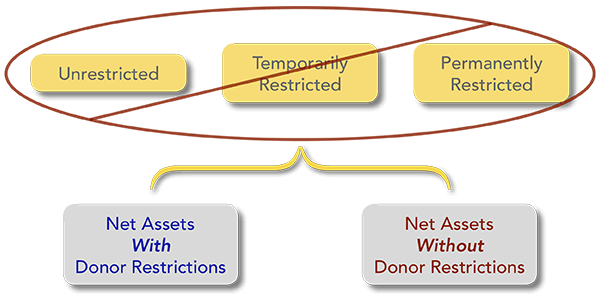
As a result of FASB’s project to enhance the usability of Not-for-Profit (NFP) entities financial statements and the associated notes to those financial statements, FASB released ASU 2016-14, Not-for-Profit Entities (Topic 958): Presentation of Financial Statements of Not-for-Profit Entities.

This update seeks to:

  • Address the complexity of the three net asset classes
  • Improve transparency in relation to liquidity issues
  • Create consistent guidelines for the presentation and disclosure of expenses
  • Simplify the statement of cash flow presentation requirements.

The current net asset classifications have been eliminated and replaced by two new classes:

Investment returns will now be presented net of expenses and the requirement to disclose those netted expenses has been eliminated. NFP entities using the direct method cash flow statements are no longer required to reconcile the direct method to the indirect method. For gifts received to acquire or build long-lived assets, entities will now be required to use the “Placed-in-Service” method to report the expiration of gift restrictions and will need to reclassify any such amounts for assets previously placed in service. The new guidelines require NFPs to present both the natural and functional classification of expenses in the same location.

Additional disclosure requirements are as follows:

  1. Disclosure of the amounts and purposes of self-imposed restrictions or limitations on assets without donor imposed restrictions.
  2. Disclosures of the composition of donor restricted net assets and how those restrictions affect their use.
  3. Qualitative information on management’s plan to meet the entity’s cash flow needs for the next twelve months as well as the availability of the assets that will be used to meet those needs.
  4. Disclosure of the methodology used to allocate expenses between program and support functions.
  5. Underwater endowment funds will now require increased disclosure requirements relating to the entity’s policies and actions taken concerning appropriation of such funds, the fair value of the funds, original gift amount to be maintained and the aggregate deficiencies of the funds, which are to be classified as part of net assets with donor restrictions.

Nonprofit organizations that will be affected include charities, foundations, colleges and universities, healthcare providers, religious organizations, trade associations, and cultural institutions, among others.

These changes will be effective for annual statements with fiscal years beginning after December 15, 2017 and for interim periods with fiscal years beginning after December 15, 2018. The amendment is to be applied on a retrospective basis; however, entities presenting comparative statements have the option to omit the increased requirements surrounding the analysis of expenses and liquidity and availability of resources for the period presented prior to adoption.

Authored by Tom Smither, Supervisor of Assurance Services.

For additional information, please contact your Dean Dorton advisor or:
Crissy Fiscus, cfiscus@deandortonstg.wpenginepowered.com
David Richard, drichard@deandortonstg.wpenginepowered.com

Filed Under: Healthcare, Higher Education, Industries, Nonprofit & Government Tagged With: Asset, college, donor, FASB, Healthcare, Higher Education, Invest, nonprofit, not-for-profit, University

Article 04.7.2016 Dean Dorton

At our recent Higher Education: Issues and Trends training day in February, we covered the newly revised cash management rules which were published by the Department of Education in the fall of 2015. Many of the provisions apply to all institutions, while several only apply to institutions that offer bank accounts to students through financial institutions or that use third-party servicers.

The National Association of College and University Business Officers (NACUBO) recently published a checklist to assist with implementing these new rules. We thought that you might find it beneficial, as several of the provisions are effective in July 2016.

Contact Crissy Fiscus at cfiscus@deandortonstg.wpenginepowered.com if you have questions regarding the checklist or revised cash management rules.Download Cash Management ChecklistView Crissy Fiscus’ Bio

Filed Under: Higher Education, Industries Tagged With: cash management, college, Education, Higher Education, nacubo, rule, University

Article 02.18.2016 Dean Dorton

Increased attention and scrutiny from the public, government agencies, and financial institutions have placed a greater emphasis on accountability, transparency, and risk management for colleges and universities and their foundations. One of the first steps to addressing this increased scrutiny is by developing a strong audit committee as part of your board of directors.

Audit committees can contribute through facilitating:

  • Accurate and timely financial reporting
  • Strong internal control environment
  • Compliance with laws and regulations
  • Management of operating risks

According to a 2011 Association of Governing Boards of Universities and Colleges (AGB) Survey of Higher Education Governance, 65% of the boards of independent institutions and 45% of public institutions had a separate audit committee. A 2010 AGB survey found 70% of college and university foundations had a separate audit committee. The industry has obviously recognized the need for the committee and in this newsletter we will discuss the committee’s purpose and responsibilities, who should be a member of a strong audit committee, and some best practices for effective audit committees.

Purpose and Responsibilities

The audit committee’s purpose is to provide oversight of the institution’s financial practices and standards of conduct. In the execution of this purpose, the committee has the following responsibilities:

  • Understand and provide oversight of accounting practices and the financial reporting process
    • The committees of private institutions must be aware of Financial Accounting Standards Board (FASB) regulations
    • Public institutions’ committees must be cognizant of Governmental Accounting Standards Board (GASB) standards
  • Oversee the internal audit function
    • Review the internal audit plan on an annual basis
    • Internal auditor should report their findings directly to the board
  • Selection and oversight of the external auditor
    • Review the performance of the external auditor
    • Ensure the independence of the external auditor
  • Review the financial statements
    • Review should include “management discussion and analysis”
    • Compare results with prior years
    • Analyze revenue and expense trends
  • Risk management
    • Understand the risks (operational, strategic, financial, compliance, and reputational) facing the institution
    • Assess whether those risks will prevent the institution from fulfilling its strategic objectives
  • Compliance
    • Analyze the institution’s recognition of and reporting required under federal, state and local laws as well as contractual compliance

The depth and breadth of this list is further evidence of the need for a separate audit committee as part of the board of directors. The board as a whole simply would not have the resources to adequately carry out these responsibilities, whereas the smaller audit committee is dedicated to these six main objectives.

Composition and Structure

According to the Association of Governing Boards of Universities and Colleges (AGB), an audit committee generally has three to six members, but the exact number is dictated by the size of the organization. These members should serve staggered, multi-year terms (often three years) to promote continuity. Each member should have a general understanding of business and finance and be knowledgeable about key compliance issues and risks facing the institution. All members should also be independent of the institution. The institutions financial management team may attend meetings, but their role should be limited to that of a staff or support role. Ideally, the committee should include at least one member that is considered a financial expert. A financial expert should possess the following attributes:

  • Understand financial statements and accounting principles
  • Ability to apply these principles in relation to the review of accounting estimates, reserves, and accruals
  • Experience in the preparation and review of the financial statements
  • Understand internal controls and audit committee functions

Best Practices

Below is a list of audit committee best practices as outlined by the AGB:

  • Meet two to four times annually
  • Meet with the president, CFO, and internal auditor annually
  • Remain current with emerging accounting principles and practices
  • Review president’s expenses
  • Ensure management takes responsibility for the financial statements
  • Report to the board the following:
    • Technical issues uncovered
    • Legal environment, including any pending lawsuits
    • Compliance with regulations and contracts
    • Tax law changes that would affect the institution

Top Questions for the External Auditor, According to the AGB

  • How does the institution’s financial health compare to last year?
  • Did the auditor issue an “unmodified” opinion?
  • Were any internal control issues identified?
  • Were there any significant changes in accounting policies for this audit?
  • How comfortable is the auditor with management’s estimates?
  • Is there any evidence of fraud at the institution?
  • Were there any findings issued under a management letter?
  • Has any other auditing work been performed for the institution during the current year?
  • Are there any issues with management which the committee should be made aware?


Article written by Tom Smither, Supervisor of Assurance Services

Citations

Staisloff, Richard. “The Audit Committee”. AGB Effective Committee Series. 2011

Filed Under: Higher Education, Industries, Services, Tax Tagged With: Audit, Board, college, Education, FASB, GASB, Tom Smither, University

  • « Go to Previous Page
  • Page 1
  • Page 2
  • Services
    • Outsourced Accounting
    • Audit & Assurance
    • Tax
    • Consulting & Advisory
    • Technology & Cybersecurity
    • Family Office
    • Wealth Management
  • Industries
  • Company
  • Locations
  • Careers
  • Insights
  • Events
  • Contact Us
facebook Dean Dorton - CPAs And Advisors On Facebook twitter twitter linkedin Dean Dorton - CPAs And Advisors On LinkedIn youtube Dean Dorton - CPAs And Advisors On YouTube

The matters discussed on this website provide general information only. The information is neither tax nor legal advice. You should consult with a qualified professional advisor about your specific situation before undertaking any action.

© 2026 Dean Dorton Allen Ford, PLLC. All Rights Reserved