
• Skip to primary navigation
  • Skip to main content
Dean Dorton – CPAs and Advisors
  • Services
        • Audit & Assurance
          • Audits, Reviews & Compilations
          • ESG Programs & Reporting
          • Internal Audit
          • International Financial Reporting
          • Lease Accounting Managed Services
          • Peer Review Services
          • SOC Reporting
        • Family Office
        • Consulting & Advisory
          • Business Valuation Services
          • Forensic Accounting
          • Fractional CFO
          • Litigation Support
          • Matrimonial Dissolution
          • Merger & Acquisition
          • SEC Services
          • Succession Planning
          • Transaction Advisory Services
          • Whistleblower Hotline
        • Outsourced Accounting
        • Private Wealth
        • Healthcare Consulting
          • Finance
          • Health Systems Operational Transformation
          • Medical Billing and Credentialing
          • Risk Management & Compliance
          • Strategic Growth for Private Practices
          • Strategy and Strategy Implementation
          • Technology & Data Analytics
        • Tax
          • Business Tax
          • Cost Segregation Studies
          • Credits and Incentives
          • Estates and Trusts
          • Individual Tax
          • International Tax
          • SEC Provision and Compliance
          • State and Local Tax
        • Technology & Cybersecurity
          • Accounting Software
          • Cybersecurity
            • Cybersecurity Assessments
            • Cybersecurity Scorecard Assessment
            • Security Awareness Training
            • Virtual Information Security Office
          • Data Analytics & AI
          • IT Audit & Compliance
            • Cybersecurity Maturity Model Certification (CMMC)
            • Data Privacy Laws
            • SOC Reporting
          • IT Infrastructure & Cloud Solutions
            • Automation
            • Backup and Disaster Recovery
            • Cloud Strategy
            • Data Center
            • Enterprise Network
            • Network Security
            • Phone and Video Conferencing
            • User Identity Management Solutions
            • Webex
          • Managed IT Services
  • Industries
        • Construction
        • Distilleries and Craft Breweries
        • Energy and Natural Resources
        • Equine
        • Financial Institutions
        • Government
        • Healthcare
        • Higher Education
        • Life Sciences
        • Manufacturing and Distribution
        • Nonprofit
        • Real Estate
  • Insights
    • Articles
    • Guides
    • Case Studies
  • Events
  • Company
        • News
        • Our Team
        • Experiences
        • Careers
          • College Students
          • Experienced Professionals
        • Locations
        • Lexington, KY

          250 West Main Street
          Suite 1400
          Lexington, KY 40507
          859-255-2341

        • Louisville, KY

          435 North Whittington Parkway
          Suite 400
          Louisville, KY 40222
          502-589-6050

        • Louisville, KY

          700 North Hurstbourne Parkway
          Suite 115
          Louisville, KY 40222
          502-589-6050

        • Ft. Wright, KY

          810 Wright’s Summit Parkway
          Suite 300
          Fort Wright, KY 41011
          859-331-3300

        • Cincinnati, OH

          312 Walnut Street
          Suite 3330
          Cincinnati, OH 45202
          859-331-3300

        • Blue Ash, OH

          9987 Carver Rd
          Suite 120
          Blue Ash, OH 45242
          513-891-5911

        • West Chester, OH

          9025 Centre Pointe Drive
          Suite 310
          West Chester, OH 45069
          513-985-6240

        • Indianapolis, IN

          5975 Castle Crk Pkwy Dr N
          Suite 400
          Indianapolis, IN 46250
          317-469-0169

        • Raleigh, NC

          4130 Parklake Avenue
          Suite 400
          Raleigh, NC 27612
          919-782-9265

  • Contact Us

Invest

Article 01.24.2017 Dean Dorton

Investment interest — interest on debt used to buy assets held for investment, such as margin debt used to buy securities — generally is deductible for both regular tax and alternative minimum tax purposes. But special rules apply that can make this itemized deduction less beneficial than you might think.

Limits on the deduction

First, you can’t deduct interest you incurred to produce tax-exempt income. For example, if you borrow money to invest in municipal bonds, which are exempt from federal income tax, you can’t deduct the interest.

Second, and perhaps more significant, your investment interest deduction is limited to your net investment income, which, for the purposes of this deduction, generally includes taxable interest, nonqualified dividends and net short-term capital gains, reduced by other investment expenses. In other words, long-term capital gains and qualified dividends aren’t included.

However, any disallowed interest is carried forward. You can then deduct the disallowed interest in a later year if you have excess net investment income.

Changing the tax treatment

You may elect to treat net long-term capital gains or qualified dividends as investment income in order to deduct more of your investment interest. But if you do, that portion of the long-term capital gain or dividend will be taxed at ordinary-income rates.

If you’re wondering whether you can claim the investment interest expense deduction on your 2016 return, please contact us. We can run the numbers to calculate your potential deduction or to determine whether you could benefit from treating gains or dividends differently to maximize your deduction.
Filed Under: Accounting & Tax, Services, Tax Tagged With: Capital, deduct, Deduction, Divident, expense, Gain, Income, interest, Invest, investment, Tax

Article 09.23.2016 Dean Dorton

If you invest, whether you’re considered an investor or a trader can have a significant impact on your tax bill. Do you know the difference?

Investors

Most people who trade stocks are classified as investors for tax purposes. This means any net gains are treated as capital gains rather than ordinary income.

That’s good if your net gains are long-term (that is, you’ve held the investment more than a year) because you can enjoy the lower long-term capital gains rate. However, any investment-related expenses (such as margin interest, stock tracking software, etc.) are deductible only if you itemize and, in some cases, only if the total of the expenses exceeds 2% of your adjusted gross income.

Traders

Traders have it better in some situations. Their expenses reduce gross income even if they can’t itemize deductions and not just for regular tax purposes, but also for alternative minimum tax purposes.

Plus, in certain circumstances, if traders have a net loss for the year, they can claim it as an ordinary loss (so it can offset other ordinary income) rather than a capital loss. Capital losses are limited to a $3,000 ($1,500 if married filing separately) per year deduction once any capital gains have been offset.

Passing the trader test

What does it take to successfully meet the test for trader status? The answer is twofold:

  1. The trading must be “substantial.” While there’s no bright line test, the courts have tended to view more than a thousand trades a year, spread over most of the available trading days, as substantial.
  2. The trading must be designed to try to catch the swings in the daily market movements. In other words, you must be attempting to profit from these short-term changes rather than from the long-term holding of investments. So the average duration for holding any one position needs to be very short, generally only a day or two.

If you satisfy these conditions, the chances are good that you’d ultimately be able to prove trader vs. investor status. Of course, even if you don’t satisfy one of the tests, you might still prevail, but the odds against you are higher. If you have questions, please contact us.

Filed Under: Accounting & Tax, Services, Tax Tagged With: Invest, Investor, Tax, Trade, Trader

Article 08.24.2016 Dean Dorton

As a result of FASB’s project to enhance the usability of Not-for-Profit (NFP) entities financial statements and the associated notes to those financial statements, FASB released ASU 2016-14, Not-for-Profit Entities (Topic 958): Presentation of Financial Statements of Not-for-Profit Entities.

This update seeks to:

  • Address the complexity of the three net asset classes
  • Improve transparency in relation to liquidity issues
  • Create consistent guidelines for the presentation and disclosure of expenses
  • Simplify the statement of cash flow presentation requirements.

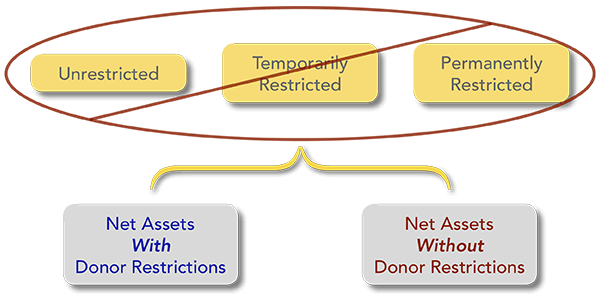
The current net asset classifications have been eliminated and replaced by two new classes:

Investment returns will now be presented net of expenses and the requirement to disclose those netted expenses has been eliminated. NFP entities using the direct method cash flow statements are no longer required to reconcile the direct method to the indirect method. For gifts received to acquire or build long-lived assets, entities will now be required to use the “Placed-in-Service” method to report the expiration of gift restrictions and will need to reclassify any such amounts for assets previously placed in service. The new guidelines require NFPs to present both the natural and functional classification of expenses in the same location.

Additional disclosure requirements are as follows:

  1. Disclosure of the amounts and purposes of self-imposed restrictions or limitations on assets without donor imposed restrictions.
  2. Disclosures of the composition of donor restricted net assets and how those restrictions affect their use.
  3. Qualitative information on management’s plan to meet the entity’s cash flow needs for the next twelve months as well as the availability of the assets that will be used to meet those needs.
  4. Disclosure of the methodology used to allocate expenses between program and support functions.
  5. Underwater endowment funds will now require increased disclosure requirements relating to the entity’s policies and actions taken concerning appropriation of such funds, the fair value of the funds, original gift amount to be maintained and the aggregate deficiencies of the funds, which are to be classified as part of net assets with donor restrictions.

Nonprofit organizations that will be affected include charities, foundations, colleges and universities, healthcare providers, religious organizations, trade associations, and cultural institutions, among others.

These changes will be effective for annual statements with fiscal years beginning after December 15, 2017 and for interim periods with fiscal years beginning after December 15, 2018. The amendment is to be applied on a retrospective basis; however, entities presenting comparative statements have the option to omit the increased requirements surrounding the analysis of expenses and liquidity and availability of resources for the period presented prior to adoption.

Authored by Tom Smither, Supervisor of Assurance Services.

For additional information, please contact your Dean Dorton advisor or:
Crissy Fiscus, cfiscus@deandortonstg.wpenginepowered.com
David Richard, drichard@deandortonstg.wpenginepowered.com

Filed Under: Healthcare, Higher Education, Industries, Nonprofit & Government Tagged With: Asset, college, donor, FASB, Healthcare, Higher Education, Invest, nonprofit, not-for-profit, University

Article 07.7.2016 Dean Dorton

Investing in mutual funds is an easy way to diversify a portfolio, which is one reason why they’re commonly found in retirement plans such as IRAs and 401(k)s. But if you hold such funds in taxable accounts, or are considering such investments, beware of these three tax hazards:

  1.  High turnover rates: Mutual funds with high turnover rates can create income that’s taxed at ordinary-income rates. Choosing funds that provide primarily long-term gains can save you more tax dollars because of the lower long-term rates.
  2. Earnings reinvestments: Earnings on mutual funds are typically reinvested, and unless you keep track of these additions and increase your basis accordingly, you may report more gain than required when you sell the fund. (Since 2012, brokerage firms have been required to track — and report to the IRS — your cost basis in mutual funds acquired during the tax year.)
  3. Capital gains distributions: Buying equity mutual fund shares late in the year can be costly tax-wise. Such funds often declare a large capital gains distribution at year end, which is a taxable event. If you own the shares on the distribution’s record date, you’ll be taxed on the full distribution amount even if it includes significant gains realized by the fund before you owned the shares. And you’ll pay tax on those gains in the current year — even if you reinvest the distribution.

If your mutual fund investments aren’t limited to your tax-advantaged retirement accounts, watch out for these hazards. And contact us — we can help you safely navigate them to keep your tax liability to a minimum.

Filed Under: Accounting & Tax, Services, Tax Tagged With: 401-k, 401(k), Capital, Invest, mutual fund, portfolio, Tax

Article 12.28.2015 Dean Dorton

You may have been interested in or may have contributed to funding campaigns on sites such as Kickstarter. There are a number of fundamental issues relating to crowdfunding – is your payment a gift to the fundee, an equity investment, a loan, or a purchase of an item? Funders don’t often think about these issues and the law isn’t always clear. Recently, the Securities and Exchange Commission (SEC) adopted final rules allowing private companies to sell securities (an equity investment) through internet-based crowdfunding. These rules will become effective on May 16, 2016 and will allow all investors (not just accredited investors) to buy private securities – i.e., to invest in crowdfunding ventures. There are limitations – see below:

  • The amount the company can raise through crowdfunding is limited to $1 million in any 12-month period.
  • If an individual investor’s annual income and net worth are both greater than $100,000, he can invest up to 10% of his net worth.
  • If an individual investor’s annual income or net worth is less than $100,000, he can invest the greater of $2,000 or 5% of his annual income or net worth.
  • Crowdfunding investors generally may not sell their securities for one year. Even without that limitation, crowdfunding investors should view their investments as highly illiquid.
  • Funding portals will be required to register with the SEC.
  • Those seeking this type of equity crowdfunding will be required to provide information about the offering and the financial condition of the company. These requirements are much less onerous than those associated with a public offering, but they are significant, and failure to comply may permit an unhappy investor to obtain a refund.

This is a significant improvement to the rules for small companies seeking to raise capital and for funders seeking an equity investment in such companies. We’re not sure if it will bring a sea-change in Kickstarter type fundraising and so the confusion about the nature of such contributions will likely continue – is it a gift, a loan, or a purchase of an item? If it’s an equity investment, it should comply with the new SEC rules.

Contact your Dean Dorton advisor if you have any questions or would like to learn more.

Filed Under: Accounting & Tax, Construction, Energy & Natural Resources, Equine, Forensic Accounting, Healthcare, Higher Education, Industries, Manufacturing & Distribution, Nonprofit & Government, Real Estate, Risk Management, Services, Tax, Technology, Wealth & Estate Planning Tagged With: Crowdfunding, Equity, fund, Gift, Internet, Invest, Investor, Kickstarter, Raise, SEC

  • Services
    • Outsourced Accounting
    • Audit & Assurance
    • Tax
    • Consulting & Advisory
    • Technology & Cybersecurity
    • Family Office
    • Wealth Management
  • Industries
  • Company
  • Locations
  • Careers
  • Insights
  • Events
  • Contact Us
facebook Dean Dorton - CPAs And Advisors On Facebook twitter twitter linkedin Dean Dorton - CPAs And Advisors On LinkedIn youtube Dean Dorton - CPAs And Advisors On YouTube

The matters discussed on this website provide general information only. The information is neither tax nor legal advice. You should consult with a qualified professional advisor about your specific situation before undertaking any action.

© 2026 Dean Dorton Allen Ford, PLLC. All Rights Reserved