• Skip to primary navigation
  • Skip to main content
Dean Dorton – CPAs and Advisors
  • Services
        • Audit & Assurance
          • Audits, Reviews & Compilations
          • ESG Programs & Reporting
          • Internal Audit
          • International Financial Reporting
          • Lease Accounting Managed Services
          • Peer Review Services
          • SOC Reporting
        • Family Office
        • Consulting & Advisory
          • Business Valuation Services
          • Forensic Accounting
          • Litigation Support
          • Matrimonial Dissolution
          • Merger & Acquisition
          • SEC Services
          • Succession Planning
          • Transaction Advisory Services
          • Whistleblower Hotline
        • Outsourced Accounting
        • Private Wealth
        • Healthcare Consulting
          • Finance
          • Health Systems Operational Transformation
          • Medical Billing and Credentialing
          • Risk Management & Compliance
          • Strategy and Strategy Implementation
          • Technology & Data Analytics
        • Tax
          • Business Tax
          • Cost Segregation Studies
          • Credits and Incentives
          • Estates and Trusts
          • Individual Tax
          • International Tax
          • SEC Provision and Compliance
          • State and Local Tax
        • Technology & Cybersecurity
          • Accounting Software
          • Cybersecurity
            • Cybersecurity Assessments
            • Cybersecurity Scorecard Assessment
            • Security Awareness Training
            • Virtual Information Security Office
          • Data Analytics & AI
          • IT Audit & Compliance
            • Cybersecurity Maturity Model Certification (CMMC)
            • Data Privacy Laws
            • SOC Reporting
          • IT Infrastructure & Cloud Solutions
            • Automation
            • Backup and Disaster Recovery
            • Cloud Strategy
            • Data Center
            • Enterprise Network
            • Network Security
            • Phone and Video Conferencing
            • User Identity Management Solutions
            • Webex
          • Managed IT Services
  • Industries
        • Construction
        • Distilleries and Craft Breweries
        • Energy and Natural Resources
        • Equine
        • Financial Institutions
        • Government
        • Healthcare
        • Higher Education
        • Life Sciences
        • Manufacturing and Distribution
        • Nonprofit
        • Real Estate
  • Insights
    • Articles
    • Guides
    • Case Studies
  • Events
  • Company
        • News
        • Our Team
        • Experiences
        • Careers
          • College Students
          • Experienced Professionals
        • Locations
        • Lexington, KY

          250 West Main Street
          Suite 1400
          Lexington, KY 40507
          859-255-2341

        • Louisville, KY

          435 North Whittington Parkway
          Suite 400
          Louisville, KY 40222
          502-589-6050

        • Louisville, KY

          700 North Hurstbourne Parkway
          Suite 115
          Louisville, KY 40222
          502-589-6050

        • Cincinnati, OH

          312 Walnut Street
          Suite 3330
          Cincinnati, OH 45202
          859-331-3300

        • Blue Ash, OH

          9987 Carver Rd
          Suite 120
          Blue Ash, OH 45242
          513-891-5911

        • Ft. Wright, KY

          810 Wright’s Summit Parkway
          Suite 300
          Fort Wright, KY 41011
          859-331-3300

        • Indianapolis, IN

          5975 Castle Crk Pkwy Dr N
          Suite 400
          Indianapolis, IN 46250
          317-469-0169

        • Raleigh, NC

          4130 Parklake Avenue
          Suite 400
          Raleigh, NC 27612
          919-782-9265

  • Contact Us

Managed IT & Infrastructure

Article 02.10.2026 Dean Dorton

Deciding where and how to run workloads has never been more complex — or consequential — than it is in today’s modern infrastructure. The critical services that run your business  must scale on demand, recover from failures and remain secure. At the same time,  technical leaders are expected to meet business goals such as lowering costs, accelerating  time to value and reducing operational overhead.

Adding to the challenge are competing mandates  to either increase cloud adoption or repatriate workloads to address data sovereignty. Each option often requires compromising something essential, creating a perceived tradeoff between what the business needs and what your teams can realistically deliver.

This tradeoff is an artifact of how infrastructures and workloads have evolved. For years, achieving the flexibility offered by cloud-native architectures meant accepting the public cloud’s operational and cost models, or stitching together automation and overlay tools in private cloud — along with the complexity that approach introduced. What has changed is that the software overlay has finally been refined and integrated. When you can deploy a single software-defined platform across your data center, edge and public cloud, the divide between control and agility begins to dissolve. This shift simplifies the operation of global applications and services.

Nutanix Cloud Platform provides that unified, software-defined foundation by collapsing compute, storage, automation and networking into a hyperconverged platform. It operates consistently whether deployed on premises, integrated with leading compute, storage and data center networking solutions, or provisioned as Nutantix Cloud Clusters in AWS, Azure, or Google Cloud Platform.

Industries under the greatest pressure to modernize infrastructure often lack the luxury of slow migrations or managing multiple platforms and interfaces. While each industry faces unique challenges, they share a common requirement: infrastructure must support steady production cycles while adapting  to unpredictable capacity demands  without driving architectural sprawl or operational disruption.

  • Construction: Project management systems and building information modeling (BIM) applications generate multi-terabyte datasets that distributed teams need to access from job sites and remote offices. Further, project-based work often creates unpredictable demand cycles. Nutanix Cloud Infrastructure runs core applications on premises for consistent performance, then extends capacity to Nutanix Cloud Clusters in AWS, Azure, or GCP as new project phases demand additional engineering and design resources, without rearchitecting applications or retraining  teams on new management tools.
  • Manufacturing: Manufacturers must run legacy production systems alongside modern operational technology without maintaining separate stacks, all while ensuring security. Nutanix Cloud Infrastructure and Nutanix Kubernetes Platform can run and manage Virtual Machines and Kubernetes containers from the same platform (Prism), regardless of whether those workloads are localized in a private cloud, public cloud, or edge.
  • Healthcare: Healthcare organizations face compliance and operational requirements that make balancing resiliency with flexibility especially challenging. Electronic health record systems (EHR) cannot incur downtime and often do not easily support cloud-native architectures. Clinical imaging generates terabytes of data daily that requires immediate  access and long-term retention. Nutanix Cloud Clusters and Nutanix Cloud support a lift-and-shift approach to initial adoption, while remaining flexible enough to migrate workloads between cloud boundaries without requiring conversion. Nutanix Unified Storage handles block, file and object storage on a single platform eliminating the need to manage separate systems for active vs archived data.

Organizations that want to thrive in these industries can not afford for infrastructure to be the bottleneck in how quickly they respond to business demands. The architectural question facing technical leadership isn’t about choosing between cloud and on premises, or between stability and agility. It’s about whether your infrastructure platform can accommodate both the workloads you’re running today and the ones you’ll need to support going forward without requiring a fundamental redesign each time your priorities shift.

Dean Dorton Technology works with clients facing these same infrastructure challenges. We’ve built a practice around integrating and implementing solutions like Nutanix to help our clients align modern infrastructure solutions to their business needs. If your teams are spending more time managing infrastructure complexity than delivering business value, we can help evaluate opportunities to unify and optimize how you deliver workloads and services.

Contact us to discuss your infrastructure strategy.
Filed Under: Accounting Software, Infrastructure, Managed IT & Infrastructure, Microsoft Dynamics 365 Tagged With: google cloud platform, nutanix cloud platform

Article 11.25.2020 Dean Dorton

Many organizations are planning and budgeting for 2021 technology needs. Even before the COVID-19 pandemic, organizations were working on technology solutions to help their people and their customers or clients collaborate efficiently. The pandemic has caused a heightened focus on collaborative technology. In this article, we will share some thoughts about collaborative technology and invite you to answer some questions about how your organization is addressing the challenges of working efficiently in today’s business realities.

Collaborative meeting solutions that function well can dramatically increase efficiency. These solutions should work regardless of team members’ location (home or office), type of device being used (computers, tablets, or phones), and whether the communication is by voice, video, messaging, or content sharing. Webex Meetings and Teams, Microsoft Teams, and Zoom are examples of now widely-used collaborative technology.

Here are some questions you might ask yourself:

  • Do your team members and clients or customers find your collaborative technology easy to use and effective in doing business?
  • Is the quality of audio, visual, and screen sharing sufficient to meet the needs of your organization?
  • Is the performance of your systems consistently good?
  • Are your systems secure from hackers?
  • Are you able to take notes and “whiteboard” ideas for multiple users, and are these notes readily accessible later?

If your current phone system does not support modern collaboration solutions, you may need to modernize your calling platform, either by replacing your on-premise equipment or by migrating to the cloud. In either case, it is very important to make sure your meeting, messaging, and calling solutions are integrated.

In the pandemic-caused rush to increase the productivity of remote workers, many organizations have relaxed controls on purchasing, and vendors have lowered the burden on acquiring their collaboration solutions. This has led to users acquiring disparate technologies overly focused on immediate needs, rather than being part of a longer-term organization-wide strategy. Including IT professionals in the planning and budgeting processes is important in maximizing the return on your technology investments and protecting your systems’ security.

Want to learn more about collaborative solutions?

IT Infrastructure Services Associate Director
drice@ddaftech.com
859.425.7735

The modern way to communicate

This article was originally published in News & Views (Dean Dorton’s quarterly newsletter).

Go to News & Views

Filed Under: 2020 Winter Edition, COVID-19, COVID-19 Business, Managed IT & Infrastructure, News & Views, Services, Technology Tagged With: collaborative technology, meeting, News & Views, Technology, webex

Article 10.27.2020 Dean Dorton

C-suite and technology leaders need to assume a more strategic role in organizational intelligence and planning. To do that, you need better visibility into technology, financial, and operational metrics, so you can make better decisions and keep your team members’ productivity high and keep your organization’s information secure working across various platforms in multiple locations.

Virtual Desktop

Significant improvements have been made to virtual desktop platforms during the past five years. In order to keep your productivity high, it’s important to have a system that is fast, secure, and easy-to-access. When is the last time you thought about upgrading your virtual access?

Here are some things to consider:

Hardware Costs in a Virtual World

As you consider your technology costs, it’s important to critically look at your current stance and analyze how best to utilize cloud solutions to help support your organizational goals and mitigate technology expenses. Cloud-based systems are far more secure, easy-to-access, and easier to manage from the technology team’s perspective across your organization. The right cloud-based solutions are scalable to your organization’s size and complexity making them cost-effective and efficient. Additionally, Cloud-based systems ensure your team always has access to the latest tools making working anywhere, anytime easier and more productive.

Cybersecurity Risks

As cybersecurity threats become more sophisticated, it’s not a matter of if but when your company will fall victim. Is your system fully secured against an attack? Do you have the visibility to know where your company is most vulnerable? Do you know what your first five steps should be after you know an attack has occurred? Does your current security insure you can avoid spending hundreds of thousands to millions of dollars in remediation when you get hit?

We worked with many clients throughout the last year who needed remediation assistance for cyber-attack incidents that could have been avoided if they had the right cyber tools in place. We often see companies pushing cybersecurity initiatives out to the next year:

  • Cybersecurity Scorecard for Small Business
  • Cybersecurity Risk Assessments (for medium and large businesses)
  • Multi-factor Authentication Platforms
  • User Awareness Training (for your team members as they are often prime targets)
  • Security tools and technology that integrates seamlessly with your existing systems

If you’d like to explore how to better control costs to meet your company’s needs and keep projects on budget, please contact me.  I am happy to answer your questions and offer meaningful recommendations.

David Rice
Senior Infrastructure Engineer
drice@ddaftech.com • 859.425.7735

Filed Under: Biotechnology, Construction, Cybersecurity, Dental Practices, Energy & Natural Resources, Equine, Franchises, Healthcare, Higher Education, Industries, Managed IT & Infrastructure, Manufacturing & Distribution, Nonprofit & Government, Professional Services, Professional Sports, Real Estate, SaaS, Services, Technology Tagged With: Cybersecurity, security, Technology, virtual desktop

Article 11.5.2015 Dean Dorton

What controls does your business have in place to manage electronic fund transfers? How easy would it be for your Accounting Department to unknowingly participate in a fraudulent request to complete a wire transfer? Without adequate controls in place, your company could easily become the next victim of a common email phishing scheme. It is easy to think that your employees wouldn’t fall for something like this, but it happens more often than you think.

A local company recently lost over $85,000 because an employee in the Accounting Department received an email that appeared to come from one of the executives. Proper controls were not in place and funds were transferred. By the time anyone realized what had happened and the FBI could be contacted, the funds were gone and could not be recovered.

These types of scams have been around for a long time. However, the thieves are getting more sophisticated and actually put a great deal of effort into the process. It only takes a few vulnerable victims to make their effort pay off. There has been a large upswing in the number of attempts to defraud businesses – yes, even here in Kentucky!

Some attacks use a method called spoofing. Spoofing allows a sender to disguise their address and make it appear as though it came from someone else. For example, I could send an email and make it look like it came from your CEO. With the proper email security and SPAM filtering in place, most of these attempts do not make it through the filters. Properly managed email systems can recognize the spoof and block the message. More recent attempts involve the thieves actually registering a new domain name that is very similar to yours and setting up an email address that comes very close to that of your CEO or management. So close, it is very easy for your employees to not recognize the difference. Generally the email address is only one character off (e.g., jmiller@deanndorton.com instead of jmiller@deandorton.com.

The best defense against these attacks is to ensure there are strong controls around your electronic fund transfer processes that require more than an email request to process the transaction. For example, it is a good idea to require written sign-off. Note that an email does not equal written sign-off. If situations arise where you do need to use email, the recipient should always start a new email message to the requester (never reply to the request email). A text message to the requester would also add an additional layer of confirmation. However, completion of a company request form would be best. A strong control would require dual sign-off for transfers, especially those over a certain dollar amount and for new vendors (or new transfers). The key point here is having a two-step process to help minimize any opportunity for fraud.

Don’t put your business at risk by not having internal controls. For help evaluating and improving your information security and internal controls, please contact your Dean Dorton advisor or Jason Miller, Director of Business Consulting Services, at 859-425-7626 or jmiller@deandorton.com.


View Jason Miller’s Bio

Filed Under: Managed IT & Infrastructure, Services, Technology Tagged With: electronic, email, fraud, fund, fund transfer, phishing, spam, spoofing, Technology, wire transfer

Article 11.4.2015 Dean Dorton

Part 1 – Cisco Prime Infrastructure 3.0

overview

Introduction

Cisco Prime Infrastructure 3.0, just released on August 31, 2015, is Cisco’s latest iteration of their network management software. It follows in the footsteps of CiscoWorks, Cisco Prime LMS/NCS, and previous editions of Cisco Prime Infrastructure software packages.

As a young IT technician in the mid 2000’s at a university who used CiscoWorks to monitor their Cisco network, the first feature of that program that impressed me was the network topology map. I thought it was clever to have that full network map showing green where devices and links were good and red where they were bad or did not exist. As I have gained experience designing, managing and troubleshooting customer networks, I have learned that network management is more than just monitoring the status of the network links and devices. It requires managing the entire lifecycle and performance of your wired and wireless networks.

Since my in-depth experience with Cisco Prime Infrastructure (PI) began earlier this year on version 2.2, I will spend less time discussing new features of version 3.0 and more time highlighting some of the features I immediately took advantage of as a first time user. This blog post will focus primarily on the wired network management. I have deployed Cisco Prime Infrastructure 3.0 internally and we are a Meraki wireless shop. I will show what information we can get from Meraki APs within PI, which is not a ton. In a traditional Cisco wireless LAN controller based wireless network, PI excels in bringing wired and wireless under a single pane of glass for management.

With that being said, one of the biggest (and best) differences between Prime Infrastructure 2.2 and 3.0 is the upgrade in user interface. PI 3.0 uses an HTML 5 based GUI and removes any dependence on Flash. Another major difference in PI 3.0 is the user’s ability to create custom alarms and events through a trap event or syslog entry. For example, I created a custom alert that would be raised anytime a duplex mismatch syslog entry was logged by a switch.

Easy Out of the Box Uses

PI has a very large feature set that, if explored completely, would turn this blog post into a novel. So instead, I am going to focus on some easy wins. If there is a particular area you would want me to explore further, contact me and let me know as I plan a follow up post looking at some more advanced PI topics.

After installation, the first thing you want to do is configure user access and bring in your devices. PI will grab just about everything there is to know about your device, whether added manually or through a scan of your network using SNMP, ssh, telnet and http(s) for discovery.

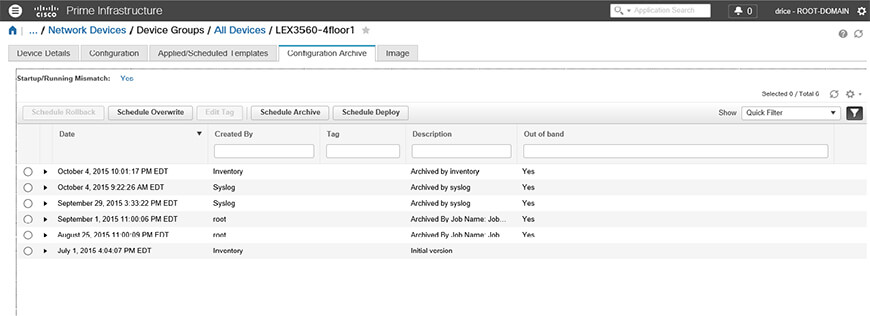
By successfully adding PI to inventory, you already achieved the benefit of a backup of the device configuration. From this point, you can schedule PI to periodically grab backups from your devices and store them in the configuration archive.

configarchive

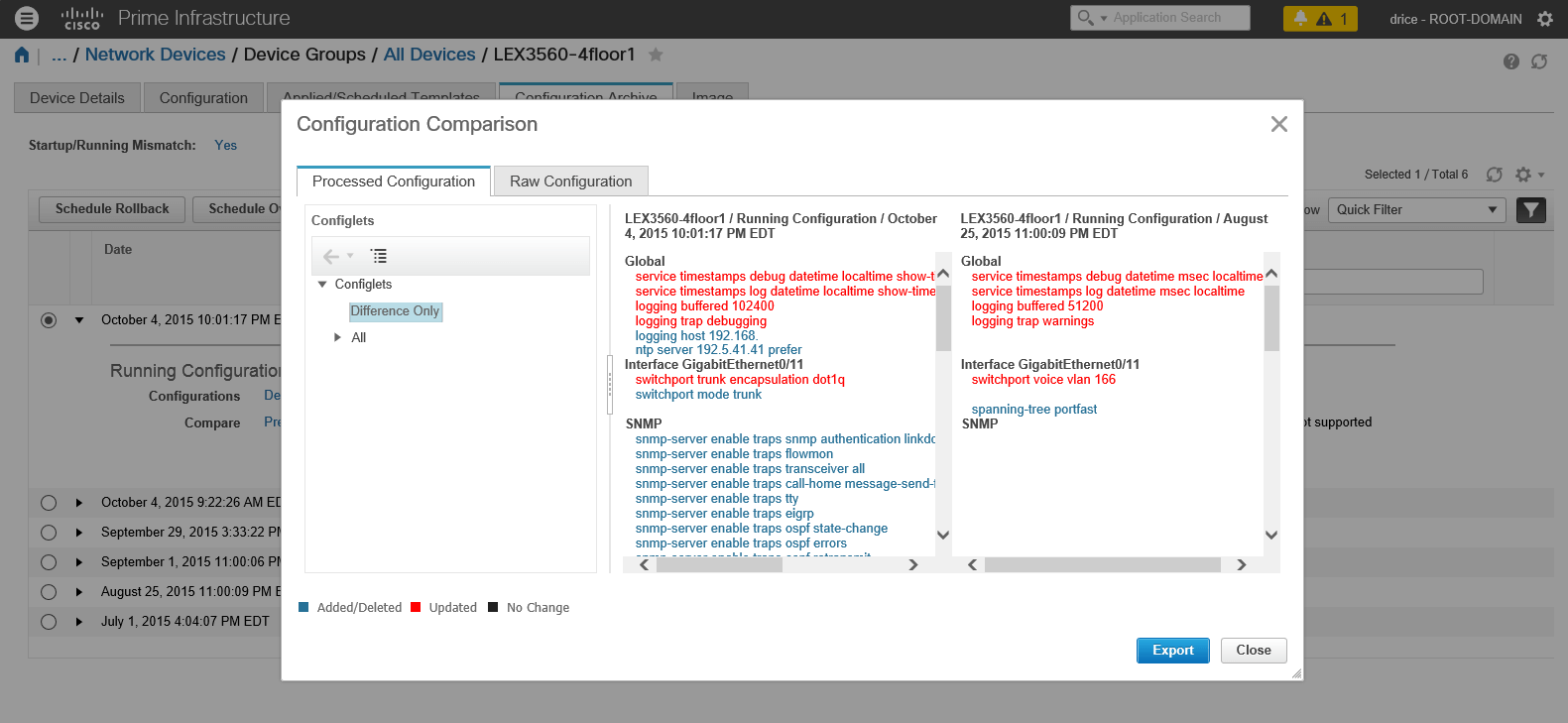
This allows you to compare configurations to other revisions of the configuration on the same device OR a completely different device. For example, say you made a configuration change that caused some unforeseen issue, but the issue did not rear its head for a week or so after. Instead of attempting to remember the changes made, you can simply have it show the differences between your last archive and the current running configuration.

configdiff

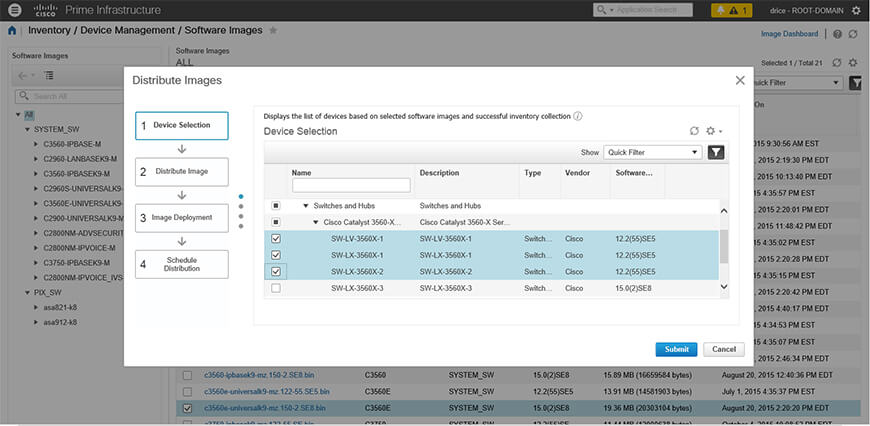
Another feature of PI is software image management. Without a management tool similar to PI used in a growing network, the odds of all devices in that network having the same software image are probably slim. PI allows you to look at a device and let Cisco provide recommended software versions. You can then download and import the image into the software image repository within PI. Once there, you can schedule a deployment of that image out to all non-compliant devices that are compatible with that image. This works for switches, routers, WLCs and autonomous APs.

imagedist

A Little Bit More Advanced

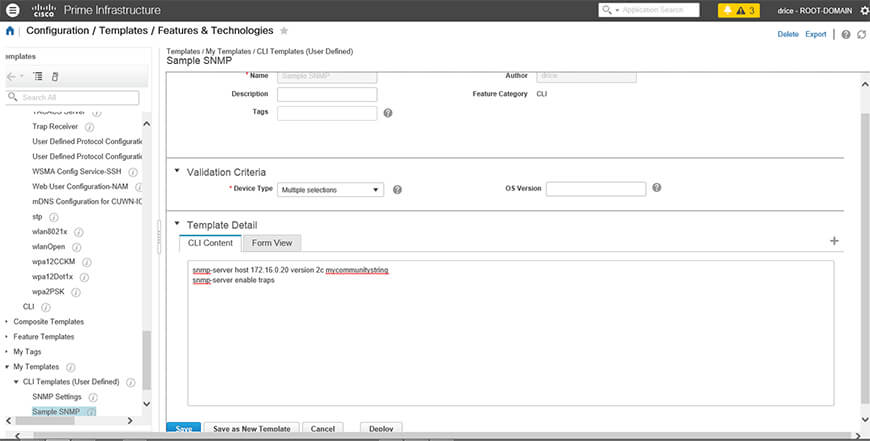
One thing all IT administrators want is a consistent and repeatable configuration for multiple identical devices anywhere in their infrastructure. The obvious advantage is the ability to ensure consistent behavior across the enterprise in regards to things like MTU, STP and QoS. PI makes this very easy by allowing for the creation of configuration templates. You can create these as static CLI configurations (e.g. NTP settings) or you can create a form based template to configure settings that would vary from device to device, such as IP address. Once created, these templates can be deployed across all compatible devices.

configtemplate

PI can take this a step further by using its Plug and Play functionality. This features allows a new device to boot up and get its initial software image and configuration from PI. This works either locally or through the Internet using a Plug and Play Gateway and an application running on an iPad or Windows laptop.

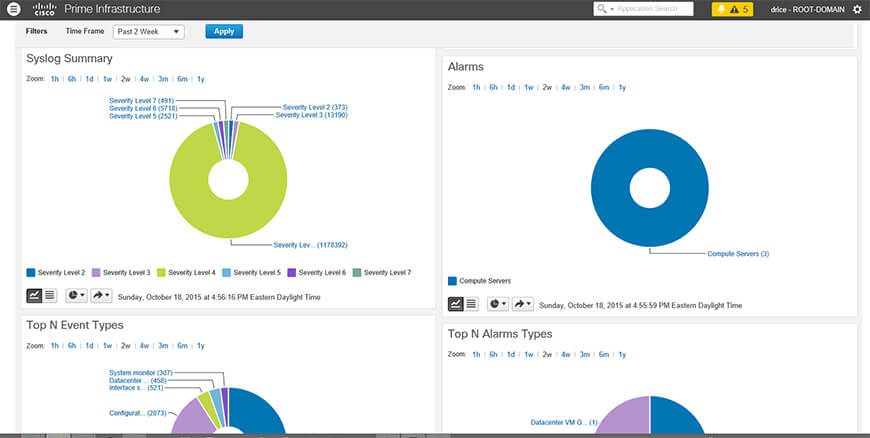
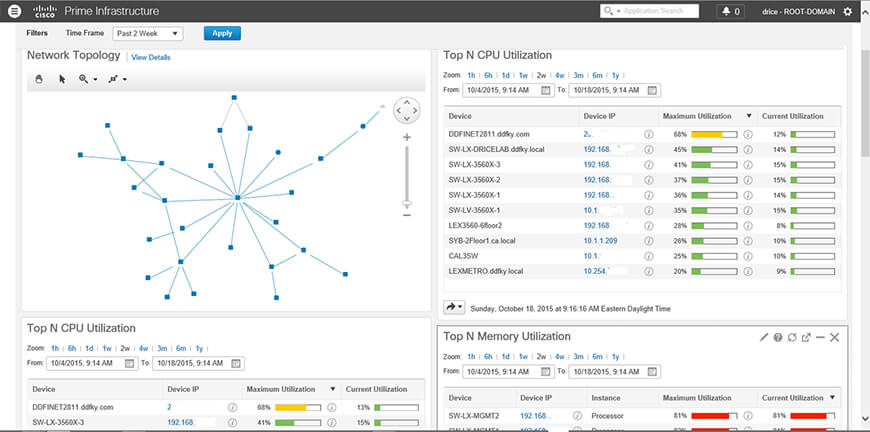
Dashboards!

One of PI’s biggest strength’s is its ability to give you a lot of information in a small amount of real estate. Cisco crams in so much information that I found navigation to be the greatest learning curve of the whole software package. Cisco could probably do a better job of helping the newbie learn where everything is located.

Having spent a great deal of time learning where everything is located, the next thing I did was customize the home page to show the particular dashboards I wanted to see. Of course, front and center (well actually top left), I have the topology dashboard so I can see the immediate status of our internal network devices. But, I also have the dashboards for the top N CPU, RAM, TX and RX usage stats.

These dashboards can be customized and saved so that each time you come in to PI, you see only the information you want and in the format you want.

dashboards

Conclusion

Although I have barely scratched the surface on what Prime Infrastructure can do, I focused on some basic features which will be immediately useful to the first-time user. Prime Infrastructure provides an entire feature set around wireless network management, application performance (netflow) and integrations with other products such as the Cisco Network Analysis Module. Keep an eye out for future posts around some of the more advanced features of Cisco Prime Infrastructure 3.0.

For the next installation in this series, we will focus on Cisco Identity Services Engine software product. In doing so, we will explore some simple use cases and discuss how it integrates with Cisco Prime Infrastructure to provide a view of the network from wire to device and from user to application.

For more information or questions in the meantime, contact David Rice at drice@ddaftech.com or 859-425-7735.Cisco Prime Infrastructure Product Page

Cisco Prime Infrastructure 3.0 User Guide

Cisco Prime Infrastructure 3.0 Reference Guide

Filed Under: Managed IT & Infrastructure, Services, Technology Tagged With: Cisco, Cisco Prime Infrastructure 3.0, IT, IT administrator, Software, Technology

Article 02.24.2015 Dean Dorton

What is multi-factor authentication?  Multi-factor authentication is a method of access control which requires a user to have two of the three factor categories: Knowledge – passwords; Possession – token or card; Inheritance – biometric.   While there is not currently any regulation or requirement for system-wide multi-factor authentication, it is a growing best practice.  Many areas of regulation or guidance, such as Health Insurance Portability and Accountability Act (HIPAA) or Payment Card Industry – Data Security Standards (PCI-DSS), encourage or require multi-factor authentication for remote network access.

The number of cybersecurity issues over the past five years continues to increase.  More and more sensitive information is being compromised due to poor password controls.  Phishing scams and malware outbreaks get more sophisticated and pervasive all the time.  These types of threats commonly result in user passwords being compromised. Other reasons to consider multi-factor authentication:

  • Many of the well-known data breaches from 2014 could have been avoided if the entity had a multi-factor authentication solution in place for the system housing sensitive information.
  • Identity theft is the fastest-growing type of crime, now more profitable than drug-related crimes.
  • Even if an organization employs vulnerability tests, anti-virus systems and advanced firewalls, lack of user authentication still leaves a company vulnerable to hackers.

According to the Verizon 2014 Data Breach Investigations Report, there were 1,367 confirmed data breaches and 63,437 security incidents in 2013 (these only account for incidents that were officially reported). Of the 1,367 breaches, the majority are precipitated external sources.

The next figure demonstrates the movement of different threat actions over the past three years.  As you will see, “Use of stolen credentials” has risen to the top of the threat list.

For more information about multi-factor authentication and information security risks, please contact Jason Miller, Director of Technology Consulting at Dean Dorton.

Jason Miller
jmiller@ddaftech.com
(859) 425-7626

View Jason Miller’s Bio

Filed Under: Cybersecurity, Managed IT & Infrastructure, Services, Technology Tagged With: Biometric, Information security, Jason Miller, Multi-factor authentication, Password, Token

PAY INVOICE SUBMIT RFP
  • Services
    • Outsourced Accounting
    • Audit & Assurance
    • Tax
    • Consulting & Advisory
    • Technology & Cybersecurity
    • Family Office
    • Wealth Management
  • Industries
  • Company
  • Locations
  • Careers
  • Insights
  • Events
  • Contact Us
SUBSCRIBE TO INSIGHTS
email Dean Dorton - CPAs And Advisors On Email facebook Dean Dorton - CPAs And Advisors On Facebook twitter twitter linkedin Dean Dorton - CPAs And Advisors On LinkedIn youtube Dean Dorton - CPAs And Advisors On YouTube

The matters discussed on this website provide general information only. The information is neither tax nor legal advice. You should consult with a qualified professional advisor about your specific situation before undertaking any action.

© 2026 Dean Dorton Allen Ford, PLLC. All Rights Reserved

  • Privacy Policy
  • Terms Of Use
  • Accessibility