• Skip to primary navigation
  • Skip to main content
Dean Dorton – CPAs and Advisors
  • Services
        • Audit & Assurance
          • Audits, Reviews & Compilations
          • ESG Programs & Reporting
          • Internal Audit
          • International Financial Reporting
          • Lease Accounting Managed Services
          • Peer Review Services
          • SOC Reporting
        • Family Office
        • Consulting & Advisory
          • Business Valuation Services
          • Forensic Accounting
          • Litigation Support
          • Matrimonial Dissolution
          • Merger & Acquisition
          • SEC Services
          • Succession Planning
          • Transaction Advisory Services
          • Whistleblower Hotline
        • Outsourced Accounting
        • Private Wealth
        • Healthcare Consulting
          • Finance
          • Health Systems Operational Transformation
          • Medical Billing and Credentialing
          • Risk Management & Compliance
          • Strategy and Strategy Implementation
          • Technology & Data Analytics
        • Tax
          • Business Tax
          • Cost Segregation Studies
          • Credits and Incentives
          • Estates and Trusts
          • Individual Tax
          • International Tax
          • SEC Provision and Compliance
          • State and Local Tax
        • Technology & Cybersecurity
          • Accounting Software
          • Cybersecurity
            • Cybersecurity Assessments
            • Cybersecurity Scorecard Assessment
            • Security Awareness Training
            • Virtual Information Security Office
          • Data Analytics & AI
          • IT Audit & Compliance
            • Cybersecurity Maturity Model Certification (CMMC)
            • Data Privacy Laws
            • SOC Reporting
          • IT Infrastructure & Cloud Solutions
            • Automation
            • Backup and Disaster Recovery
            • Cloud Strategy
            • Data Center
            • Enterprise Network
            • Network Security
            • Phone and Video Conferencing
            • User Identity Management Solutions
            • Webex
          • Managed IT Services
  • Industries
        • Construction
        • Distilleries and Craft Breweries
        • Energy and Natural Resources
        • Equine
        • Financial Institutions
        • Government
        • Healthcare
        • Higher Education
        • Life Sciences
        • Manufacturing and Distribution
        • Nonprofit
        • Real Estate
  • Insights
    • Articles
    • Guides
    • Case Studies
  • Events
  • Company
        • News
        • Our Team
        • Experiences
        • Careers
          • College Students
          • Experienced Professionals
        • Locations
        • Lexington, KY

          250 West Main Street
          Suite 1400
          Lexington, KY 40507
          859-255-2341

        • Louisville, KY

          435 North Whittington Parkway
          Suite 400
          Louisville, KY 40222
          502-589-6050

        • Louisville, KY

          700 North Hurstbourne Parkway
          Suite 115
          Louisville, KY 40222
          502-589-6050

        • Ft. Wright, KY

          810 Wright’s Summit Parkway
          Suite 300
          Fort Wright, KY 41011
          859-331-3300

        • Cincinnati, OH

          312 Walnut Street
          Suite 3330
          Cincinnati, OH 45202
          859-331-3300

        • Blue Ash, OH

          9987 Carver Rd
          Suite 120
          Blue Ash, OH 45242
          513-891-5911

        • West Chester, OH

          9025 Centre Pointe Drive
          Suite 310
          West Chester, OH 45069
          513-985-62405

        • Indianapolis, IN

          5975 Castle Crk Pkwy Dr N
          Suite 400
          Indianapolis, IN 46250
          317-469-0169

        • Raleigh, NC

          4130 Parklake Avenue
          Suite 400
          Raleigh, NC 27612
          919-782-9265

  • Contact Us

Cisco

Article 05.1.2024 Autumn Hines

What do racehorses and industrial machines have in common? Both reach peak performance once they have a tiny sensor attached.

For years now, manufacturers have been using small, internet-connected sensors to measure how machines are vibrating. They use that data to identify when performance is declining or the risk or breakdown is rising—and the sensors have been remarkably successful at helping manufacturers get more predictive, preventive, and proactive.

Of course, a running horse produces vibrations too. Sensors used to track vibrations for industrial applications can just as easily track them for equine applications. And once trainers have a reliable and accessible way to monitor every single stride of a horse’s performance, it will transform horse racing as we know it, and the equine industry more broadly.

In fact, it’s already happening. 

Why Put Sensors on Horses?

Placed in the saddle cloth, these sensors weigh only a few ounces and track forces in four directions: up, down, forward, and back. Trainers can use that data to develop performance baselines for an animal, and then identify when performance deviates in any way.

That’s useful for two big reasons:

  • Health and Wellness: Sensor data can help to flag health issues that might be invisible otherwise, and help to flag them early enough for trainers to intervene before injury occurs. The sensors take the guesswork out of vital health and safety decisions so that horses receive the best care possible.
  • Training and Performance: Trainers know more about how horses develop when they can track how much and how quickly the sensor data changes. They can dynamically adjust training routines based on the data to help the animals achieve more than they could with past training methods informed more by observation than data.

These are just the two most obvious and exciting use cases, but many more will likely emerge as adoption increases—until one day when there’s a sensor in every saddle.

Getting Started with Sensors

Sensors are compact, inexpensive, and user-friendly. Plus, the sensors have been extensively studied in Australia, New York, and now by the Kentucky Horse Racing Commission, resulting in a rich pool of data to develop baselines and benchmarks to follow. This all makes it easy for trainers, racetracks, vets, and anyone else in the equine industry to adopt this game-changing technology.

It takes more than just sensors, though. The space where the sensors will be used – racetrack, training facility, etc – needs a robust wireless network to transmit the data. It takes dedicated software to organize the raw data into a usable format and analyze results in real-time. With all these pieces in place, individual operators can begin using sensors—but the biggest beneficiary will be the equine industry as a whole as sensor data, continually collected from thousands of races around the world, connects us with horses like never before. With decades of experience in the equine industry, along with comprehensive technical expertise, Dean Dorton can help you integrate sensors into your operation. Contact us to learn more

Filed Under: Equine, Technology Tagged With: Cisco, Technology

Article 10.18.2016 Dean Dorton

Cisco Systems named Dean Dorton Technology, a premier provider of technology solutions for companies throughout the region, to the Cisco Winner’s Circle. Of the more than 50,000 Cisco partners world-wide, only 350 top performing Cisco commercial partners received the Winner’s Circle honor, signifying the top level of success (double-digit growth) in the midmarket with Cisco. Dean Dorton Technology is the only Cisco partner in Kentucky to achieve this distinguished honor.

Information technology is growing at an unprecedented pace and the world is becoming more connected and innovative than ever before. Companies striving to achieve high levels of success must be committed to regularly assessing their software, security, and collaborative solutions. Most companies have a strategic technology partner like Dean Dorton Technology, who can help modernize networks, maintain security, and offer unified communication systems through the latest state-of-the-art solutions.

“Companies are seeking ways to respond faster, empower their workforce, and personalize their customers’ experiences,” says Jason Miller, Director of Business Consulting Services. “In short, the digital transformation is creating boundless opportunities, but in order to reap the benefits companies need trusted technology advisors that understand their business, goals, and keys to success. We are truly honored to partner with Cisco, the industry leader, and provide meaningful technological advancements to our clients.”

“This is certainly a great achievement in working with Cisco, representing the value we bring to clients far beyond the basics. I am thrilled to have a direct impact on the technological advancements of companies throughout Kentucky and the Ohio Valley and look forward to keeping Kentucky’s companies competitive through the use of innovative technology,” says David Rice, a Senior Infrastructure Engineer at Dean Dorton and member of Cisco’s Small Midmarket Business (SMB) Partner Advisory Board.

Filed Under: Services, Technology Tagged With: business consulting, circle, Cisco, consulting, Technology, winner

Article 04.13.2016 Dean Dorton

Today your business relies on email and web more than ever. As the use of email and web increases, so does the number of advanced threats targeted at infecting users through these critical channels. An advanced email and web security strategy is critical to maintain business operations and protect your organization’s business-sensitive data.Watch this short video on Cisco email and web security solutions to learn about:

  • The current email and web threat landscape
  • Why traditional security solutions are falling short
  • What you need to protect your organization
  • How Cisco email and web security can help

Watch NowUpcoming Events

Join us this spring as we discuss comprehensive business network security topics including Cisco’s Advanced Malware Protection suite of products that provides a solution to secure your infrastructure before, during, and after a malware attack. We highly encourage company chief financial officers, chief operating officers, and chief information officers in the industry to attend this event.3:00 – 5:00 p.m.


Crank & Boom Craft Ice Cream
1210 Manchester Street
Lexington, KY 40504


Registration Closes April 193:00 – 5:00 p.m.


Against the Grain Brewery
401 East Main Street
Louisville, KY 40202Register NowContact Jason Miller at jmiller@ddaftech.com or David Rice at drice@ddaftech.com if you have any questions.View Jason Miller’s Bio

Filed Under: Cybersecurity, Services, Technology Tagged With: Cisco, Crank & Boom, David Rice, email, Jason Miller, security, seminar, Technology, Web

Article 03.24.2016 Dean Dorton

Are your defenses as resilient as your digital ambitions?

Digitization – creating business value through digitized assets and expanded connectivity – is increasing exposure to cyber attacks. As a result, cyber-risk strategies are under the microscope.

New threat intelligence and trend analysis in the Cisco 2016 Annual Security Report explains advances by the security industry and by criminals. Gain insights into how to effectively combat these threats with increased collaboration, communication, and coordination, and by investing for resilience. You’ll also learn how your security peers assess the state of security preparedness in their organizations.

Report highlights include:

  • How industry efforts have crippled major attacks
  • Shifts in tactics by cybercriminals to make money
  • Expert insights into top vulnerabilities
  • How adaptive, integrated solutions can quicken time to detection
  • An update about the state of enterprise security preparedness

Cisco 2016 Annual Security Report: Achieving Attack Resilience in a Digital Age

Contact Jason Miller (jmiller@ddaftech.com) or David Rice (drice@ddaftech.com) for more information.


View Jason Miller’s Bio

Filed Under: Cybersecurity, Services, Technology Tagged With: attack, Cisco, Cyber, cyber-security, David Rice, defense, digitiz, Jason Miller, Risk, security

Article 11.4.2015 Dean Dorton

Part 1 – Cisco Prime Infrastructure 3.0

overview

Introduction

Cisco Prime Infrastructure 3.0, just released on August 31, 2015, is Cisco’s latest iteration of their network management software. It follows in the footsteps of CiscoWorks, Cisco Prime LMS/NCS, and previous editions of Cisco Prime Infrastructure software packages.

As a young IT technician in the mid 2000’s at a university who used CiscoWorks to monitor their Cisco network, the first feature of that program that impressed me was the network topology map. I thought it was clever to have that full network map showing green where devices and links were good and red where they were bad or did not exist. As I have gained experience designing, managing and troubleshooting customer networks, I have learned that network management is more than just monitoring the status of the network links and devices. It requires managing the entire lifecycle and performance of your wired and wireless networks.

Since my in-depth experience with Cisco Prime Infrastructure (PI) began earlier this year on version 2.2, I will spend less time discussing new features of version 3.0 and more time highlighting some of the features I immediately took advantage of as a first time user. This blog post will focus primarily on the wired network management. I have deployed Cisco Prime Infrastructure 3.0 internally and we are a Meraki wireless shop. I will show what information we can get from Meraki APs within PI, which is not a ton. In a traditional Cisco wireless LAN controller based wireless network, PI excels in bringing wired and wireless under a single pane of glass for management.

With that being said, one of the biggest (and best) differences between Prime Infrastructure 2.2 and 3.0 is the upgrade in user interface. PI 3.0 uses an HTML 5 based GUI and removes any dependence on Flash. Another major difference in PI 3.0 is the user’s ability to create custom alarms and events through a trap event or syslog entry. For example, I created a custom alert that would be raised anytime a duplex mismatch syslog entry was logged by a switch.

Easy Out of the Box Uses

PI has a very large feature set that, if explored completely, would turn this blog post into a novel. So instead, I am going to focus on some easy wins. If there is a particular area you would want me to explore further, contact me and let me know as I plan a follow up post looking at some more advanced PI topics.

After installation, the first thing you want to do is configure user access and bring in your devices. PI will grab just about everything there is to know about your device, whether added manually or through a scan of your network using SNMP, ssh, telnet and http(s) for discovery.

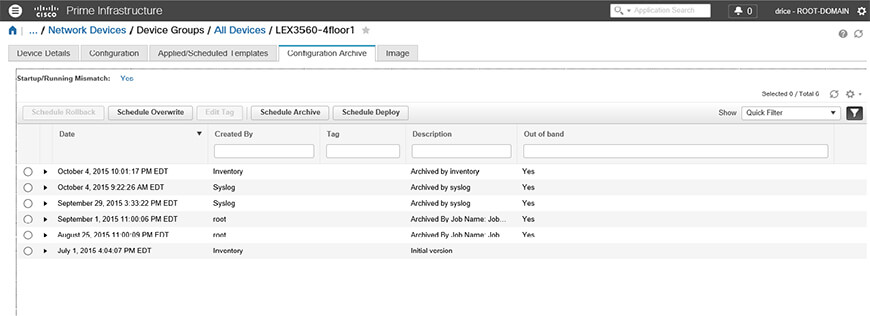
By successfully adding PI to inventory, you already achieved the benefit of a backup of the device configuration. From this point, you can schedule PI to periodically grab backups from your devices and store them in the configuration archive.

configarchive

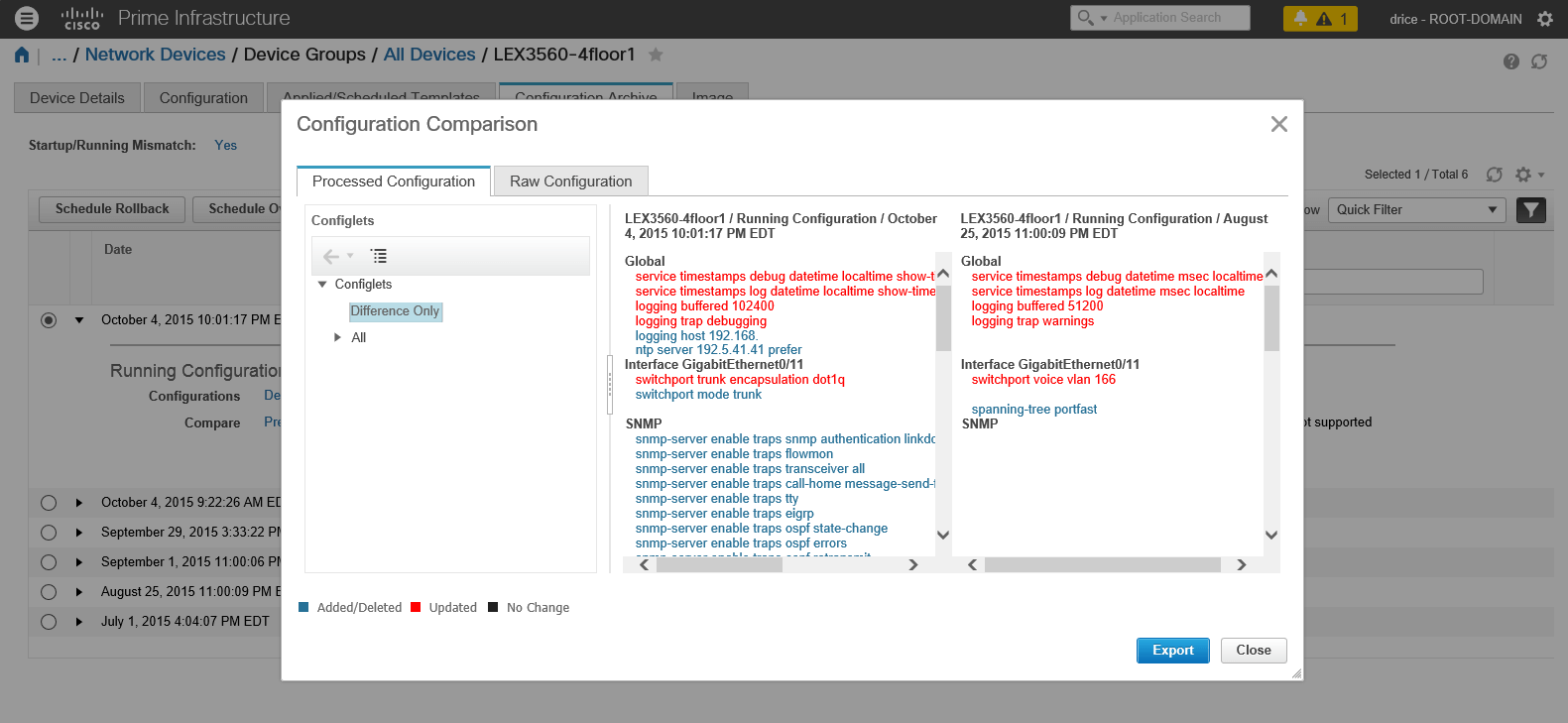
This allows you to compare configurations to other revisions of the configuration on the same device OR a completely different device. For example, say you made a configuration change that caused some unforeseen issue, but the issue did not rear its head for a week or so after. Instead of attempting to remember the changes made, you can simply have it show the differences between your last archive and the current running configuration.

configdiff

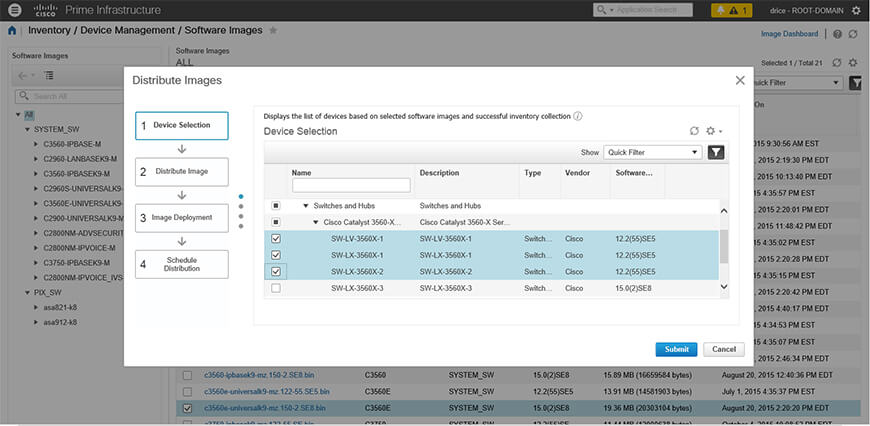
Another feature of PI is software image management. Without a management tool similar to PI used in a growing network, the odds of all devices in that network having the same software image are probably slim. PI allows you to look at a device and let Cisco provide recommended software versions. You can then download and import the image into the software image repository within PI. Once there, you can schedule a deployment of that image out to all non-compliant devices that are compatible with that image. This works for switches, routers, WLCs and autonomous APs.

imagedist

A Little Bit More Advanced

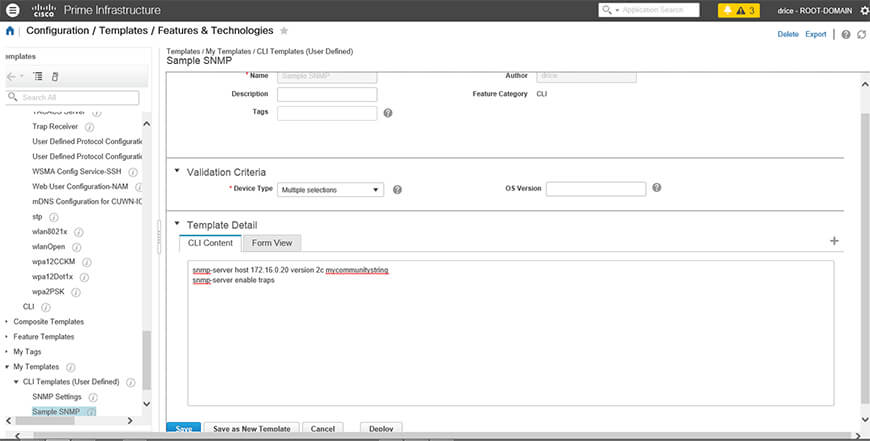
One thing all IT administrators want is a consistent and repeatable configuration for multiple identical devices anywhere in their infrastructure. The obvious advantage is the ability to ensure consistent behavior across the enterprise in regards to things like MTU, STP and QoS. PI makes this very easy by allowing for the creation of configuration templates. You can create these as static CLI configurations (e.g. NTP settings) or you can create a form based template to configure settings that would vary from device to device, such as IP address. Once created, these templates can be deployed across all compatible devices.

configtemplate

PI can take this a step further by using its Plug and Play functionality. This features allows a new device to boot up and get its initial software image and configuration from PI. This works either locally or through the Internet using a Plug and Play Gateway and an application running on an iPad or Windows laptop.

Dashboards!

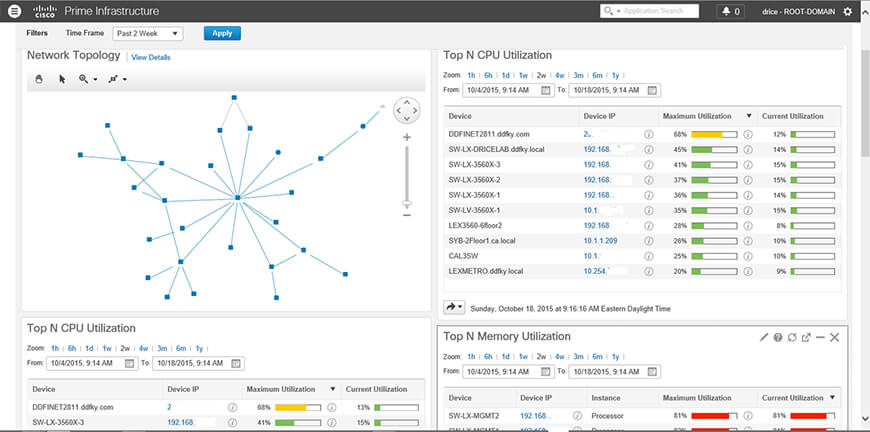
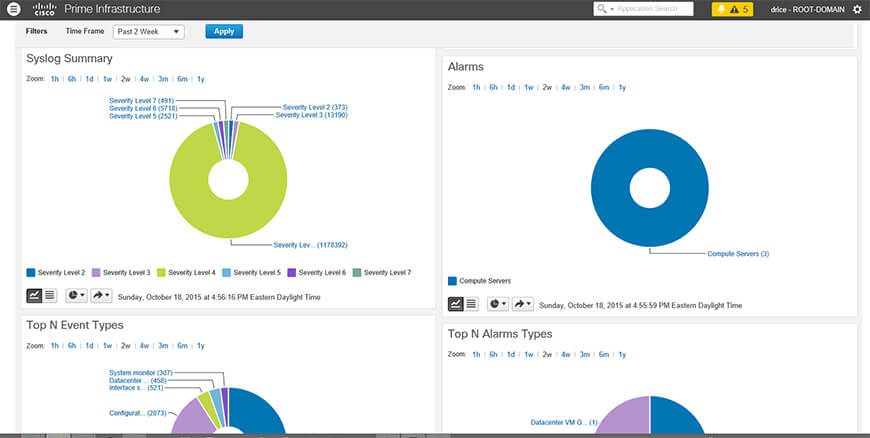
One of PI’s biggest strength’s is its ability to give you a lot of information in a small amount of real estate. Cisco crams in so much information that I found navigation to be the greatest learning curve of the whole software package. Cisco could probably do a better job of helping the newbie learn where everything is located.

Having spent a great deal of time learning where everything is located, the next thing I did was customize the home page to show the particular dashboards I wanted to see. Of course, front and center (well actually top left), I have the topology dashboard so I can see the immediate status of our internal network devices. But, I also have the dashboards for the top N CPU, RAM, TX and RX usage stats.

These dashboards can be customized and saved so that each time you come in to PI, you see only the information you want and in the format you want.

dashboards

Conclusion

Although I have barely scratched the surface on what Prime Infrastructure can do, I focused on some basic features which will be immediately useful to the first-time user. Prime Infrastructure provides an entire feature set around wireless network management, application performance (netflow) and integrations with other products such as the Cisco Network Analysis Module. Keep an eye out for future posts around some of the more advanced features of Cisco Prime Infrastructure 3.0.

For the next installation in this series, we will focus on Cisco Identity Services Engine software product. In doing so, we will explore some simple use cases and discuss how it integrates with Cisco Prime Infrastructure to provide a view of the network from wire to device and from user to application.

For more information or questions in the meantime, contact David Rice at drice@ddaftech.com or 859-425-7735.Cisco Prime Infrastructure Product Page

Cisco Prime Infrastructure 3.0 User Guide

Cisco Prime Infrastructure 3.0 Reference Guide

Filed Under: Managed IT & Infrastructure, Services, Technology Tagged With: Cisco, Cisco Prime Infrastructure 3.0, IT, IT administrator, Software, Technology

PAY INVOICE SUBMIT RFP
  • Services
    • Outsourced Accounting
    • Audit & Assurance
    • Tax
    • Consulting & Advisory
    • Technology & Cybersecurity
    • Family Office
    • Wealth Management
  • Industries
  • Company
  • Locations
  • Careers
  • Insights
  • Events
  • Contact Us
SUBSCRIBE TO INSIGHTS
email Dean Dorton - CPAs And Advisors On Email facebook Dean Dorton - CPAs And Advisors On Facebook twitter twitter linkedin Dean Dorton - CPAs And Advisors On LinkedIn youtube Dean Dorton - CPAs And Advisors On YouTube

The matters discussed on this website provide general information only. The information is neither tax nor legal advice. You should consult with a qualified professional advisor about your specific situation before undertaking any action.

© 2026 Dean Dorton Allen Ford, PLLC. All Rights Reserved

  • Privacy Policy
  • Terms Of Use
  • Accessibility