• Skip to primary navigation
  • Skip to main content
Dean Dorton – CPAs and Advisors
  • Services
        • Audit & Assurance
          • Audits, Reviews & Compilations
          • ESG Programs & Reporting
          • Internal Audit
          • International Financial Reporting
          • Lease Accounting Managed Services
          • Peer Review Services
          • SOC Reporting
        • Family Office
        • Consulting & Advisory
          • Business Valuation Services
          • Forensic Accounting
          • Litigation Support
          • Matrimonial Dissolution
          • Merger & Acquisition
          • SEC Services
          • Succession Planning
          • Transaction Advisory Services
          • Whistleblower Hotline
        • Outsourced Accounting
        • Private Wealth
        • Healthcare Consulting
          • Finance
          • Health Systems Operational Transformation
          • Medical Billing and Credentialing
          • Risk Management & Compliance
          • Strategy and Strategy Implementation
          • Technology & Data Analytics
        • Tax
          • Business Tax
          • Cost Segregation Studies
          • Credits and Incentives
          • Estates and Trusts
          • Individual Tax
          • International Tax
          • SEC Provision and Compliance
          • State and Local Tax
        • Technology & Cybersecurity
          • Accounting Software
          • Cybersecurity
            • Cybersecurity Assessments
            • Cybersecurity Scorecard Assessment
            • Security Awareness Training
            • Virtual Information Security Office
          • Data Analytics & AI
          • IT Audit & Compliance
            • Cybersecurity Maturity Model Certification (CMMC)
            • Data Privacy Laws
            • SOC Reporting
          • IT Infrastructure & Cloud Solutions
            • Automation
            • Backup and Disaster Recovery
            • Cloud Strategy
            • Data Center
            • Enterprise Network
            • Network Security
            • Phone and Video Conferencing
            • User Identity Management Solutions
            • Webex
          • Managed IT Services
  • Industries
        • Construction
        • Distilleries and Craft Breweries
        • Energy and Natural Resources
        • Equine
        • Financial Institutions
        • Government
        • Healthcare
        • Higher Education
        • Life Sciences
        • Manufacturing and Distribution
        • Nonprofit
        • Real Estate
  • Insights
    • Articles
    • Guides
    • Case Studies
  • Events
  • Company
        • News
        • Our Team
        • Experiences
        • Careers
          • College Students
          • Experienced Professionals
        • Locations
        • Lexington, KY

          250 West Main Street
          Suite 1400
          Lexington, KY 40507
          859-255-2341

        • Louisville, KY

          435 North Whittington Parkway
          Suite 400
          Louisville, KY 40222
          502-589-6050

        • Louisville, KY

          700 North Hurstbourne Parkway
          Suite 115
          Louisville, KY 40222
          502-589-6050

        • Ft. Wright, KY

          810 Wright’s Summit Parkway
          Suite 300
          Fort Wright, KY 41011
          859-331-3300

        • Cincinnati, OH

          312 Walnut Street
          Suite 3330
          Cincinnati, OH 45202
          859-331-3300

        • Blue Ash, OH

          9987 Carver Rd
          Suite 120
          Blue Ash, OH 45242
          513-891-5911

        • West Chester, OH

          9025 Centre Pointe Drive
          Suite 310
          West Chester, OH 45069
          513-985-6240

        • Indianapolis, IN

          5975 Castle Crk Pkwy Dr N
          Suite 400
          Indianapolis, IN 46250
          317-469-0169

        • Raleigh, NC

          4130 Parklake Avenue
          Suite 400
          Raleigh, NC 27612
          919-782-9265

  • Contact Us

Reporting

Article 09.21.2022 Dean Dorton

Environmental, Social and Governance (ESG) programs have become an important topic for entities of all types. Stakeholders at all levels including investors, employees, and customers want to invest, work, and buy from sustainable entities that are both environmentally and socially aware. ESG programs bring structure to these consumer demands and allow businesses to both improve and boast successes in these areas.

What makes ESG programs unique? They work in any industry. Certain industries like healthcare and higher education have already seen great success by being on the forefront of these programs.

All ESG programs are built around four main pillars:

When establishing an ESG program entities should first review overarching goals and core values of the business and explore how those core values are tied to the four pillars of ESG. To get started many entities will research examples of successful, well established programs outside of their place of business, but we encourage you to search your operations internally as well. You may be pleasantly surprised at what programs and initiatives are already in-place, working towards ESG specific goals. When trying to establish your first program it’s best practice to explore sustainability programs on public company websites to get additional ideas. In fact, the Sustainability Accounting Standards Board (SASB) has industry-specific ESG metrics that can assist with establishing your first set of goals.

Measurements around greenhouse gas emissions, diversity (including employee, board, and suppliers), and safety statistics are basic ESG metrics that will help you get started. It’s important to first establish baseline metrics and then work to set goals that will improve those metrics moving forward.

Keys to Success

Here are a few things that are sure to get you off to a successful start in ESG:

  1. Reinforce the entity’s mission – Mission alignment is critical when establishing or optimizing a new or existing ESG program. To gain buy-in from key parties within the organization, your program must align with the main values of the entity.
  2. Make ESG a priority in reporting – Allocating resources to measure and report on ESG will help you leverage statistically backed marketing for stakeholders. Numbers drive business, and by prioritizing key metrics you will have a baseline of information to motivate teams to reach goals. To begin, start with one metric for each pillar. Once your program matures, you can add additional and more details tracking metrics.
  3. Work with passion – Working towards environmental, social, and governmental goals can ignite the passions of your workforce. Keep your team involved and informed with your progress and you will see more impactful results.

Frameworks

As of now, most entities are not under required ESG mandates, in fact, entities have a lot of latitude in how and when they establish their plans. Due to the lack of regulation there are several reporting frameworks that currently exist, but there is belief that consolidation of reporting metrics and real regulations and requirements could be coming in the near future. In fact, on August 1, 2022, the IFRS Foundation completed a consolidation with Value Reporting Foundation as they move closer to comprehensive global sustainability disclosures for capital markets.

Accountability and Assurance

To date, most ESG programs have not been subject to third party assurance procedures. Without assurance validation the concept of “greenwashing” has emerged as entities use their ESG programs as a marketing vehicle to promote themselves without any regard for accountability. Embellishing numbers and tracking is unacceptable and could be subject to audit if new governmental requirements are established.

All of the value of an ESG program will be lost if the program is used without regard to integrity, further stressing the importance of establishing reliable tracking earlier in your program launch.

Bill Kohm, CPA, MBA| Assurance Director
bkohm@deandorton.com
859.425.7625
Filed Under: Energy & Natural Resources, Industries Tagged With: envirnment, Environmental Social and Governance, ESG, governance, Reporting, Social

Article 01.7.2022 Dean Dorton

Environmental, Social and Governance (ESG) has transformed the landscape for health systems over the past few years. Stakeholders have expanded their expectations beyond financial results. Healthcare facilities should be proactive and identify meaningful ESG metrics that will resonate with their stakeholders and employees, which will vary depending on your size, location, and more.

Human resource departments should play an active role in this endeavor as ESG should be used as a retention and recruitment tool. People want to work for institutions that have a sustainable future. Additionally, the purchasing department needs to be part of the ESG team due to the impact of the supply chain on ESG metrics. Your healthcare organization needs to ensure that your third parties share in your commitment to ESG to maximize the benefits as well. For example, you may choose to place product orders with other groups that also have ESG programs, versus those who do not.

Here are some ESG areas that healthcare facilities should consider measuring and reporting:

“Environmental” refers to the impact of the facility’s operations on the environment. This includes environmental factors such as energy use, waste management, and water conservation. By tracking and reporting on these metrics as part of their ESG strategy, healthcare facilities can identify opportunities to reduce their environmental impact, improve sustainability, and enhance their reputation among stakeholders.

Some of the key environmental metrics that healthcare facilities should consider measuring and reporting on to support their ESG initiatives include:

  • Greenhouse gas emissions
  • Water consumption
  • Recycling
  • Materials, including plastic use

The “S” in ESG stands for “Social” and refers to a company’s commitment to ethical and social responsibility. It includes areas such as employee welfare, community involvement, diversity and inclusion, and human rights.

In the healthcare sector, social responsibility is particularly important as it involves the care and well-being of patients and the impact healthcare organizations have on the communities they serve. By addressing social factors, healthcare facilities can enhance their reputation, improve employee retention and recruitment, and ultimately improve patient outcomes.

Below are some of the social factors that healthcare facilities can include within their ESG framework:

  • Safety
  • Community impact and integration
  • Diversity and inclusion
  • Investment policies

The “G” in ESG stands for “Governance” and refers to a company’s commitment to transparency, accountability, and ethical leadership. In the healthcare industry, governance is critical and is probably already a part of most organizations’ everyday monitoring. This includes the responsible management of resources and maintaining high standards of patient care in health services.

By addressing governance factors, healthcare facilities can strengthen their relationships with stakeholders, improve financial performance, and ensure regulatory compliance. Included within these governance factors are:

  • Supply chain management
  • Board diversity
  • Policies
  • Long-term strategy

Examples of ESG Principles at Work in Healthcare

Institutions have begun to update investment policies to divest from fossil fuels, divert funds to green initiatives and focus on investments that lean towards diversity measures.

Baptist Health South Florida has focused on sustainability. Their green initiatives include:

  • Green building practices
  • Recycling more than 20 tons of waste per month
  • Paperless purchases
  • Sustainability educational and training events
  • Community outreach to market the importance of sustainability activities

UnitedHealth Group’s Sustainability Report has the following social pillars:

  • Expanding access to care – 85% of members to receive preventive care services annually by 2030
  • Improving health care affordability – 55% of outpatient surgeries and radiology services will be delivered at high-quality, cost-efficient sites of care by 2030
  • Enhancing the health care experience – established a training program with the American Academy of Family Physicians to help family physicians change the culture of health care organizations and improve physician wellness using operational improvements and change management tactics. 200 family physicians will undergo training to lead change for improved clinical well-being.
  • Achieving better health outcomes – close 600 million gaps in care for members by the end of 2025
  • Advancing health equity including equity and diversity in the health workforce – actions include funding scholarship programs for students of color pursuing careers in healthcare, supporting STEM programs in high schools focused on girls and Black and Hispanic/Latino students and using innovation to help hard-to-reach communities receive needed care including improved access to telehealth, mobile medical units, home visits and school-based care programs.
  • Building healthier communities – committing funds to build new homes for seniors and families, all with connections to health and wellness services and social supports.

UnitedHealth Group has a variety of ESG metrics in 2020 including:

  • 6 million employee volunteer hours
  • 41% people of color (U.S. workforce)
  • 37% of female in top management positions
  • 627 diverse suppliers with average spend of $849,000 per year
  • 2 directors of color out of 10 directors
  • 6,709 metric tons of waste transferred
  • 19,647 MWh renewable energy use (5% of total energy consumption)

No matter what ESG direction you choose, you need to ensure that your ESG metrics align with your institution’s mission. Additionally, boards should hold management accountable to measuring ESG metrics accurately and for providing regular ESG reports to the board.

Wondering how to get started with ESG for your hospital, physician practice, or medical clinic? Contact us to learn more.

Sources: https://baptisthealth.net/non-indexed-content-folder/old/greening-our-future
https://www.unitedhealthgroup.com/content/sustainability/en.html

Adam Shewmaker, FHFMA | Healthcare Consulting Director
ashewmaker@ddafhealthcare.com
502.566.1054

Filed Under: Healthcare, Industries Tagged With: envirnment, Environmental Social and Governance, ESG, governance, Healthcare, Reporting, Social

Article 07.2.2021 Dean Dorton

As of the morning of July 1, 2021, the Health and Human Services (HHS) Provider Relief Fund (PRF) Reporting Portal is open. There are a few new resources of the portal that may help you through the Provider Relief Fund reporting process, which are also linked below. Further guidance was released to provide more detailed information on how to use the reporting portal.

Additional resources:

  • PRF Reporting User Guide
  • Portal FAQs
  • Portal Registration User Guide
  • Portal Worksheets (downloadable Excel workbook)  

Reporting Time Periods (Updates – June 2021)

Provider Relief Fund recipients are required to report in each Payment Received Period in which they received one or more payments exceeding, in the aggregate, $10,000, as indicated in the table. Reporting must be completed and submitted to Health Resources and Services Administration (HRSA) by the last date of the reporting time period. Provider Relief Fund recipients that do not report within the respective reporting time period are out of compliance with payment Terms and Conditions and funds may be subject to recoupment.

Payment Received Period (Payments Exceeding $10,000 in Aggregate Received) Reporting Time Period
Period 1 Payments received April 10, 2020 to June 30, 2020 July 1, 2021 to September 30, 2021
Period 2 Payments received July 1, 2020 to December 31, 2020 January 1, 2022 to March 31, 2022
Period 3 Payments received January 1, 2021 to June 30, 2021 July 1, 2022 to September 30, 2022
Period 4 Payments received July 1, 2021 to December 31, 2021 January 1, 2023 to March 31, 2023

LanceMann, CPA, CFE, CGMA 
Assurance Director
lmann@deandorton.com • 502.566.1005

Filed Under: COVID-19, COVID-19 Industries, Healthcare, Industries Tagged With: Finance, Healthcare, Provider Relief Fund, Provider Relief Fund Reporting, Reporting

Article 06.14.2021 Dean Dorton

On June 11, 2021, HHS issued a Press Release that announced the Provider Relief Fund (PRF) reporting portal will now be open on July 1, 2021. HHS also provided a new reporting matrix, which is included below. You’ll note that PRF distributions received subsequent to June 30, 2020, may be used during periods beyond the original June 30, 2021 deadline. HHS has also updated the Post Payment Reporting Requirements to address the use of SNF and Infection Control distributions as well as the FAQs related to the Portal.

This guidance could add complexity to your reporting process given the newly created reporting periods based on when payments were received. We will continue to analyze this guidance.

Period of Availability and Reporting Time Periods

The period of availability of funds and reporting time period applies to all past and future PRF payments.

Provider Relief Fund recipients must only use payments for eligible expenses, including services rendered, and lost revenues attributable to coronavirus before the deadline that corresponds to the relevant Payment Received Period. These deadlines are based on the date the payments are received, as indicated in the table below – all funds will be available for at least 12 months and a maximum of 18 months. The payment is considered received on the deposit date for automated clearing house (ACH) payments or the check cashed date. Providers must follow their basis of accounting (e.g., cash, accrual, or modified accrual) to determine expenses.

Deadlines for Use of Funds

Payment Received Period Deadline to Use Funds
Period 1 Payments received April 10, 2020 to June 30, 2020 June 30, 2021
Period 2 Payments received July 1, 2020 to December 31, 2020 December 31, 2021
Period 3 Payments received January 1, 2021 to June 30, 2021 June 30, 2022
Period 4 Payments received July 1, 2021 to December 31, 2021 December 31, 2022

Reporting Time Periods (Updates June 2021)

Provider Relief Fund recipients are required to report in each Payment Received Period in which they received one or more payments exceeding, in the aggregate, $10,000, as indicated in the table below. Reporting must be completed and submitted to HRSA by the last date of the reporting time period. Provider Relief Fund recipients that do not report within the respective reporting time period are out of compliance with payment Terms and Conditions and funds may be subject to recoupment.

Payment Received Period
(Payments Exceeding $10,000 in Aggregate Received)
Reporting Time Period
Period 1 Payments received April 10, 2020 to June 30, 2020 July 1, 2021 to September 30, 2021
Period 2 Payments received July 1, 2020 to December 31, 2020 January 1, 2022 to March 31, 2022
Period 3 Payments received January 1, 2021 to June 30, 2021 July 1, 2022 to September 30, 2022
Period 4 Payments received July 1, 2021 to December 31, 2021 January 1, 2023 to March 31, 2023

Dean Dorton will continue to monitor the PRF frequently asked questions and the reporting portal and will send future updates as they are released.

LanceMann, CPA, CFE, CGMA 
Assurance Director
lmann@deandorton.com • 502.566.1005

Filed Under: COVID-19, COVID-19 Industries, Healthcare, Industries Tagged With: Finance, Healthcare, medical reporting, Provider Relief Funds, Reporting

Article 10.20.2020 Dean Dorton

Nonprofit finance leaders need to assume a more strategic role in organizational intelligence and planning. To do that, you need better visibility into both financial and operational metrics, so you can make better decisions.

In the Secrets to Gaining Visibility into Nonprofit Financials eBook, we explore the challenges of nonprofit financial reporting, reveal the secrets to gaining the visibility you need to develop winning strategies to advance your mission and discuss how your peers are using the cloud to deliver on growth strategies.

Download the eBook

Alisa Brill, CFO, Paws Chicago

Before, everyone was in the dark, but with Sage Intacct it’s a whole new world.  Department managers can see precisely how they are doing with the click of a button… As a result, people are controlling their costs proactively, the organization’s overall expenses are down, we’re sticking to our budget, and our spend is under control.

If you’d like to explore how to better control costs and keep projects on budget, contact us!

Filed Under: Accounting Software, Industries, Nonprofit & Government, Sage Intacct, Services, Technology Tagged With: Finance, metrics, Nonprofit finance, Reporting

Article 06.16.2020 Dean Dorton

Sage Intacct users: have you ever needed to present two different sets of numbers depending on the audience? No, we are not advocating for anything misleading or nefarious. Think about the different stakeholders that you need to present financial reporting to. You’ve got your auditors, who want to see your GAAP financial statements. You’ve got your tax professionals, who are interested in tax basis. You have department managers, who are in need of detailed budget versus actual reporting. The business owners probably want to see a host of different reports including cash results, profitability forecasts, and maybe even a view of what your company has committed to spending but not actually spent yet. Maybe you, as the accounting and finance professional, want to create “what if” scenarios or to be able to show a report with the before and after the impact of a transaction. If you have these kinds of needs right now (in today’s environment, who doesn’t?), you may find yourself back to your trusty old friends Excel or Google Sheets. There is a better way that comes at no additional cost – Sage Intacct User-Defined Books.

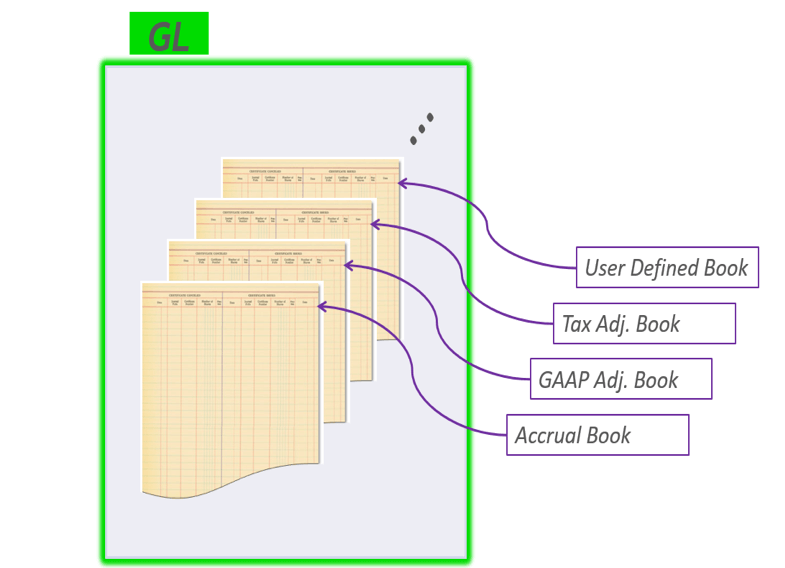
Sage Intacct, as an accounting system, has unique architecture. It is built on a “multi-book” concept. If you have used Dynamic Allocations, Contracts, or Global Consolidations, you have already worked with the “multi-book” architecture and you already have experience with User-Defined Books. The below graphic illustrates this concept:

general ledger user-defined books

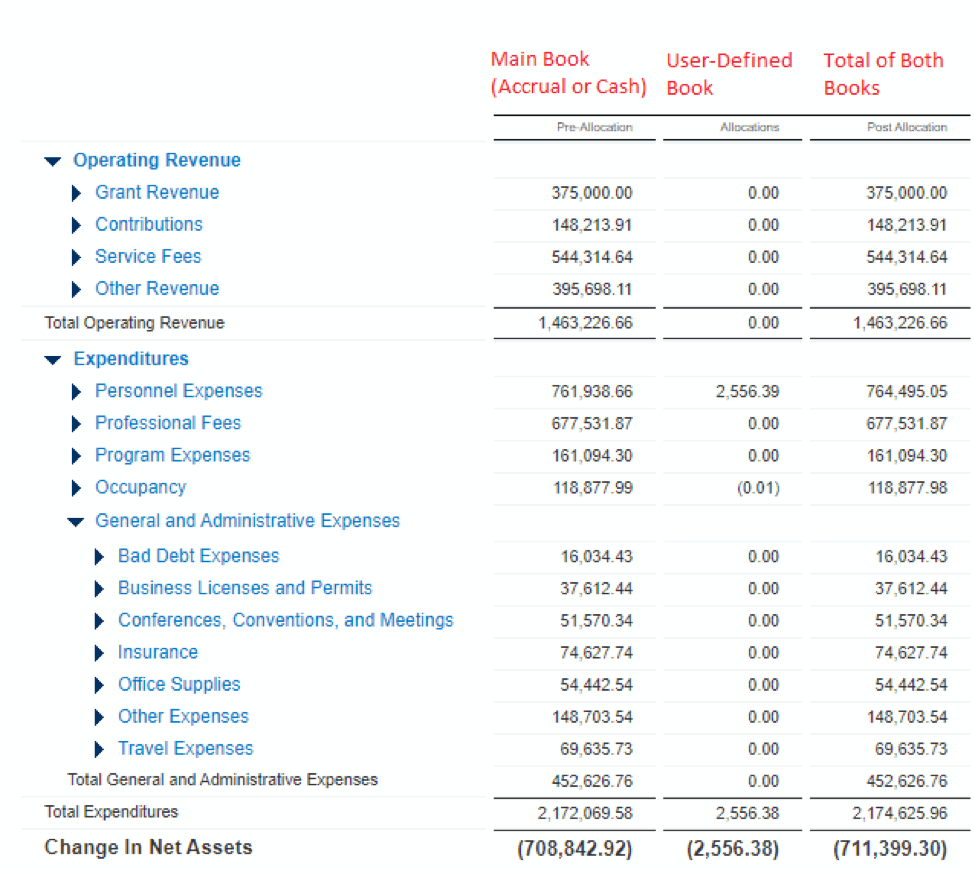
The power of this concept comes into play when you use what we like to refer to as “book stacking.” When you stack one book on top of the next, your result is the cumulative effect of entries within ALL the books. In Sage Intacct, you have the flexibility in financial reports to display all books stacked on top of each other or to display your Accrual (or Cash) book and your user-defined book(s) in separate columns. This affords you an incredible amount of flexibility in creating financial statement presentations for different audiences. Here’s an example of a before and after the allocation statement: you can do the same thing with before and after tax, with and without commitments, hypothetical transactions, etc:

The best part about this for accounting and finance professionals is that everything lives inside your Sage Intacct environment. When you are starting from your system of record, your constant risk of an offline schedule being out of date vanishes. User-Defined books are a tremendous opportunity for efficiency, and in many cases the limit of what you can do is only your creativity! Dean Dorton has a wealth of experience in using and implementing this feature for clients across all industries.

Filed Under: Accounting Software, Sage Intacct, Services, Technology Tagged With: Reporting, Sage Intacct, user-defined books

  • Page 1
  • Page 2
  • Page 3
  • Page 4
  • Go to Next Page »
PAY INVOICE SUBMIT RFP
  • Services
    • Outsourced Accounting
    • Audit & Assurance
    • Tax
    • Consulting & Advisory
    • Technology & Cybersecurity
    • Family Office
    • Wealth Management
  • Industries
  • Company
  • Locations
  • Careers
  • Insights
  • Events
  • Contact Us
SUBSCRIBE TO INSIGHTS
email Dean Dorton - CPAs And Advisors On Email facebook Dean Dorton - CPAs And Advisors On Facebook twitter twitter linkedin Dean Dorton - CPAs And Advisors On LinkedIn youtube Dean Dorton - CPAs And Advisors On YouTube

The matters discussed on this website provide general information only. The information is neither tax nor legal advice. You should consult with a qualified professional advisor about your specific situation before undertaking any action.

© 2026 Dean Dorton Allen Ford, PLLC. All Rights Reserved

  • Privacy Policy
  • Terms Of Use
  • Accessibility