• Skip to primary navigation
  • Skip to main content
Dean Dorton – CPAs and Advisors
  • Services
        • Audit & Assurance
          • Audits, Reviews & Compilations
          • ESG Programs & Reporting
          • Internal Audit
          • International Financial Reporting
          • Lease Accounting Managed Services
          • Peer Review Services
          • SOC Reporting
        • Family Office
        • Consulting & Advisory
          • Business Valuation Services
          • Forensic Accounting
          • Fractional CFO
          • Litigation Support
          • Matrimonial Dissolution
          • Merger & Acquisition
          • SEC Services
          • Succession Planning
          • Transaction Advisory Services
          • Whistleblower Hotline
        • Outsourced Accounting
        • Private Wealth
        • Healthcare Consulting
          • Finance
          • Health Systems Operational Transformation
          • Medical Billing and Credentialing
          • Risk Management & Compliance
          • Strategic Growth for Private Practices
          • Strategy and Strategy Implementation
          • Technology & Data Analytics
        • Tax
          • Business Tax
          • Cost Segregation Studies
          • Credits and Incentives
          • Estates and Trusts
          • Individual Tax
          • International Tax
          • SEC Provision and Compliance
          • State and Local Tax
        • Technology & Cybersecurity
          • Accounting Software
          • Cybersecurity
            • Cybersecurity Assessments
            • Cybersecurity Scorecard Assessment
            • Security Awareness Training
            • Virtual Information Security Office
          • Data Analytics & AI
          • IT Audit & Compliance
            • Cybersecurity Maturity Model Certification (CMMC)
            • Data Privacy Laws
            • SOC Reporting
          • IT Infrastructure & Cloud Solutions
            • Automation
            • Backup and Disaster Recovery
            • Cloud Strategy
            • Data Center
            • Enterprise Network
            • Network Security
            • Phone and Video Conferencing
            • User Identity Management Solutions
            • Webex
          • Managed IT Services
  • Industries
        • Construction
        • Distilleries and Craft Breweries
        • Energy and Natural Resources
        • Equine
        • Financial Institutions
        • Government
        • Healthcare
        • Higher Education
        • Life Sciences
        • Manufacturing and Distribution
        • Nonprofit
        • Real Estate
  • Insights
    • Articles
    • Guides
    • Case Studies
  • Events
  • Company
        • News
        • Our Team
        • Experiences
        • Careers
          • College Students
          • Experienced Professionals
        • Locations
        • Lexington, KY

          250 West Main Street
          Suite 1400
          Lexington, KY 40507
          859-255-2341

        • Louisville, KY

          435 North Whittington Parkway
          Suite 400
          Louisville, KY 40222
          502-589-6050

        • Louisville, KY

          700 North Hurstbourne Parkway
          Suite 115
          Louisville, KY 40222
          502-589-6050

        • Ft. Wright, KY

          810 Wright’s Summit Parkway
          Suite 300
          Fort Wright, KY 41011
          859-331-3300

        • Cincinnati, OH

          312 Walnut Street
          Suite 3330
          Cincinnati, OH 45202
          859-331-3300

        • Blue Ash, OH

          9987 Carver Rd
          Suite 120
          Blue Ash, OH 45242
          513-891-5911

        • West Chester, OH

          9025 Centre Pointe Drive
          Suite 310
          West Chester, OH 45069
          513-985-6240

        • Indianapolis, IN

          5975 Castle Crk Pkwy Dr N
          Suite 400
          Indianapolis, IN 46250
          317-469-0169

        • Raleigh, NC

          4130 Parklake Avenue
          Suite 400
          Raleigh, NC 27612
          919-782-9265

  • Contact Us

Microsoft Dynamics GP

Article 03.19.2018 Dean Dorton

Microsoft Dynamics GP users may think they are doing fine with their current system, but with another software update around the corner, now is the time to weigh the risks involved in hanging onto outdated software.

So what might the future look like if you stay with an on-premises financial management system and what do the potential risks mean for your growing company?

Time and Expense-Related Risk

Accounting runs a lot of reports and as your company grows, so does reporting and its complexity.  With GP, reports need to be cleaned up, then emailed, and that takes time too. Growing companies face the risk of stagnant growth because with outdated on-premises systems because extra reporting tasks take time away from other growth tasks.  

Resource-Related Risk

While Dynamics GP has Microsoft’s Management Reporter for reporting functions, that add-on is no longer being modified for growth – and hasn’t been since 2016, outside of patch updates. Most important, however, it is difficult to use. Because Dynamics GP requires add-ons for custom fields, multi-entity processes, and many other reporting needs, users spend more money to do necessary reporting jobs than they would with a strong cloud-based system.

Accuracy-Related Risk

Any native reporting direct from GP won’t import directly into Excel, so these reports require re-entry, manual modifying leaving room for growing error margins. Companies that hang onto Microsoft Dynamics GP with manual data management.

Sage Intacct, a best-in-class cloud financial management solution, eliminates the risks that come with outdated and on-premises-based systems.

A True Cloud System:

While Dynamics GP offers cloud hosting, updates and many processes still happen in-house.

Sage Intacct offers a true cloud experience which means:

  • Systems update automatically for every entity, location and computer. No extra effort on your part.
  • Users can access company data from wherever they work.
  • Data is always current, which means accurate reports and inventories, client details and projects. No waiting or manual re-entries.

Streamlined reporting:

  • Sage Intacct Dashboards allow users to customize their unique metrics views, for fast decision-making and strategy.
  • Dimensions, use tags to create a detailed chart of accounts and simplify your accounting.
  • Over 120 reports drill back to the originating transaction for deep examination.
  • Reports transfer directly into excel. Users quickly run and deliver reports in minutes with up-to-date data, without spending countless hours cleaning up a CSV or tab-delimited report as with Microsoft Dynamics GP.

Growth-focused Design:

  • Unlike Dynamics GP which requires a consultant or add-on to create custom fields, Sage Intacct offers custom fields already built into the software so users make modifications without consultants or extra expense.  
  • Sage Intacct system integrates with many other cloud software solutions work seamlessly behind the scenes to reduce or even eliminate manual entry and delayed updates.

Rather than an increased workload just to hang onto static, inflexible, on-premises system, consider a better way.

Contact us. We can help your teams work faster and smarter, to take your business further.
Filed Under: Accounting Software, Microsoft Dynamics GP, Sage Intacct, Services Tagged With: Cloud Accounting, dynamics gp

Article 03.9.2018 Dean Dorton

Written by Billie Grigg, Senior Dynamics GP Consultant

I’m going to introduce you to one of my favorite Dynamics GP tools, the Reconcile to GL tool.  This powerful tool can save you lots of time and headaches when it comes to reconciling your A/R, A/P or cash sub-ledger to your General Ledger.  The Reconcile to GL tool will show you which transactions are unmatched, potentially matched and matched.

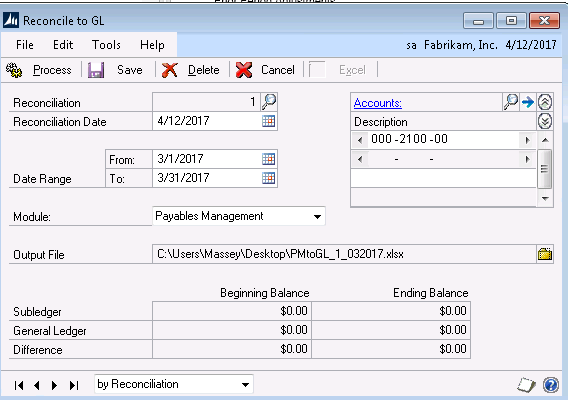
The Reconcile to GL tool is found by going to Financial>Routines>Financial>Reconcile to GL.  The first time you use this tool you will have to add it to your GL account(s) that you are reconciling to, the date range, the module, and the output file location.   

In this example, I’m reconciling my accounts payable from 3/1/2017-3/31/2017 using my AP GL account 000-2100-00.  I have selected the Payable Management module and have selected where I want my output file to go.

Figure 1

gp tips

Once we have filled out the information shown in the screenshot above, we can now hit

Process in the upper left-hand corner. Once we select Process, three things will happen:

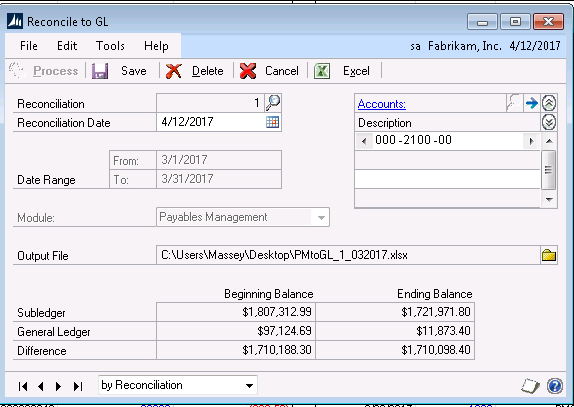
  • The bottom part of the Reconcile to GL window will be populated with our Beginning and Ending Balances (see figure 2)
  • The file will be saved to the output location we selected
  • The file will open in Excel.  

Figure 2

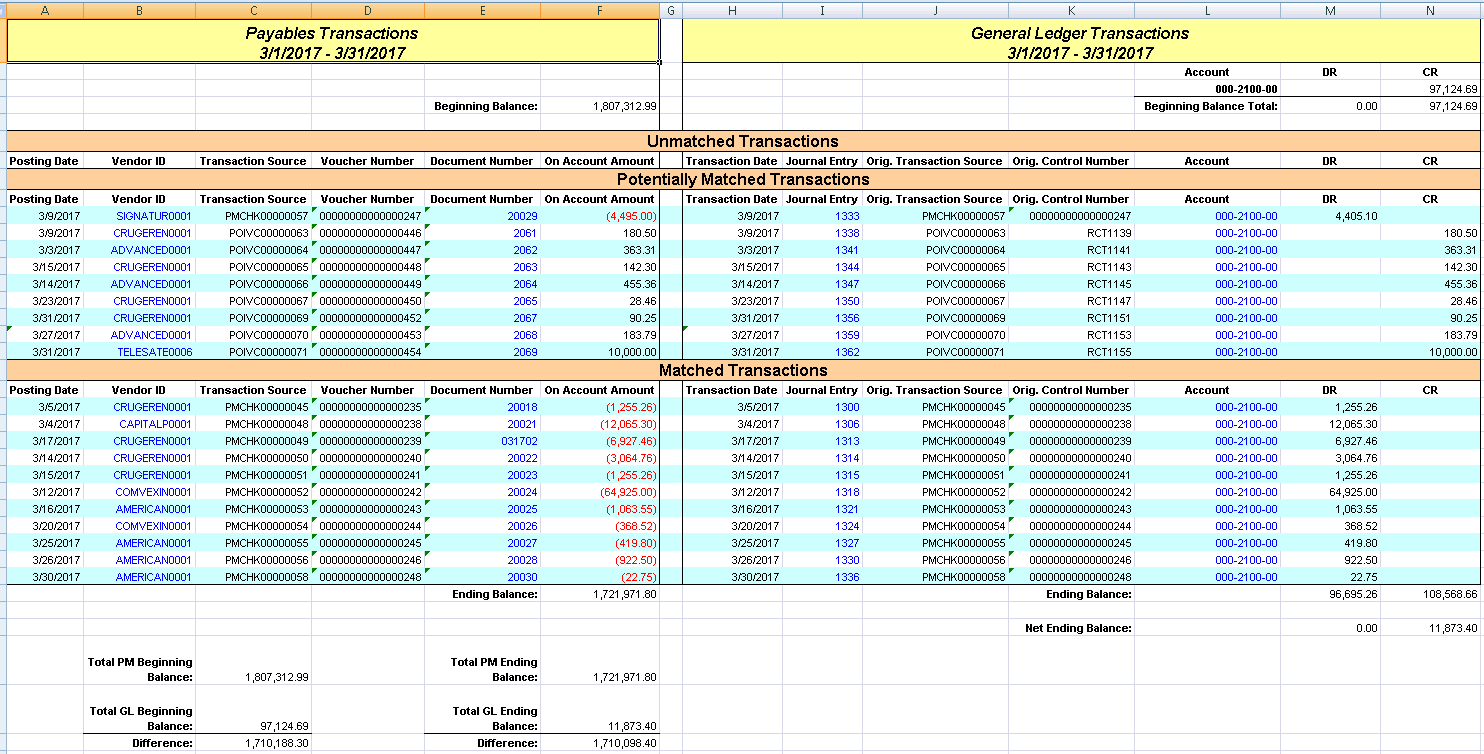
Output File

The Output file is divided into three sections:  Unmatached, Potentially Matched and Matched. For reconciliation purposes, you will want to focus on the unmatched and potentially matched transactions.  

Unmatched Transactions are transactions that are in the GL but not in purchasing or vice versa.  The potentially matched transactions often contain transactions that match, but because of items like discounts that weren’t coded to the Discount GL properly, the matched transactions mean that everything matches between the ledger and sub-ledgers.

The output file contains hyperlinks in blue font that allow you to drill back into GP.  In the example below, you can see that we could drill back to a vendor, a vendor document, a journal entry or a GL Account.  

Troubleshooting tips:

  1. Have you included all the GL accounts associated with this subledger?
  2. Are there any unposted batches?
  3. Check your posting setup for the module and confirm that both check marks are in for Post to and Post thru.
  4. Check your dates and make sure something wasn’t posted to the wrong period.
  5. Check your voids to see if something was voided in a period other than when it was originally posted.

Filed Under: Accounting Software, Microsoft Dynamics GP, Services Tagged With: dynamics gp, General Ledger, how to guide, Microsoft Dynamics, reconciliation

Article 03.1.2018 Dean Dorton

Underwhelming. Pressure. Security.

Those were the three words that headline predictions for Microsoft Dynamics GP for the year 2018. Certainly not words that you might expect to hear from a long-time proponent of Dynamics GP, but maybe these are the times we live in now.  This post and more include the most prolific proponents of Dynamics GP questioning Microsoft’s direction and potential prospects evaluating multiple solutions.

The first 40 days of 2018 have actually given us three major, interesting Dynamics GP news items.  For months now, many partners and insiders have wondered what effect Dynamics 365 would have on the existing product bases, including Dynamics GP and SL.  Founded or unfounded, those fears have left doubt in some people’s minds at a time when the cloud is picking up steam for accounting and finance professionals.  More and more end users are asking for cloud solutions, so they can focus on their business, not their servers.  Could Microsoft be heading in that direction as well?

Public-facing champion gone

First, let’s examine the latest news item, the termination of Pam Misialek. Pam was the Product Marketing Manager for Dynamics GP but her employment was terminated by Microsoft on January 21, 2018. Her responsibilities will be absorbed by Gordon Macdonald, the current Marketing Manager for all of Dynamics.  Layoffs happen all the time, but in one single move, Microsoft has eliminated the single biggest, public-facing champion for Microsoft Dynamics GP and put the job in the hands of a person already managing other products.

Product development behind the curve

Second, consider that – as Mariano Gomez exposed – Microsoft Dynamics GP is still dependent on TLS 1.0.  TLS 1.0 is a technology that has been mandated by PCI compliance authorities to be deprecated in favor of newer versions. To be fair, Microsoft has now stated that they are working on a fix but won’t commit to a timeline other than by June 30, 2018 – the mandated deadline.  Even if they make the fix in time for the PCI mandated deadline (already delayed two years), what does it say about product development that the ERP system has not already met the standard?

Only non-accounting features generating buzz

And last, but not least, the blog post from early 2018 in which Marc Polino lamented on the underwhelming feature set of Dynamics GP 2018.  Even msdynamicsworld.com editor, Jason Gumpert, noted reaction from many partners is good, but that it seems more iterative than anything else.  Only the non-accounting features like Azure, Power BI and Workflow are generating buzz. It’s also relevant to note that Polino predicts the pressure around Dynamics 365 will shift from customers to partners by offering partners incentives to get customers to transition.  But, how good is the transition?  Time will tell.

Impact of change

A new year typically brings new possibilities, but for Dynamics GP, it only seems to bring questions.  How will product direction change with the loss of its greatest public champion?  Will other issues like TLS 1.0 that have yet to be uncovered be exposed? And, will predictions ring true to the extent that the real buzz around Dynamics GP is not Dynamics GP at all, but other products that make up for GP shortcomings?  Only time will tell.

You have a lot to consider

You might be concerned about what all of this means for you. If you are interested in talking to us about your instance of Dynamics GP we’d be happy to help you assess the situation.  We can help itemize the risks and benefits of solution options for you.  If current developments have you more strongly considering the cloud, we’d especially recommend a consultation.  We have helped many companies move from Dynamics GP to cloud-based, AICPA-endorsed Sage Intacct.  Don’t hesitate to contact us: we’ll be happy to assess your situation for free.

Need Some More Convincing?

Check out our free white paper “9 Reasons Why Sage Intacct Beats Dynamics GP” to see why a cloud-based ERP software might be the best solution for the future of your business.

get the whitepaper

Filed Under: Accounting Software, Microsoft Dynamics GP, Sage Intacct, Services Tagged With: Accounting Software, cloud solutions, dynamics gp, Sage Intacct, TLS 1.0

Article 02.26.2018 Dean Dorton

At Massey Consulting, we pride ourselves in being able to provide our customers with solutions that improve their business and scale their growth. The products and solutions that we offer range from human capital management, time and expense, to budgeting and forecasting. The invaluable aspect about our solutions is that there is something for every type of business, no matter the size, industry, or budget.

We’d like to shine the spotlight on one of our top industry solutions for budgeting, forecasting and analyzing financials- Adaptive Insights. 

About Adaptive Insights

Adaptive Insights is the worldwide leader in cloud-based business analytics solutions for companies of all sizes. The company’s software as a service (SaaS) platform allows finance and management teams to work together to plan, monitor, report on, and analyze financial and operational performance.

With capabilities for budgeting, forecasting, reporting, consolidation, dashboards, and business intelligence, Adaptive Insights enables finance, sales, and other business leaders to make better, faster, more collaborative decisions that drive a true competitive advantage.

Adaptive Insights is used by over 1,700 organizations worldwide, from mid-sized companies and nonprofits to large corporations, and is the only provider of a cloud business analytics solution that gives you a 360-degree view of your organization’s performance- past, present, and future.

Recent Accomplishments

In December 2017, Adaptive Insights announced its achievement of two significant $100 million dollar milestones.  The company has crossed the $100 million revenue threshold, for the trailing 12 months, in addition to having $100 million in annual recurring subscriptions under contract. These triumphs are two highly recognized indicators of scale for successful SaaS companies.

“Massey Consulting recognizes the significant achievements that Adaptive Insights has accomplished recently and we are proud to call ourselves a partner. The relationship that we have had with them over this past year has been a phenomenal one, full of growth and strong collaboration,” said Philip Massey, President of Massey Consulting. “We look forward to expanding our clientele base with Adaptive Insights and working hard to continuously attain success through our partnership.

Some information above is from Adaptive Insights. To read their full press release, click HERE.

Filed Under: Accounting Software, Biotechnology, Franchises, Industries, Industry Solutions, Microsoft Dynamics 365, Microsoft Dynamics GP, Professional Services, SaaS, Sage Intacct, Services Tagged With: Adaptive Insights, budgeting and forecast, industry solution, Partner Spotlight

Article 02.16.2018 Dean Dorton

Repost from Avalara  

2017 was a big year for sales and use tax, and 2018 promises to be even bigger. States will likely continue to creatively redefine physical presence nexus, impose use tax reporting requirements, and tax third-party (marketplace) sales. They’ll almost certainly have to adjust their sales tax laws if Congress succeeds in enacting federal tax reform. And 2018 could be the year the Supreme Court of the United States reconsiders Quill Corp. v. North Dakota, 504 U.S. 298 (1992), the seminal ruling that prohibits states from taxing remote businesses without an in-state presence.

While we can’t tell the future, we can anticipate some of the trends sales and use tax will see in 2018. Read on to learn more.

State efforts to tax marketplace sales

Collect tax or comply with use tax reporting requirements

Although Amazon now collects tax in all states with a sales tax, it only does so on its own sales; sales by its marketplace sellers go untaxed unless the seller specifically asks (and pays) Amazon to collect it. That changed in 2018 — at least in one state.

Starting Jan. 1, Amazon started to collect tax on all of its Washington state sales, marketplace transactions included. The e-commerce giant is complying with Washington state’s new marketplace fairness law, which requires it to either collect the tax or comply with new use tax reporting requirements for non-collecting retailers. Why Amazon has chosen to comply with this law is unclear, though Washington is its home state.

Minnesota, Pennsylvania, and Rhode Island have enacted similar laws. Although Minnesota won’t require collection on these sales until the middle of 2019, Pennsylvania expects marketplace facilitators to register and collect by March 1, 2018, and the Rhode Island law took effect last August. It’s unclear how many businesses are complying with it, or how the state plans to enforce it in the coming months.

These states aren’t going after marketplace facilitators only. All hold the marketplace seller liable if the facilitator doesn’t collect and remit tax on its behalf. They also impose collection or use tax reporting requirements on certain referrers.

Since Amazon is complying with Washington’s law, there’s a good chance we’ll see more of these laws in 2018. Keep an eye on New York, North Carolina, and Texas, three states that considered taxing marketplace facilitators 2017.

Identify your third-party sellers

Massachusetts and Connecticut are taking a different tactic. They’ve asked Amazon to identify all marketplace sellers with inventory in their states.

Last spring, Connecticut Revenue Services Commissioner Kevin B. Sullivan told Bloomberg BNA that he expects Amazon to comply with the state’s request. If it has, Connecticut is keeping quiet about it. As far as we know, the online behemoth hasn’t complied with Massachusetts’ request: It may be in private discussions with the state, or it may plan to fight the Massachusetts Superior Court’s order to comply.

A legal battle could drag on for much of 2018 in Massachusetts. On the other hand, the company could work out a deal with one or both states. Stay tuned for more news.

Here’s looking at you, seller

Virginia hasn’t asked Amazon to identify its third-party sellers. However, it does hold marketplace sellers liable for sales tax if they keep inventory in Virginia. States will be watching to see if Virginia actually brings in the more than $20 million it expects to get from this in the 2018 fiscal year. Could it be that easy to get remote sales tax revenue?

And as of Dec. 1, 2017, Mississippi is holding certain remote vendors who “purposefully or systematically” exploit the Mississippi market liable for tax on their sales. If it succeeds in getting remote vendors to comply, other states may enact similar legislation in 2018.

Just give us the money

South Carolina has taken still another stance. In 2017, it handed Amazon a bill for millions in uncollected tax on its marketplace sales, and that’s just for the first quarter of 2016. The state wants Amazon to collect tax and place it in trust until this issue can be resolved, which could happen when the case goes to trial in November 2018.

If South Carolina wins, expect other states to follow its lead.

Hungry for sales tax

If not, Connecticut, Massachusetts, Ohio, and Rhode Island have a plan. They all maintain that out-of-state internet companies establish a physical presence in the state when they place software or web cookies on in-state devices, like computers, phones, and tablets. While this might not impact catalog sellers that don’t advertise online, it will surely affect online sellers.

It will be interesting to see how these laws play out in the coming year. Rhode Island’s policy took effect last August, Massachusetts’ policy on Oct. 1, 2017. Ohio’s new law took effect Jan. 1, 2018, and Connecticut will release guidelines in early 2018.

The sneaky solution

Tired of waiting for Godot, some states have come up with a creative, if sneaky, solution. They’re imposing use tax reporting and notification requirements on non-collecting vendors, which require these vendors to inform all potential customers that they don’t collect sales tax and the customer may have to remit use tax directly to the state. Non-collecting vendors also have to send all customers an annual report detailing the total amount of their purchases that year, at a minimum, and send states annual reports of the total amount of customer purchases.

This is a way to pressure non-collecting vendors to collect without enacting litigious remote sales tax laws — the lengthy legal battle over use tax reporting has already come and gone. If the first states to enact these (Colorado, Vermont) see an uptick in sales tax collections, other states are likely to consider similar requirements in 2018.

The ongoing battle to kill Quill

Let the Supreme Court decide

The slow-burning battle to kill Quill is likely to heat up this year. South Dakota has petitioned the Supreme Court of the United States to hear a case involving its remote seller compliance law, which was created specifically to challenge the physical presence precedent upheld by Quill. If the court takes the case, all states will be watching. If it abrogates Quill, states will have a clearer path to tax sales by remote vendors. If the court doesn’t take the case, states will aggressively enact the preceding concepts.

Let Congress decide

Many states are hoping the court will intervene because Congress hasn’t, despite repeated calls for it to do so. Yet Congressman Bob Goodlatte, Chairman of the House Judiciary Committee, recently asked the court to not “give up on Congress.” He says his committee “has been working diligently and assiduously” to solve the problem of untaxed remote sales and urges the court to let Congress finish what it’s started.

Does this mean we can expect to see more congressional action on this in 2018? Time will tell.

Federal tax reform fallout

Until we know exactly what the final plan is, there’s no knowing exactly how state sales and use tax will be impacted by federal tax reform. However, there is guaranteed to be fallout. If Congress succeeds in pushing it through as quickly as it hopes, states will be scrambling to understand and react to it in 2018.

Everything else

The above are some of the biggest issues facing sales tax in 2018, but they’re far from the only changes.

Taxing sin, exempting essentials

State and local governments are still grappling with how to tax specific products: those that aren’t all that good for us (i.e., candy and soda), and those some of us absolutely need (i.e., diapers, tampons).

Arkansas raised the sales tax rate on both candy and soda Jan. 1, the same day new taxes on sweetened beverages took effect in San Francisco and Seattle. And a group in Oregon is looking to put a sugar-sweetened tax to voters sometime in 2018. On the other hand, the Cook County soda tax was recently repealed, and a Michigan lawmaker is looking to prohibit local governments from imposing any sort of tax or fee on the manufacture, distribution, or retail sale of food.

Like Wisconsin, the Florida legislature will consider a sales tax exemption for diapers and incontinent products in 2018. They’ll likely be joined by several other states, including California and Texas.

Already on the calendar is an exemption for feminine hygiene products in Florida (effective Jan. 1), and an exemption for both diapers and feminine hygiene products in Connecticut (as of July 1, 2018).

Taxing … wheels?

On Jan. 1, sales-tax-free Oregon began to tax sales of bikes and vehicles. Be warned, if it has wheels, it could be taxed.

Oregon isn’t the only state getting creative with vehicle taxes. Fuel-efficient cars are better for the environment, but they take a bite out of the gas tax revenue cities states rely on to fund roads. California, Utah, and Seattle are all starting or considering pilot projects to tax miles driven rather than fuel. Expect to see more of this in 2018.

Rate changes

There will be a plethora of sales and use tax rate changes in 2018, some of which have already been announced. And watch out for department of revenue rulings, which remind us just how complicated sales tax can be.

There is sure to be more sales and use tax news in 2018, but one of the most entertaining aspects of tax (if it can be said to be entertaining), is that we never know what we’re going to get

Filed Under: Accounting Software, Industry Solutions, Microsoft Dynamics 365, Microsoft Dynamics GP, Sage Intacct, Services Tagged With: 2018 sales tax, Avalara, avatax, Intacct and AvaTax

Article 02.14.2018 Dean Dorton

One thing we know – along with accounting, is that great companies stay great by putting their customers first. This is on our list of top success priorities, and it’s a big part of what drives us to do what we do, and how we do it.

By putting our customers first, we learn all about their unique needs. This helps us figure out what products and services will offer the most help for them now, and in the future.

Our goal is to build close relationships with our customers, and stick with them as they grow, to see their company succeed every step of the way. That means we need to offer products that are a great solution for our customers now, and as much as in the future.

We’re Listening

Sure, we are “numbers” people – it’s what we do.  It’s the reason we can expertly help growing businesses without them missing a beat – or a winning goal like we did with the Carolina Hurricanes. But we’re also really good at putting our listening ears on – and leaving them on.

Staying in tune with our customers matters because it means we can offer custom solutions for their unique issues. We’ll help find solutions that streamline financial processes that can scale, to handle new growth challenges in the future.

Staying in tune with customers helps us create solutions that pave the road to their future success.  That’s how we developed our own unique integration product, MConnect, to make our customers’ software solution integrations even better.

We Deliver Long-Range Solutions

We put our customers first by offering a range of products and options that meet their unique needs.

When we met up with Legacy Healthcare, they had trouble moving beyond their current software arrangement. With multiple locations and services, they were building up to 300 different reports a month.  They needed a solution to simplify their complex reporting needs, while also offering flexibility to scale with their rapid growth.

Our financial management expertise comes from working with many other multi-location businesses with growth challenges. By knowing the industry-specific issues, we could show Legacy how Sage Intacct – a best-in-class financial management solution, simplifies and automates their complex reporting setup.

Sage Intacct’s cloud-based solutions boost accuracy and offer the flexibility to streamline month-end closings, while also breathing life into your unique success metrics.

Jay Huffman, Legacy CFO, talks about his experience with us:

“Upon taking my position at Legacy…I had a lunch with Philip Massey and Jim Stubanas… I felt completely at ease with the consulting firm choice afterward and looked to them for advice on moving to a new ERP system.”

Whether you’re a change-making organization like UAB Educational Foundation, or a franchise managing complex reporting with multiple locations, we want to know you!

Let’s connect! We will show you the love by tuning into your company’s unique needs to help drive productivity, boost accuracy, and streamline systems to fit your growing business.

Filed Under: Accounting Software, Industry Solutions, mConnect, Microsoft Dynamics GP, Sage Intacct, Services Tagged With: accounting solutions, Cloud Accounting, customers, ERP software, Massey Consulting, products and services, Sage Intacct, solutions, success stories

  • « Go to Previous Page
  • Page 1
  • Page 2
  • Page 3
  • Page 4
  • Page 5
  • Page 6
  • Interim pages omitted …
  • Page 12
  • Go to Next Page »
  • Services
    • Outsourced Accounting
    • Audit & Assurance
    • Tax
    • Consulting & Advisory
    • Technology & Cybersecurity
    • Family Office
    • Wealth Management
  • Industries
  • Company
  • Locations
  • Careers
  • Insights
  • Events
  • Contact Us
facebook Dean Dorton - CPAs And Advisors On Facebook twitter twitter linkedin Dean Dorton - CPAs And Advisors On LinkedIn youtube Dean Dorton - CPAs And Advisors On YouTube

The matters discussed on this website provide general information only. The information is neither tax nor legal advice. You should consult with a qualified professional advisor about your specific situation before undertaking any action.

© 2026 Dean Dorton Allen Ford, PLLC. All Rights Reserved