• Skip to primary navigation
  • Skip to main content
Dean Dorton – CPAs and Advisors
  • Services
        • Audit & Assurance
          • Audits, Reviews & Compilations
          • ESG Programs & Reporting
          • Internal Audit
          • International Financial Reporting
          • Lease Accounting Managed Services
          • Peer Review Services
          • SOC Reporting
        • Family Office
        • Consulting & Advisory
          • Business Valuation Services
          • Forensic Accounting
          • Fractional CFO
          • Litigation Support
          • Matrimonial Dissolution
          • Merger & Acquisition
          • SEC Services
          • Succession Planning
          • Transaction Advisory Services
          • Whistleblower Hotline
        • Outsourced Accounting
        • Private Wealth
        • Healthcare Consulting
          • Finance
          • Health Systems Operational Transformation
          • Medical Billing and Credentialing
          • Risk Management & Compliance
          • Strategic Growth for Private Practices
          • Strategy and Strategy Implementation
          • Technology & Data Analytics
        • Tax
          • Business Tax
          • Cost Segregation Studies
          • Credits and Incentives
          • Estates and Trusts
          • Individual Tax
          • International Tax
          • SEC Provision and Compliance
          • State and Local Tax
        • Technology & Cybersecurity
          • Accounting Software
          • Cybersecurity
            • Cybersecurity Assessments
            • Cybersecurity Scorecard Assessment
            • Security Awareness Training
            • Virtual Information Security Office
          • Data Analytics & AI
          • IT Audit & Compliance
            • Cybersecurity Maturity Model Certification (CMMC)
            • Data Privacy Laws
            • SOC Reporting
          • IT Infrastructure & Cloud Solutions
            • Automation
            • Backup and Disaster Recovery
            • Cloud Strategy
            • Data Center
            • Enterprise Network
            • Network Security
            • Phone and Video Conferencing
            • User Identity Management Solutions
            • Webex
          • Managed IT Services
  • Industries
        • Construction
        • Distilleries and Craft Breweries
        • Energy and Natural Resources
        • Equine
        • Financial Institutions
        • Government
        • Healthcare
        • Higher Education
        • Life Sciences
        • Manufacturing and Distribution
        • Nonprofit
        • Real Estate
  • Insights
    • Articles
    • Guides
    • Case Studies
  • Events
  • Company
        • News
        • Our Team
        • Experiences
        • Careers
          • College Students
          • Experienced Professionals
        • Locations
        • Lexington, KY

          250 West Main Street
          Suite 1400
          Lexington, KY 40507
          859-255-2341

        • Louisville, KY

          435 North Whittington Parkway
          Suite 400
          Louisville, KY 40222
          502-589-6050

        • Louisville, KY

          700 North Hurstbourne Parkway
          Suite 115
          Louisville, KY 40222
          502-589-6050

        • Ft. Wright, KY

          810 Wright’s Summit Parkway
          Suite 300
          Fort Wright, KY 41011
          859-331-3300

        • Cincinnati, OH

          312 Walnut Street
          Suite 3330
          Cincinnati, OH 45202
          859-331-3300

        • Blue Ash, OH

          9987 Carver Rd
          Suite 120
          Blue Ash, OH 45242
          513-891-5911

        • West Chester, OH

          9025 Centre Pointe Drive
          Suite 310
          West Chester, OH 45069
          513-985-6240

        • Indianapolis, IN

          5975 Castle Crk Pkwy Dr N
          Suite 400
          Indianapolis, IN 46250
          317-469-0169

        • Raleigh, NC

          4130 Parklake Avenue
          Suite 400
          Raleigh, NC 27612
          919-782-9265

  • Contact Us

Best practices

Article 08.9.2018 Dean Dorton

You might already know the cloud is the right move to make when it comes to getting the most you can from your data, and now you’re ready to commit.  Or maybe you’re just considering the idea, and aren’t in the final stages of making a decision yet.

Wherever you’re at in the process of exploring a best-in-class financial management solution, at some point you’ll ask, “Who do I look to for answers?”  And once you’ve found a source, “What are the right questions to ask about the transition?”

Unfortunately, you can’t just grab a box off the shelf, get the details, load it, and be done. So many key details have to line up along the way, and if you’re uninformed, you can very well choose the
right solution, but apply the wrong transition strategy.

If you’re considering the journey to the cloud, we’ve got some information that can shed a strong light on the subject to guide the way to a well-informed choice that fits your needs, and key details to streamline the process.

In our whitepaper, “7 Pitfalls to Avoid as You Transition Business Software to the Cloud,” you will learn:

  • Best tips from companies like yours that have been there and done that. Find out about their experiences during the transition, and what to expect when you transition.
  • Key warning signs to look out for that indicate you’re headed down a difficult path as you make the move.
  • Best practices on how to anticipate and avoid common, but unnecessary challenges as you transition to streamlining your financials.

In our free whitepaper, we offer clear, practical, applicable action plans from experts for when you need fast answers and direction in the process, to guide you, and clue you in before costly mistakes happen. You’ll find out the right features to prioritize in your cloud solution search and what questions you should ask in your fact-finding.

Equally important, you’ll learn some of the common phrases you might hear as you explore your options, and what statements should send up a red flag, and why. Before you decide on a financial management solution, arm yourself with the knowledge to make an informed choice.

Download our free whitepaper now. It’s an invaluable resource to access, and it’s a powerful tool to help you confidently make the right decision, and coordinate your transition to the cloud to run as smoothly as possible.

Have other questions? Reach out! We are here to help!

get it now: 7 pitfalls to avoid as you transition business software to the cloud
Filed Under: Accounting Software, Industries, SaaS, Sage Intacct, Services Tagged With: Best practices, Cloud Accounting, ERP, financial management, Software

Article 07.23.2018 Dean Dorton

If you maintain inventory in Dynamics GP, then you have likely needed to use the built-in reconcile routine at some point. The reconcile routines in Dynamics GP are used to check the tables and transactions and confirm that the totals are correct. This is especially useful in the inventory module because it interacts with the purchasing and sales modules. Say, for example, you were posting a purchase receipt and GP crashed- you could then use the inventory reconcile tool to correct any balances.

That being said, it is always a good idea to run the reconcile routines on a regular basis. The problem a lot of customers run into is that all the users need to be out of the system for it to run and just the inventory reconcile piece by itself can take more than 24 hours.  If you are running other maintenance and reconcile routines over a weekend, you may run out of time.

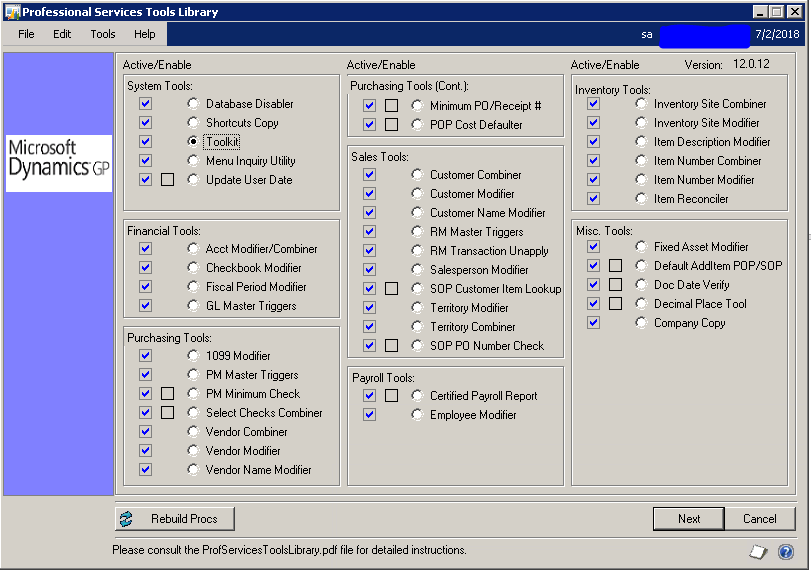
The best way I have found to save time is to use the free Inventory Reconcile tool from Professional Services Tools Library, or PSTL as it is commonly referred to, instead of the one built into Dynamics GP. PSTL is a free set of tools that help you complete various tasks in Dynamics GP.   Under the inventory tools section you will find the Item Reconciler (Example 1).

reconcile inventory dynamics gp

Ex. 1

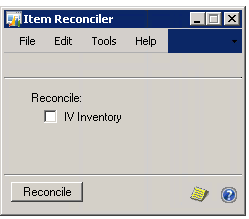
To use the inventory Reconciler mark the circle next to Inventory Reconciler under the Inventory Tools section and select next at the bottom right of the PSTL  window. This will bring up the Item Reconciler window (Example 2). On this window, you will select IV Inventory and then reconcile.

reconcile inventory dynamics gp

Ex. 2

The PSTL reconcile tool will now run and normally completes in 10 minutes.  I have seen one case where it took a little over an hour but the customer had such a large database that they hadn’t been able to run a reconcile in over 10 years.  One key difference between the PSTL inventory reconcile tool and the one found under the tools menu in GP is that the PSTL reconciler only runs for items that don’t reconcile whereas the GP one runs for every item in the range of numbers selected.  

If you are looking to speed up your inventory reconciling process then this is definitely worth looking into.  Please feel free to reach out to the Dean Dorton team with any questions.

Filed Under: Accounting Software, Microsoft Dynamics GP, Services Tagged With: Accounting Software, Best practices, dynamics gp, Inventory reconcile, Microsoft, Reconcile, Tips and tricks

Article 03.22.2016 Dean Dorton

Recent economic volatility, financial reporting changes, and increased competition for donations has placed greater emphasis on managing resources and strategic decision making. Not-for-profit organizations that have active, qualified finance committees will have a competitive advantage in these uncertain times.

In this article we will explore the purpose and responsibilities of a finance committee, composition and structure of the committee and nonprofit finance committee best practices.

Nonprofit Finance Committee Purpose and Responsibilities

The main responsibility of the finance committee is to ensure that the institution is operating in a financially sustainable manner by balancing short-term and long-term obligations and goals. In order to fulfill this purpose, board members have certain roles and responsibilities:

  • Carry out the governing board’s fiduciary responsibility to ensure the organization’s mission and purpose are fulfilled by:
    • Gaining an understanding of how the organization is financially supported/capitalized
    • Assessing risks, internal and external, that may have a financial impact on the organization
    • Monitoring the organization’s financial efficiency
  • Provide financial guidance to the board of trustees through:
    • Assessing how to protect the organization’s resources
    • Overseeing the budgeting process to ensure that they are based on reasonable assumptions, aligned with organizational goals and that they are properly monitored
  • Determine what is possible given the available resources of the organization
    • Stay involved with other committees regarding new projects and expenditures
  • Assist management in executing the strategic goals of the organization by:
    • Establishing guardrails for management regarding their financial decision making authority
    • Ensuring management has the resources and skills required to facilitate proper internal controls
  • Timely communication of all pertinent issues to the board of directors

Financial reports and budgets are two significant tools at the committee’s disposal to effectively and efficiently perform their vital governance role. Financial statements have a retrospective focus in that financial statements, for the most part, report what has already happened while budgets have more of a forward looking focus, projecting what will happen in the future.

Ratio analysis (using common ratios to determine metrics such as asset turnover, profitability, leverage, and program expenses) can be utilized to help an organization identify negative trends before they become problems. Budgets should be reviewed by questioning the underlying financial assumptions of the budget and comparing them to historical data for reasonableness. Reconciliation between the financial statements and the budgets can also be an effective tool for the committee.

During this reconciliation, the committee works with management to explain significant variances. This process not only helps to understand past performance but is also useful in the development of the next period’s budget.

Nonprofit Finance Committee Composition and Structure

Since the finance committee plays such a vital role in the board’s governance of the organization, it is important to determine who should serve on the committee. The committee should comprise a chair and a vice chair for direction and focus. It should also include members of other key committees such as the student affairs committee, academic affairs committee, and other committees that oversee vital functions of the institutions. This will improve communication and cooperation between the finance committee and other committees.

Members should serve for terms of at least four to five years and the terms should be staggered to promote continuity. Oftentimes, the chief financial officer, budget officer, and chief accounting officer will serve as staff of the committee, and the president of the organization will attend committee meetings. Once again, this serves to aid communication and cooperation between management and the finance committee which is integral to effective governance.

In general, the finance committee should have the skills necessary to fulfill its responsibilities and be structured in a way that fosters communication and cooperation between other committees, the board, and management.

Nonprofit Finance Committee Best Practices

Below are a list of best practices for finance committees:

  • Chair of finance committee and board chair should define the scope and responsibilities of the finance committee
  • In spring or early summer, the finance committee chair and CFO should meet to coordinate the committee’s annual work and identify/discuss any key issues facing the organization
  • Chair should communicate the work plan to the rest of the committee and the board
  • At each board meeting, the finance committee chair should deliver a status update including information on budget to actual results, emerging trends, and expenditure recommendations

A typical work plan might include the following:

  • Late spring – Committee chair, CFO, and president meet to develop work plan and discuss key issues, internal and external, facing the organization
  • Early summer – Adopt annual budgets, both operational and capital
  • Fall – Review financial results for prior year and use to evaluate the reasonableness of the current budgets; discuss significant changes in key financial metrics
  • Winter – Re-examine revenue projections and discuss and agree on a set of budgetary assumptions for the following year
  • Spring – Study changes in revenue estimates and make recommendations for updates

Article written by Tom Smither, Supervisor of Assurance Services

Citations

Stafford, Ingrid. “The Finance Committee”. AGB Effective Committee Series. 2013

Filed Under: Industries, Nonprofit & Government Tagged With: Best practices, donation, Finance, nonprofit

  • Services
    • Outsourced Accounting
    • Audit & Assurance
    • Tax
    • Consulting & Advisory
    • Technology & Cybersecurity
    • Family Office
    • Wealth Management
  • Industries
  • Company
  • Locations
  • Careers
  • Insights
  • Events
  • Contact Us
facebook Dean Dorton - CPAs And Advisors On Facebook twitter twitter linkedin Dean Dorton - CPAs And Advisors On LinkedIn youtube Dean Dorton - CPAs And Advisors On YouTube

The matters discussed on this website provide general information only. The information is neither tax nor legal advice. You should consult with a qualified professional advisor about your specific situation before undertaking any action.

© 2026 Dean Dorton Allen Ford, PLLC. All Rights Reserved