
• Skip to primary navigation
  • Skip to main content
Dean Dorton – CPAs and Advisors
  • Services
        • Audit & Assurance
          • Audits, Reviews & Compilations
          • ESG Programs & Reporting
          • Internal Audit
          • International Financial Reporting
          • Lease Accounting Managed Services
          • Peer Review Services
          • SOC Reporting
        • Family Office
        • Consulting & Advisory
          • Business Valuation Services
          • Forensic Accounting
          • Litigation Support
          • Matrimonial Dissolution
          • Merger & Acquisition
          • SEC Services
          • Succession Planning
          • Transaction Advisory Services
          • Whistleblower Hotline
        • Outsourced Accounting
        • Private Wealth
        • Healthcare Consulting
          • Finance
          • Health Systems Operational Transformation
          • Medical Billing and Credentialing
          • Risk Management & Compliance
          • Strategy and Strategy Implementation
          • Technology & Data Analytics
        • Tax
          • Business Tax
          • Cost Segregation Studies
          • Credits and Incentives
          • Estates and Trusts
          • Individual Tax
          • International Tax
          • SEC Provision and Compliance
          • State and Local Tax
        • Technology & Cybersecurity
          • Accounting Software
          • Cybersecurity
            • Cybersecurity Assessments
            • Cybersecurity Scorecard Assessment
            • Security Awareness Training
            • Virtual Information Security Office
          • Data Analytics & AI
          • IT Audit & Compliance
            • Cybersecurity Maturity Model Certification (CMMC)
            • Data Privacy Laws
            • SOC Reporting
          • IT Infrastructure & Cloud Solutions
            • Automation
            • Backup and Disaster Recovery
            • Cloud Strategy
            • Data Center
            • Enterprise Network
            • Network Security
            • Phone and Video Conferencing
            • User Identity Management Solutions
            • Webex
          • Managed IT Services
  • Industries
        • Construction
        • Distilleries and Craft Breweries
        • Energy and Natural Resources
        • Equine
        • Financial Institutions
        • Government
        • Healthcare
        • Higher Education
        • Life Sciences
        • Manufacturing and Distribution
        • Nonprofit
        • Real Estate
  • Insights
    • Articles
    • Guides
    • Case Studies
  • Events
  • Company
        • News
        • Our Team
        • Experiences
        • Careers
          • College Students
          • Experienced Professionals
        • Locations
        • Lexington, KY

          250 West Main Street
          Suite 1400
          Lexington, KY 40507
          859-255-2341

        • Louisville, KY

          435 North Whittington Parkway
          Suite 400
          Louisville, KY 40222
          502-589-6050

        • Louisville, KY

          700 North Hurstbourne Parkway
          Suite 115
          Louisville, KY 40222
          502-589-6050

        • Cincinnati, OH

          312 Walnut Street
          Suite 3330
          Cincinnati, OH 45202
          859-331-3300

        • Blue Ash, OH

          9987 Carver Rd
          Suite 120
          Blue Ash, OH 45242
          513-891-5911

        • Ft. Wright, KY

          810 Wright’s Summit Parkway
          Suite 300
          Fort Wright, KY 41011
          859-331-3300

        • Indianapolis, IN

          5975 Castle Crk Pkwy Dr N
          Suite 400
          Indianapolis, IN 46250
          317-469-0169

        • Raleigh, NC

          4130 Parklake Avenue
          Suite 400
          Raleigh, NC 27612
          919-782-9265

  • Contact Us

adam shewmaker

Article 06.9.2016 Dean Dorton

Perhaps lost in the shuffle last year due to the implementation of ICD-10, was the creation of MACRA, which was signed into legislation by President Obama on April 16, 2015. Fast forward one year later to current day and the recently proposed MACRA rules, which have been described as the most significant Medicare policy change in recent history.

What is it?
MACRA replaces the sustainable growth rate (SGR) formula with a framework that rewards providers for providing higher quality care through the creation of two reimbursement pathways:

  • Merit-based incentive Payment System (MIPS), and
  • Alternative Payment Models (APMs).

Additionally, the proposed rules collapse three existing quality reporting programs (PQRS, Value-based Payment Modifier, and Meaningful Use) into the newly created MIPS pathway. Not all providers will receive positive reimbursement adjustments. In fact, CMS estimates that 45% of eligible providers and up to 87% of small group practices will see a penalty in the first payment year.

Most physicians that bill Medicare Part B claims will be impacted. Rural health clinics and FQHC providers are excluded.

When do changes occur?
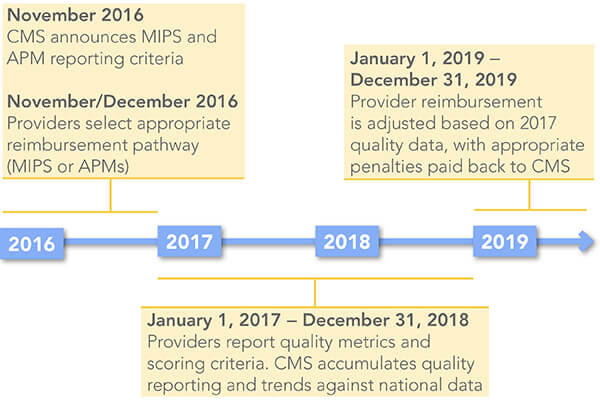
MACRA timeline graphic 4

Note: In less than five months, providers will select the quality metrics that will impact their 2019 Medicare reimbursement.

Significance
Starting in 2019, Medicare provider reimbursement will be impacted either positively or negatively based on 2017 quality data. Since CMS projects that the majority of providers will follow the MIPS track, the following outlines the proposed Medicare Part B reimbursement impact under that pathway:
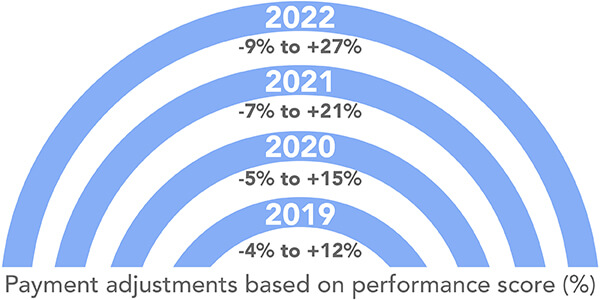
MACRA percent rainbow

MACRA ensures that there will only be increases or decreases in Medicare Part B reimbursement – it is budget neutral in aggregate. To ensure your Medicare Part B reimbursement is protected against these future penalties, now is the time to assess your readiness and implement operational changes that might be needed to potentially share in the reimbursement increases scheduled in 2019.

Contact Adam Shewmaker at ashewmaker@ddafhealthcare.com or Porter Roberts at proberts@deandorton.com to learn more.

View Adam Shewmaker’s BioView Porter Roberts’ Bio

Filed Under: Healthcare, Industries Tagged With: adam shewmaker, APM, Healthcare, MACRA, Medicare, MIPS, Porter Roberts, Reimburse, rule

Article 03.30.2016 Dean Dorton

The healthcare industry continues to experience the push toward shorter hospital length of stays, increased outpatient services, and ongoing staffing challenges. Centers for Medicare & Medicaid Services (CMS) surveyors are taking note. Recent CMS surveyor activity in the state of Kentucky has focused on staffing levels in various departments of the hospital.

Based on Kentucky data from CMS for 2015, the highest volume of citations fell into three main categories:

  • Patient rights (14)
  • Nursing services (13)
  • Emergency Medical Treatment & Active Labor Act (EMTALA) compliance (10)

Many of these citations included a component relative to staffing levels and/or use of contracted employees which contributed to the incidents that resulted in the citations. Healthcare providers should consider the areas below as you monitor compliance with CMS guidelines and as you develop your annual risk assessment. When hospitals begin a risk assessment for the targeted areas, the staffing levels and methodology should be included.

The risk assessment process for each of these items will differ slightly, due to differing requirements. The items that are consistent for each area include:

  • Policies and Procedures
    • When was the last time the policies and procedures were matched up with the conditions of participation and CMS and The Joint Commission (TJC) guidelines?
    • Do the policies and procedures align with actual day-to-day operational functions?
    • Are the policies and procedures reviewed at least annually?
  • Training and Education
    • When did formal training on policies and procedures last occur?
    • Who was included in the training program? Did it include contracted staff?
    • How frequently is the training updated? When policies and procedures are updated, are staff educated on what changed and how it impacts their jobs (tailored to the audience)?
  • Monitoring
    • Have procedures for monitoring performance relative to policies and procedures been developed?
    • If developed, what types of issues has the monitoring uncovered?
    • How were deficiencies handled? Were action plans implemented?
    • Are deficiencies identified in the monitoring being reported to the appropriate levels of management?

Risk specific considerations may include the following:

  • Patient Rights
    • Are nursing staff fully aware of all the elements within the patient rights?
    • Have nursing staff been trained on how to communicate the rights to the patients they are working with?
    • Have staff been trained on what constitutes a violation of a patient right and to whom and when those violations must be reported?
    • If a patient or family member reports a concern to staff, do staff understand when to consider the concern a grievance? Do they know the process for providing feedback to the patient’s family member?
  • Nursing Services
    • Are staffing levels being maintained at an appropriate level based on the census?
    • Does the staffing level include the appropriate mix of RNs, LPNS, and CNAs?
    • Do RNs have the appropriate balance between direct patient care and supervision of the LPNs and CNAs as required?
    • How is compliance with the patient nursing care plan monitored, with deviations reported to the attending physician?
    • Have evidence-based practices been implemented to address key patient safety areas such as CAUTI, CLABSI, falls, restraints/seclusions, pressure ulcers, etc.?
    • If evidence based practices have not been implemented, has the facility looked at consistency of practices between units?
  • Emergency Medical Treatment & Active Labor Act (EMTALA)
    • Has all staff, including contracted staff, been educated on requirements under EMTALA?
    • Has the education been tailored to the roles of the individuals?
    • When are all patients logged into the central log? Is the process designed to log them upon presentation to the ED, even if the patient has not been triaged or received an MSE?
    • Has required signage been posted in all locations where patients may access emergency services (including ambulance bays)?
    • When does the hospital ask for insurance information from patients presenting to the ED? Note that it should not occur until after the patient has received a medical screening exam and stabilizing treatment.
    • What specialties does the hospital advertise? For those advertised, is there a specialist on-call to the emergency department at all times?
    • Has the hospital documented their transfer policy?
    • Does the hospital conduct monitoring of transfer documentation to verify it aligns to the policy and CMS requirements specific to EMTALA?

The above list is not intended to be all-inclusive. Each facility may have additional risks that are unique to their location and size. Management should customize the risk assessment to meet their needs based on past surveyor reviews, existing practices and results of internal audits. Consider including Quality Managers and Compliance in risk assessments to obtain best results.

Contact your Dean Dorton advisor or a member of our Healthcare Industry Team for more information.

  • Adam Shewmaker, Director of Healthcare Consulting Services: ashewmaker@ddafhealthcare.com
  • Shawn Stevison, Manager of Healthcare Consulting: sstevison@ddafhealthcare.com
  • Lance Mann, Director of Assurance Services: lmann@deandorton.com

View Adam Shewmaker’s BioView Lance Mann’s Bio

Filed Under: Healthcare, Industries Tagged With: adam shewmaker, Citation, CMS, EMTALA, Hospital, Lance Mann, Medicaid, Medicare, Nursing services, Patient, Patient rights, Shawn Stevison, Surveyor

Article 12.17.2015 Dean Dorton

Construction and capital improvement projects can be complex financial expenditures for an organization, and present significant risks to the organization’s goals and objectives. Generally, organizations do not have construction cost experts on staff when they embark upon a major construction project. Frequently, this gap in internal knowledge is “patched” through the use of a construction management firm.

However, while a construction management firm can help with the logistics of a construction project, such as coordination of bidding, ensuring that construction is performed timely and safely, and that the specifications of the project are adhered to, a construction management firm rarely provides significant help in ensuring that the financials of the construction project are appropriate.

The risk undertaken by the owner organization during a construction project is heavily influenced by the type of contract that is used for the project. There are generally three types of contract used:

  1. Fixed price contract – Fixed price, or lump sum, contracts are most frequently used, especially on large projects. A fixed price contract transfers most, but not all, of the financial risk to the construction company. The owner of the project retains some financial risk through the change order process. As the number and value of change orders increases, so the risk that the original contract price was underbid increases, and may indicate that the construction company is attempting to pass the financial risk back to the owner. Management of change orders is essential in managing the project, and frequently the owner’s staff are not knowledgeable enough to provide effective financial oversight. Additionally, with a fixed price contract any cost savings accrue solely to the construction company.
  2. Guaranteed maximum price contract – A GMP contract is in essence a time and materials contract with a maximum price that will not be exceeded (unless it is increased through change orders). A GMP contract results in a sharing of financial risk between the construction company and the owner. Additionally, any cost savings identified during the project will generally accrue to both the construction company and the owner.
  3. Time and materials contract – Under a time and materials (or T&M) contract, the financial risk is almost entirely retained by the owner of the project. The construction company may retain some financial risk through warranties or similar contract provisions.

With a GMP or T&M contract, it is essential for the owner to ensure that costs being applied to the contract are appropriate and reasonable. An owner does not want to pay billings for costs unrelated to their project. Some costs can be easy to monitor, such as materials and labor allocated to the job, as the owner can monitor the materials delivered to the site and the construction personnel physically working on the project. However, many owners fail to perform any procedures to ensure that the amounts billed match the amounts delivered to the jobsite or the personnel that were observed working on the project. Additionally, there are other more ambiguous costs, such as insurance charges, maximums placed on rental charges, overhead and home office allocations, et cetera, that are frequently applied to contracts that an owner has little ability to fact check or verify.

It is essential for the organization to have construction financial experts available to perform procedures on billings received from construction companies to ensure that billings include only those costs allowed under the contract and that relate to the project.

If you are considering undertaking a construction or capital improvement project, or are currently going through a construction or capital improvement project, Dean Dorton professionals can work with you to enhance your existing controls and provide added value to your organization. Our comprehensive, customizable range of services can help you protect your financial interest in construction and capital improvement projects.

Contact Simon Keemer, Adam Shewmaker, or your Dean Dorton advisor for more information on how we can help you.

Simon Keemer
502-566-1036
skeemer@deandorton.com

View Simon Keemer’s Bio

Adam Shewmaker
502-566-1054
ashewmaker@deandorton.com

View Adam Shewmaker’s Bio

Filed Under: Construction, Healthcare, Industries Tagged With: adam shewmaker, Construction, Contract, GMP, Material, Project, Simon Keemer, T&M

Article 10.16.2015 Dean Dorton

In a time when healthcare reform increases the complexities of revenue cycle operations, it is becoming clear that a robust revenue performance will play an increasingly important role in providers’ financial health.

Dean Dorton’s healthcare industry team leader Adam Shewmaker is moderating Health Enterprises Network’s Revenue Cycle Management roundtable next Thursday, October 22 in Louisville, KY. Joining Adam are other experts on revenue cycle management to discuss the impact of healthcare reform and market consolidation. Other topics include:

  • Increase collaboration with clinical departments to measure and improve quality outcomes
  • Hiring, training and retention of qualified staff is essential for revenue cycle improvement
  • Utilization of predictive analytics and business intelligence tools
  • Transition to value-based reimbursement methodologies

When: Thursday, October 22, 2015

Where: Kosair Charities Clinical & Translational Research Building:
505 S. Hancock Street, Louisville, KY 40202

Cost: HEN board members free; HEN members $40; Non-members $75; Full-time students $10

Register: Register@HealthEnterprisesNetwork.com or call 502-625-0149

For questions or additional information, contact Adam Shewmaker at 502-566-1054 or ashewmaker@deandorton.com.


View Adam Shewmaker’s Bio

Filed Under: Healthcare, Industries, Revenue cycle Tagged With: adam shewmaker, healthcare reform, revenue cycle, revenue cycle management

Article 07.10.2015 Dean Dorton

Merger and acquisition (M&A) transaction volume in the healthcare industry is off to a fast start in 2015, continuing the robust trend from 2014.  Many analysts and executives believe M&A activity will continue its strong momentum and may accelerate at an even faster pace for the remainder of 2015.

Participants in the marketplace, both buyers and sellers, are assessing whether future transactions meet their organization’s goals and operational strategies.  Furthermore, management teams are assessing the value of the subject entity to ensure the transaction price reflects the current market and maximizes their long-term return on capital.  Understanding the marketplace of the subject entity can be a daunting task and determining whether the assessed value will enable the organization to meet its objectives can be challenging.  To further complicate the analysis, Stark Law requirements and other regulatory concerns must be addressed.

The approaches to valuation are often implicitly known and performed, but often not formally outlined. The three primary approaches to valuing a healthcare entity (or any closely-held business) are the asset, market, and income approaches.  The asset approach looks to the subject entity’s tangible equity on the balance sheet, but often ignores the intangible assets (e.g. customer relationships, assembled workforce, and goodwill).  The market approach uses known transactions in the marketplace for entities that are comparable to the subject entity to arrive at valuation multiples (often reflected as multiples of revenue or earnings) which are applied to the subject entity’s financial metrics.  The income approach derives value by converting the subject entity’s forecasted future cash flows to present value using a discount rate adjusted for the risks of the forecast, industry, and inherent characteristics of the subject entity.

Dean Dorton’s valuation expertise and experience, combined with its healthcare industry knowledge, has contributed to the success of many M&A transactions.  From guidance in strategy to valuation, Dean Dorton can assist with the challenges involved with M&A transactions.

For more information, contact Adam Shewmaker at 502.566.1054 or ashewmaker@deandorton.com or David Angelucci at 859.425.7695 or dangelucci@deandorton.com.

View Adam Shewmaker’s Bio

Filed Under: Healthcare, Industries Tagged With: Acquisition, adam shewmaker, Buy, David Angelucci, Healthcare, M&A, Merger, Sell, Valuation

Article 06.19.2015 Dean Dorton

The Medicare Fraud Strike Force announced yesterday the “biggest ever” fraud takedown in the history of the Justice Department.  In excess of $700 million was associated with fraudulent billings after the Medicare Fraud Strike Force targeted 17 districts in Florida, Texas, California, Louisiana, New York, and Michigan.

Of the 243 professionals charged in this allegation, 46 were physicians, nurses, and other licensed medical professionals.  Charges ranged from conspiracy to commit health care fraud, violations of the anti-kickback statutes, money laundering and aggravated identify theft.

In one of the cases, a Michigan physician prescribed unnecessary narcotics in exchange for patients’ identification information, which was used to generate false billings. Patients then became deeply addicted to the prescription narcotics and were bound to the scheme as long as they wanted to keep their access to the drugs.  In another instance, a mental health facility billed over $60 million for psychotherapy sessions that turned out to simply involve moving patients from one location to another.

Dean Dorton offers a comprehensive listing of advisory services aimed at mitigating risk and ensuring compliance in the healthcare industry.  From guidance in establishing strong internal controls to reviewing medical chart documentation, Dean Dorton may be able to provide significant value to your organization.

For more information contact Adam Shewmaker at 502-566-1054 or ashewmaker@deandorton.com.

View Adam Shewmaker’s Bio

Filed Under: Healthcare, Industries Tagged With: adam shewmaker, fraud, Medicare, Medicare Fraud Strike Force

  • Page 1
  • Page 2
  • Go to Next Page »
PAY INVOICE SUBMIT RFP
  • Services
    • Outsourced Accounting
    • Audit & Assurance
    • Tax
    • Consulting & Advisory
    • Technology & Cybersecurity
    • Family Office
    • Wealth Management
  • Industries
  • Company
  • Locations
  • Careers
  • Insights
  • Events
  • Contact Us
SUBSCRIBE TO INSIGHTS
email Dean Dorton - CPAs And Advisors On Email facebook Dean Dorton - CPAs And Advisors On Facebook twitter twitter linkedin Dean Dorton - CPAs And Advisors On LinkedIn youtube Dean Dorton - CPAs And Advisors On YouTube

The matters discussed on this website provide general information only. The information is neither tax nor legal advice. You should consult with a qualified professional advisor about your specific situation before undertaking any action.

© 2026 Dean Dorton Allen Ford, PLLC. All Rights Reserved

  • Privacy Policy
  • Terms Of Use
  • Accessibility