• Skip to primary navigation
  • Skip to main content
Dean Dorton – CPAs and Advisors
  • Services
        • Audit & Assurance
          • Audits, Reviews & Compilations
          • ESG Programs & Reporting
          • Internal Audit
          • International Financial Reporting
          • Lease Accounting Managed Services
          • Peer Review Services
          • SOC Reporting
        • Family Office
        • Consulting & Advisory
          • Business Valuation Services
          • Forensic Accounting
          • Fractional CFO
          • Litigation Support
          • Matrimonial Dissolution
          • Merger & Acquisition
          • SEC Services
          • Succession Planning
          • Transaction Advisory Services
          • Whistleblower Hotline
        • Outsourced Accounting
        • Private Wealth
        • Healthcare Consulting
          • Finance
          • Health Systems Operational Transformation
          • Medical Billing and Credentialing
          • Risk Management & Compliance
          • Strategic Growth for Private Practices
          • Strategy and Strategy Implementation
          • Technology & Data Analytics
        • Tax
          • Business Tax
          • Cost Segregation Studies
          • Credits and Incentives
          • Estates and Trusts
          • Individual Tax
          • International Tax
          • SEC Provision and Compliance
          • State and Local Tax
        • Technology & Cybersecurity
          • Accounting Software
          • Cybersecurity, IT Audit, & Compliance
            • Cybersecurity Assessments
            • Cybersecurity Maturity Model Certification (CMMC)
            • Cybersecurity Scorecard Assessment
            • Data Privacy Laws
            • Security Awareness Training
            • SOC Reporting
            • Virtual Information Security Office
          • Data Analytics & AI
          • IT Infrastructure & Cloud Solutions
            • Automation
            • Backup and Disaster Recovery
            • Cloud Strategy
            • Data Center
            • Enterprise Network
            • Network Security
            • Phone and Video Conferencing
            • User Identity Management Solutions
            • Webex
          • Managed IT Services
  • Industries
        • Construction
        • Distilleries and Craft Breweries
        • Energy and Natural Resources
        • Equine
        • Financial Institutions
        • Government
        • Healthcare
        • Higher Education
        • Life Sciences
        • Manufacturing and Distribution
        • Nonprofit
        • Real Estate
  • Insights
    • Articles
    • Guides
    • Case Studies
  • Events
  • Company
        • News
        • Our Team
        • Experiences
        • Careers
          • College Students
          • Experienced Professionals
        • Locations
        • Lexington, KY

          250 West Main Street
          Suite 1400
          Lexington, KY 40507
          859-255-2341

        • Louisville, KY

          435 North Whittington Parkway
          Suite 400
          Louisville, KY 40222
          502-589-6050

        • Louisville, KY

          700 North Hurstbourne Parkway
          Suite 115
          Louisville, KY 40222
          502-589-6050

        • Ft. Wright, KY

          810 Wright’s Summit Parkway
          Suite 300
          Fort Wright, KY 41011
          859-331-3300

        • Cincinnati, OH

          312 Walnut Street
          Suite 3330
          Cincinnati, OH 45202
          859-331-3300

        • Blue Ash, OH

          9987 Carver Rd
          Suite 120
          Blue Ash, OH 45242
          513-891-5911

        • West Chester, OH

          9025 Centre Pointe Drive
          Suite 310
          West Chester, OH 45069
          513-985-6240

        • Indianapolis, IN

          5975 Castle Crk Pkwy Dr N
          Suite 400
          Indianapolis, IN 46250
          317-469-0169

        • Raleigh, NC

          4130 Parklake Avenue
          Suite 400
          Raleigh, NC 27612
          919-782-9265

  • Contact Us

Biotechnology

Article 07.25.2018 Dean Dorton

From initiating funding to product and project management, biotech companies require a unique strategy to gather funding, and flexibility to accommodate fast expansion. If today’s biotech companies want to stay successful, they need to scale growth and still manage to assert control over time and resources.

They can begin to do that with these 5 accounting tips:

1. Apply Project Accounting to Track Costs

For commercializing biotech research, having deep insight into project costs helps keep your projects lean and profitable, satisfies funders and allows for continued research, and innovation down the road.

Growing beyond Quickbooks to adopt a more responsive and project-minded financial management solution can provide real-time visibility and deep insights on project metrics with reporting dashboards.

2. Ensure traceability with automated batch/lot tracking

Traceability in your batches and lots mitigates risk for business continuity and safety and assures investors.

Adopt a system with more automation and integrations, to further eliminate the risks generated from paper-based system errors, and to streamline departmental efficiency.

3. Support reporting, forecasts, and budgeting with collaborative systems

Forecasting and budgeting can protect funding and drive growth. Biotech companies that collaborate see their funding stretch further and have more control over where that funding goes.

From clarifying policies to resolving exceptions, when teams put their heads together with a strong cloud-based financial management solution that supports collaboration, their company can move more quickly to new funding rounds and get the most out of their current support.

4. Streamline business processes

Biotech companies that automate and streamline their processes are better able to keep administration costs lean for faster-paced growth when they can ensure information accuracy and compliance.

A best-in-class financial management solution can automate mundane tasks that inflate labor hours and potential for error.

5. Use technology to its fullest to scale business

When companies work from the cloud for their accounting, they can leverage data availability and accuracy to support growth beyond the capability of outdated, on-premises software.

For your biotech business to remain agile, using systems that reduce personnel and IT costs, improve security, boost collaboration and improve accuracy can help them scale their business as quickly as growth happens.

Sage Intacct, a strong cloud-based financial management solution, offers strong integration and collaboration options right into the transaction, real-time visibility on metrics from reporting dashboards, and offers traceability in the details for powerful risk management.

We want to help you drive your biotech company’s success with the right tools to fit your changing needs.
Is your biotech company facing these pain points?

Filed Under: Accounting Software, Biotechnology, Industries, Sage Intacct, Services Tagged With: Accounting, Accounting Software, Biotechnology, Clinical Trials, Cloud technology, ERP, Forecasting and Budgeting, Project Accounting, Sage Intacct

Article 05.18.2018 Dean Dorton

Essential Financial Management Practices of Biotech Companies – A 5-Part Series

Article 5 – Prepare to Scale with Cloud Technology

The growth trajectory for biotech companies is unique – years of research followed by fast expansion with the success of a product.  Cloud technology is well-suited to scale quickly to meet those changing needs.

Positioned for success today and beyond

Technology played a huge role at the end of the 20th Century and has been accelerating innovation in the 21st Century.  Perhaps the most under-appreciated aspects of today’s technology are how easy it is to use.  Consider how much technology and useful applications reside on your smartphone and within your home.

But what about the workplace?  Is there a technology gap in your biotech organization?  Often cutting-edge technology is used in research and development while, in sharp contrast, archaic manual processes, outdated legacy systems, and spreadsheets are used in the accounting department.  What’s wrong with this picture?

Sage Intacct describes the benefit of their solution this way, “tomorrow’s innovative technology to make your today easier.”  The best result of technology addresses complex problems in a simple but effective way.

However, it’s not enough to simply address today’s problems.  As CFO, you know you need to be planning for the future. Any investment in a financial accounting solution should result in the automation of repetitive processes to increase productivity but also free up your time to prepare for future challenges.

Modern cloud architecture to scale with your growing Biotech business

The word “agile” is not a corporate-speak buzzword for Biotech CFOs – it is a way of life.  As you manage the financials from one funding milestone to the next, you must move quickly, and forecast confidently and correctly.

Inaccurate or delayed financial information threatens the success of the business.  You know this more acutely than anyone else in the organization.

“The reason I recommend Sage Intacct is that it immediately gives Biotech CFOs real-time financial information, but more importantly, a means by which to automate processes that are a waste of the CFO’s time,” explains Philip Massey, CPA and founder of Massey Consulting.  “Last century a best practice was to ‘delegate more.’ Today, best practices urge company leaders to ‘automate more.’ It’s amazing how much changes for the better when a CFO is able to automate even one workflow. As their technology partner, we look to automate as many processes as possible, which gives back precious time allowing CFOs to do more strategic work.”

Functional agility with minimal disruption

The reason businesses are flocking to SaaS models are many;  anytime, anywhere access; higher ROI, lower TCO, a shift from variable OPEX to fixed CAPEX – but also the ease at which SaaS financial accounting can be implemented.  As a noted in an article on the Tech-Savvy CFO, “solutions can be configured and re-configured with clicks, not code, and software can easily ingrate with other best-in-class business systems.”  

The net result:  you are empowered with modern technology, the best accounting features, real-time reporting, and state-of-the-art dashboards with little, if any, disruption and without a hefty investment in personnel or IT costs.

When the time comes to expand, merge, and/or move from a funded model to a revenue model, the configurability of Sage Intacct makes it easy to add new users, new business units, and new software modules.  Again it comes back to the SaaS delivery model which allows you to manage sudden increases in users and transactions, without having to worry about upgrading servers or network infrastructure.

Choose wisely – why Sage Intacct is the experts’ choice

“Biotech CFOs, CPAs and auditors sit up and take notice when I point out that Sage Intact is the only AICPA-endorsed solution for cloud financials,” notes Massey.  That endorsement, combined with the deep functionality that allows Biotech organizations to streamline complex accounting and finance processes.

Given that everyone in the organization wants to see projects completed with a minimum of funding diverted for administrative operations, Sage Intacct’s track record of documented rapid payback and meaningful ROI makes it an attractive option. “Sage Intacct is committed to customer success and they track and report on customer ROI,” said Massey.  “The published statistic is that Sage Intacct customers enjoy, on average, a return on investments of over 250 percent. With the average payback period just under six months. At Massey Consulting we understand that these results may vary. We work with Biotech CFOs and based on their specific situation calculate what they can expect. It’s remarkable just how quickly Sage Intacct pays for itself.”

Massey notes that it’s hard to overstate the positive impact Sage Intacct has for Biotech leadership.  “They have greater visibility, faster analyses, and real-time reporting for smarter business decisions.”

Sage Intacct can also make an impressive boast when it comes to customer satisfaction.  Third-party surveys show Sage Intacct out-performing the other leading brands (both on-premises and Cloud) in overall customer satisfaction.  

“Another area where Sage Intacct outshines the competition is in ease-of-use,” concludes Massey.  “If a solution is not easy to use it delays ROI, frustrates end users, and chews up time. The design of the software makes it easy to learn and users are quickly proficient, leveraging the solution at an optimal level.”

This concludes “Prepare to scale with cloud technology,” part 5 of the Essential Financial Management Practices of Biotech Companies series.  

Click on the links below to read other parts of the Essential Financial Management Practices of Biotech Companies series:

Part 1: Track Costs with Project Accounting

Part 2: Automate Batch/Lot Tracking to Ensure Traceability

Part 3: Support Flexible Reporting, Forecasts, and Budgeting

Part 4: Streamline Business Processes

Filed Under: Accounting Software, Biotechnology, Industries, Sage Intacct, Services Tagged With: Biotechnology, Cloud Accounting, Cloud technology, ERP software, Financial Management Practices, Sage Intacct

Article 05.17.2018 Dean Dorton

Essential Financial Management Practices of Biotech Companies – A 5-Part Series

Article 4 – Streamline business processes to ensure compliance, accuracy of information and insight

It can be a long and challenging path from drug design to marketing products; from proof of concept to scale-up to market.  With the many uncontrollable factors that play a role in your project lifecycle, it’s important to control what you can.

You can mitigate risk by streamlining business processes with today’s technology to ensure compliance when you: systemize processes; support consistent documentation; and ensure consistency through expansion.

But the other key benefit of using technology to automate and streamline processes is that CFOs can spend more time communicating and advising stakeholders (CEO, R&D teams, investors, etc.) on the many decisions they need to make and the actions they take – from pre-revenue, through funding milestones and on to IPO or acquisition.

Up-to-date but always looking ahead

There are unique accounting challenges and pressures for Biotech CFOs.

As Thomas H. Fagley, Partner at Hughes Pittman & Gupton, LLP explains, “Biotech CFOs have to communicate and manage relationships.  It’s important to have a good relationship with the board and investors, as well as your CEO and R&D Team, communicating financial information to them on a timely basis, keeping them up-to-date on the financial status of research and development programs and identifying budget variances in a timely manner.”

“The Biotech CFO needs to make sure that the cash forecast sufficiently addresses the short-term and long-term funds necessary to get the project to the next financial milestone or development milestone that may potentially trigger additional investment,” notes Fagley.

Questions from stakeholders need to be answered quickly with accurate information.  “A delay of even a day or two can have serious implications on the forecast and project momentum,” notes Philip Massey, CPA and founder of Massey Consulting.  “In order to have meaningful communication with stakeholders, a CFO must be armed with real-time, accurate data.”

If questions arise surrounding the data (and they usually do), the CFO must be able to quickly drill down to the details to find the answers.  “If a CFO doesn’t have the right ERP system, has information stored in discrete system silos, and must answer stakeholder questions with ‘I’ll have to get back to you’ – it means that time, and possibly funding, is being squandered,” says Massey.

Timing and funding – striking the crucial balance

As the CFO and stakeholders review forecasts and the progress of research and development, the need for additional funding can arise.  The stakeholders then need to determine what kind of funding would be preferable for both short-term and long-term goals.

“They may determine that they’d like to take non-diluted funding in the form of a government grant or the licensing of some of their technology,” says Fagley.  “There are pros and cons that have to be considered with an eye toward maximizing the investor’s return on investment.”

“Not only does the CFO have a unique counseling role, but he or she will also be responsible for tracking and reporting on each funding source,” explains Massey.  “Suddenly it becomes clear how necessary an ERP Accounting solution is when it excels in project accounting, can track multiple sources of funding to the satisfaction of the funders, will facilitate online approval processes, and automate repetitive accounting processes.”

It all circles back to access to timely accurate data as the foundation of success.

“If you have a timing delay,” warns Fagley, “usually it means the development is going to cost more.  Being able to have information quickly and being able to effectively communicate that to the board and investors, is key for Biotech companies.”

Look to automation to keep administration costs lean

Prudent use of funds is paramount throughout the stages of development.

Administrative functions like accounting are not desirable places to make a significant investment in personnel – most biotech would prefer to funnel funds into researchers and clinicians in the pre-revenue phase, and marketing and sales after the IPO.

“For that reason, investing in financial accounting software has a better ROI than bringing additional administrative headcount on board,” says Massey.

Full speed ahead

As more employees and investment partners join the organization to support growth, biotech companies need to formalize business processes to ensure consistency.  Without a unified platform to coordinate activities across the organization, the effort is piecemeal with critical steps left to chance.

With modern, integrated business management systems, you can connect new users, new locations, and new lines of business to support growth.  Drive consistent processes across business units and locations to promote compliance and profitability.

This concludes “Streamline business processes to ensure compliance, the accuracy of information and insight,” part 4 of the Essential Financial Management Practices of Biotech Companies series.

Click on the links below to read other parts of the Essential Financial Management Practices of Biotech Companies series:

Part 1: Track Costs with Project Accounting

Part 2: Automate Batch/Lot Tracking to Ensure Traceability

Part 3: Support Flexible Reporting, Forecasts, and Budgeting

Part 5: Prepare to Scale with Cloud Technology

Filed Under: Accounting Software, Biotechnology, Industries, Sage Intacct, Services Tagged With: automation, Biotechnology, Cloud Accounting, financial management, Sage Intacct, Streamlining

Article 03.13.2018 Dean Dorton

Essential Financial Management Practices of Biotech Companies – A 5-Part Series

Article 2: Automate Batch/Lot Tracking to Ensure Traceability

How quickly and effectively can you act?

One of the ingredients used last month may have been contaminated.  How much is still in inventory? How much was used in products that were finished and shipped? Where were they shipped? Is the ingredient in use in current batches?  

The stress and pressure of a recall are acute.  Having to deal with a recall via spreadsheets is an even more painful nightmare. Having to sift through endless paper, stashed in multiple file cabinets? That’s a crisis situation that may have dire consequences.

On the other hand, if you could log into your ERP/Warehouse & Inventory management system, and run a quick query, response time is quicker, giving you and the company better control over the situation.

You understand how important traceability is.  Manual systems – whether paper-based or spreadsheet-driven – put your organization at risk.  You simply cannot react at an optimal level.

Manual versus modern

In the second part of our 5-part series, the subject is automating batch/lot tracking to ensure traceability.  Technology has allowed the affordable automation of even the most complex workflows.

Traceability is the foundation for compliance and transparency.  If the processes for traceability are manual and paper-based – you are operating on a shaky, questionable foundation. From raw materials through finished goods, accurate tracking of all inputs to batches and lots is critical to assure investors and regulators of full traceability.

Paper-based systems can be compromised.  Paper documents are easily damaged or destroyed. Paper documents are easy to mistakenly place in the trash or recycling bin.  And, if misfiled, a paper document might be never be found. It’s a process guaranteed to break down at some point – inflicting frustration in the best case scenario, catastrophe in the worst case scenario.

3 benefits of automation

There are three key ways that automation can serve your organization:  consistent quality assurance processes; consistent tracking and documentation; and Investor confidence due to reliable processes.

  • Consistent quality assurance processes – a digital platform designed specifically for biotech provides a single source of information to reliably support compliance.  Track ingredients by lot and batch across the full lifecycle in a unified system.
  • Consistent tracking and documentation – through automated processes, your organization can trace ingredients across process stages and quality checks.  Manage quality documentation from cradle to grave in a single unified system.
  • Reliable processes assure investors – Tracking ingredients across products, process stages, and quality checks by lot or batch minimizes the risk of non-compliance and simplify managing audits.  With integrated quality and compliance management capabilities, you can assure investors of consistent, verifiable results.

A unified system

When it comes to ERP/Warehouse & Inventory management system software, there are two configuration models: a complete suite of modules by a single publisher model or a best-in-class or best-of-breed solution model.

Both models can provide what we are calling a unified system.  

Suite integration – In the past, the suite model provided the most integration between functions because the modules and the interfaces were designed by the same publisher.  Integration was seamless but the drawback was the relative strength of each module. The suite might have a powerful manufacturing module but a bare-bones accounting module – or vice versa.  

It was difficult then, and even more difficult now, for publishers to have deep domain knowledge in multiple functional areas.  

Best-of-breed integration – The advent of the cloud and open architecture have given rise to a unified system approach that employs best-of-breed software applications.  This model ensures that financial accounting has the best accounting system, sales have the best CRM system, and operations have the best warehouse and inventory management system, etc.

“We are proponents of the best-of-breed integration approach for two reasons,” explains Philip Massey, CPA and founder of Massey Consulting. “The first reason is pragmatic: departments tend to buy applications first and think about integration later.  The second reason is that best-of-breed is as described – it means you’re free to choose the best application for each department/functional area.”

Philip Massey (Massey Consulting) and James Wang (QStock Inventory) share some examples of how a best-of-breed ERP/Warehouse & Inventory management system combine to provide biotech and life science companies with the best solutions for accounting, inventory, lot/serial traceability, etc.  

“The integration between QStock and Sage Intacct gives biotech leadership in accounting and operations deep web services level integration,” explains Wang.  “There are subledger touchpoints with dimensional support. This means that there is real-time access to critical information.”

“The other benefit is streamlined, efficient workflows,” explains Wang.  “Integration of ERP/Warehouse & Inventory management systems means the elimination of many manual processes, re-keying of data, and the inefficiencies of paper-based systems.”

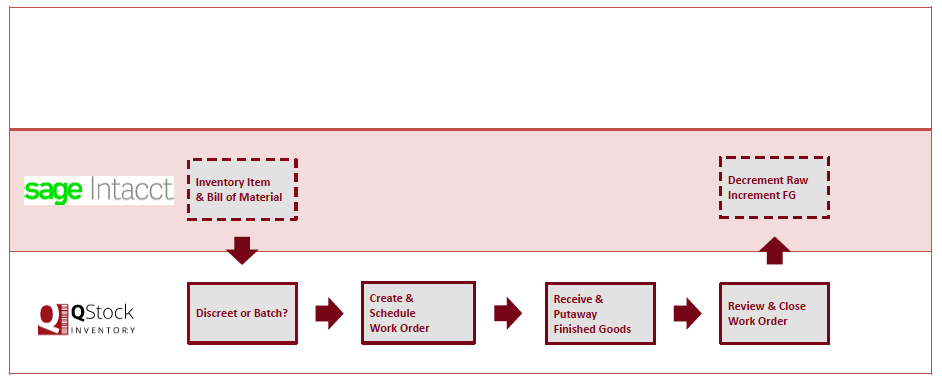
Optimized Work Order Build Process

biotech intacct workflowIn this workflow, the biotech company has their inventory and BOM master records originate in Sage Intacct.  And those master records are used by QStock when a production order is started. This is an example of two best-of-breed solutions sharing the same records.  This integration helps the organization use available inventory, easily see quantity levels to know if they can start production (avoid ordering unnecessary ingredients or conversely being alerted to the need order needed ingredients).

This gives the biotech team the capability to track (within Sage Intacct or QStock) which raw materials were used in which lots.  You have lot and serial number tracking capabilities throughout this Work Order Build Process.

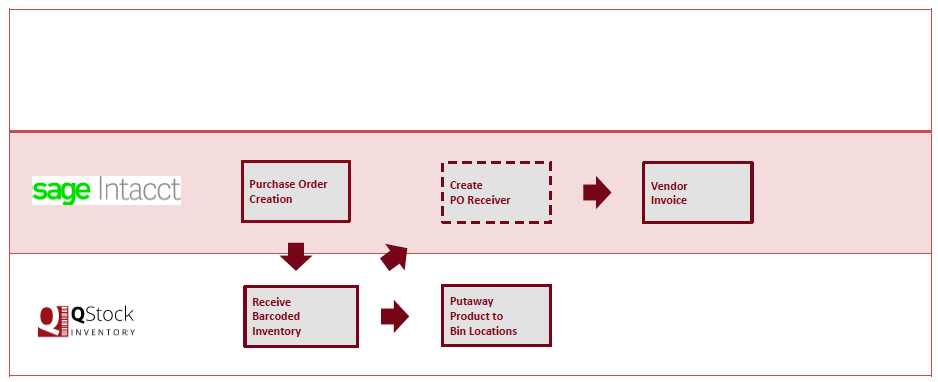
Optimized Procure to Pay Process

biotech workflow 2This example depicts an optimal procure-to-pay process with the creation of the Purchase Order in Sage Intacct.  The integration between Sage Intacct and QStock allows QStock to receive items, using handhelds to scan inventory – this is faster and more accurate than paper-based processes.   At this point users have the option of creating receipt of goods in Intacct, while QStock ensures the inventory in place in the correct warehouse bin locations. Automation within Sage Intacct completes the process by turning the PO receipt into a Vendor Invoice, facilitating vendor payment.

Optimized Lead to Cash Process

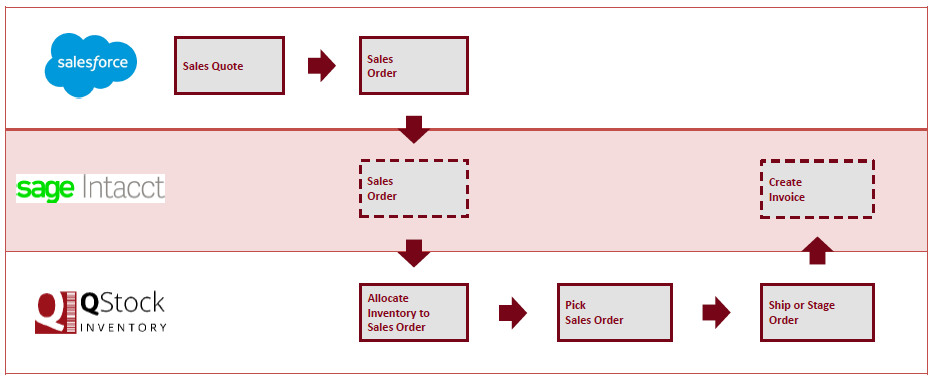
In this workflow, three best-of-breed solutions (CRM, Accounting, Warehouse & Inventory) streamline the Lead to Cash Process.  

Your sales team will utilize Salesforce (the most widely used CRM systems) to manage leads, opportunities, and orders.  Upon signature and approval, those orders are moved to Sage Intacct, which then triggers QStock to begin allocating inventory and to initiate the picking process. Again, manual, error-prone processes are eliminated, as hand-held scanners are used to pick the appropriate items and record lot numbers, bin locations, and more.  

Once all items are picked and the order is fulfilled and shipped, using the automation in QStock, Sage Intacct is notified and creates an invoice. Sage Intacct can email the invoice and receive electronic payment – which completely eliminates paper from the process.

Conclusion

“You have the merging of two or more major universes with a best-of-breed approach.  You’ve got comprehensive reporting that can enable quick response and correction if there’s a problem like a recall,” says Wang.  “But what’s more visible and immediate are the day-to-day improvements in processes and results. That means being more competitive if the company is revenue-driven.  Better performance and strong reporting mean no hiccup in funding for companies that are startups.”

“When a biotech company takes a best-of-breed approach to information systems, there is a groundswell of improvement,” explains Massey.  “Managers, throughout the organization, are better able to run their department because they have greater insight into their functional areas.  We’ve seen countless examples within our customer-base of the dramatic improvements that are possible when CFOs have real-time, accurate data. They can better address both problems and opportunities.”

Read Part 1: Accurately Track Costs with Project Accounting

Read Part 3: Support Flexible Reporting, Forecasts and Budgeting

Filed Under: Accounting Software, Biotechnology, Industries, Sage Intacct, Services Tagged With: Biotechnology, Cloud Accounting, financial management, Sage Intacct, salesforce, traceability

Article 02.8.2018 Dean Dorton

Essential Financial Management Practices of Biotech Companies – A 5-Part Series

Article 1: Track Costs with Project Accounting

It’s staggering when you consider the contributions biotech companies have made.

Tools that enable less invasive surgery and faster recovery.  Drugs that save and enhance lives.  Devices that improve the quality of life.  Ideas that lead to cures.  Knowledge that leads to innovations.  Research breakthroughs that reduce pain and suffering.  

Right here in North Carolina and throughout the United States, from small startups to companies on the verge of IPO, biotech companies are beginning projects that could lead to even more revolutionary breakthroughs.

It’s not all science and engineering – project management and financial accounting required

From the pre-revenue stages, throughout the funding stages, and up to the ultimate goal of merger, acquisition, going public or simply operating as a much larger, profit-yielding entity – financial accounting is a key component of effectively managing a life science or biotech company.  

Commercialization of biotech research requires a clear understanding of the costs associated with each project.

There are any number of things beyond your control that could threaten your research and projects.  Lack of sound financial accounting practices shouldn’t be one of those threats.  Technology and solutions exist that put you in control of your financial accounting. These are cloud-based and affordable solutions that can quickly bring biotech companies the accounting processes and reporting they need to satisfy funders, maintain compliance, and make data-driven decisions.

Project management and project accounting enhance efficiency and effectiveness

Project management – In any project-centric organization, an efficient, knowledgeable, and organized project manager is worth their weight in gold.  They serve as a go-to in getting up-to-date, accurate information on the project’s progress, obstacles, adherence to budget, staffing, milestone metrics and more.

“Project management is an established discipline, with degrees, techniques, and professional certification.  Yet many of the people who do this kind of work in scientific industries do it without this formal training – or they pick up that training later.”  ScienceMag.org

Project accounting – Equipping your organization with a powerful project accounting system is an essential best practice for biotech companies.  If you have skilled project managers it will make them that much more effective.  However, if you don’t have project managers (in the traditional sense the title implies) and the various responsibilities of project management fall to more than one person (accounting has a role, researchers have a role, IT has a role, etc.) then a project accounting solution is vital.

The project accounting solution you implement should automatically track all costs related to a specific project, for example, drug development – including time, materials and testing.  The solution should also help you accurately allocate shared costs to provide greater insight into potential profitability.

Evolution of Your Accounting Solution and Preparing for Growth

Graduating from QuickBooks – It’s hard to find an organization whose first accounting solution wasn’t QuickBooks.  QuickBooks is a great solution for what it was designed to do.  However, the needs of biotech companies very quickly exhaust the capabilities of QuickBooks.

“Within a biotech company, things begin to accelerate rather quickly,” says Philip Massey, CPA and president of accounting software technology firm Massey Consulting.   “Each project needs to be tracked and meet the reporting requirements of the funder.  When there are multiple projects, multiple funds, and perhaps multiple locations, trying to manage the financial accounting on an entry level system is difficult, if not impossible. I have seen situations where the accounting staff was spending 40 plus hours a month working in spreadsheets to try and sort things out – which is simply an inefficient use of time and manpower, not to mention the high risk of error.”

The other drawback of continuing to use QuickBooks, spreadsheets and other manual processes is the lack of integration between different information systems throughout the organization.  In part three of this series, we’ll address the importance of unified systems in more depth.

Robust project accounting for the long haul – Outgrowing a software solution and implementing a new one will disrupt the organization to some degree.  When selecting a solution, obviously you want the solution to address today’s challenges.  But you also need to think in terms of future needs.

Your future accounting needs may include different phases of funding from the seed stage to angel investors, to various rounds of funding until you reach the Mezzanine level, make your IPO or proceed with merger and acquisition strategies.

The activity of the organization may also change in time from pre-revenue stages – concept and research, through business planning, product development, and maybe several other stages – to revenue generation, expansion and IPO.

You don’t want to be changing solutions every other year – it would be disruptive, expensive and painful.  The point is to select a solution that will sustain your momentum by delivering project-centric accounting that offers opportunities for automation, scalability, tracking, reporting, and greater insight to better manage projects and satisfy the needs of the organization and your funders.

The Ideal Project Accounting System – 5 Benefits

Informed decisions with project insights – there are five ways a modern, project-centric system can strengthen the financial accounting and project insight of a biotech company:

  1. Multiple operating dimensions
  2. A single source of the truth
  3. A statistical book of measures
  4. Self-service reports and custom dashboards
  5. Real-time project visibility

“What multiple operating dimensions means is that the system should allow you to track the various dimensions of the business and research projects,” explains Massey.  

The first to feel the positive effects of best-in-breed financial accounting and project accounting solution will be the CFO, Controller, and accounting staff.  But Massey points out that there is a ripple effect, “The executive management team, the board, and funders will be enthusiastic about the ease with which they can drill down into the areas of concern or exceptions which is facilitated by the architecture of the software – the multiple operating dimensions.

Having a single source of the truth is paramount in providing accurate, consistent, audit-ready, and traceable information tracking and reporting. It comes down to your data being able to withstand the most intense examination.  For as James Wang of San Jose-based QStock notes, “Reporting and accounting must be very clean for biotech companies because they will be scrutinized.”

The system should be able to serve as a statistical book of measures by combining operational and financial metrics for greater insights. The system should be integration-friendly allowing you to look at headcount, locations, and contracts not captured in a standard ledger.

There will be a positive ripple effect of the solution outside of accounting and the executive team.  A modern, cloud-based accounting solution should offer self-service reports and custom dashboards. “Give project managers easy access to data that’s meaningful to their work, and they will be able to manage better and drive faster results,” reports Massey.  “They will know where they stand budget to actual and be able to make data-driven decisions that will move the research forward without fear of over-spending.”

Real-time project visibility means knowing exactly what the status of a project is today – not last week, last month or last quarter.  Real-time project visibility provides optimal control and clarity and gives decision-makers and leaders the data they need to act with confidence.

As you evaluate your next accounting software for your biotech company, get the best software, domain and technical assistance you can.  Look for a consultant who understands and has worked with biotech companies before.  

It’s important to scrutinize not only the software itself but other factors such as customer reviews and references, satisfaction ratings, third-party reviews, and endorsements from accounting experts like the AICPA.  

This five-part series will continue with part two ‘Automation, Tracking, and Traceability’.

Download our E-book

Filed Under: Accounting Software, Biotechnology, Industries, Sage Intacct, Services Tagged With: Accounting, Biotechnology, cloud solution, ERP software, financial management, Project Accounting, Reporting, Sage Intacct

Article 01.29.2018 Dean Dorton

When it comes to Biotech business systems, it’s complicated. All of it. Tracking profitability is complicated. Reporting for regulatory compliance – also complicated. When you also consider the rapid growth your company is going through, your team’s research and development, reporting and business decisions aren’t going to get any easier any time soon.

We understand.

Our accounting experts recognize the unique management complexities that Biotech companies face. These companies have issues unlike any other industry, and those issues demand a unique approach to managing workflows and financials.  

Biotech companies need systems that can flex with new changes but can still provide a strong foundation that will scale with the company in the future.

To help Biotech companies navigate these hurdles for the long haul, we have created a free ebook on the 5 Essential Financial Management Practices of Biotech Companies Poised for Growth.

In our eBook, you will discover how to keep your financials accurate, and your workflow systems streamlined, now and going forward.  You’ll learn:

  • How to efficiently track project accounting costs using systems that will flex with your teams’ changing needs.
  • Habits in lot tracking and batch automation for precision, accuracy, and traceability.
  • Ways to unify your systems for flexible reporting that will scale with your company’s expansion.
  • More effective processes for streamlining workflows.
  • How best to grow with cloud technology to support your company’s unique complexities.

Success isn’t going to stop and wait for lagging internal processes, and productivity bottlenecks to catch up when the business is going strong.

Your business needs strong, timely solutions right now. Your company needs a best-in-class cloud solution like Sage Intacct to adapt quickly and to maintain the pace. It needs scalable business practices that deliver streamlined reporting efficiency, and real-time visibility into metrics stakeholders and decision-makers need.

Your teams need all the right integrations to keep research and development going, as systems and processes change to handle new growth, even when your company is at the height of production.

Do all you can to ensure your company’s unique needs are being met, in the areas they need the most help.

Filed Under: Accounting Software, Sage Intacct, Services Tagged With: Accounting Software, Biotechnology, Cloud Accounting, financial management, growth, life sciences

  • Services
    • Outsourced Accounting
    • Audit & Assurance
    • Tax
    • Consulting & Advisory
    • Technology & Cybersecurity
    • Family Office
    • Wealth Management
  • Industries
  • Company
  • Locations
  • Careers
  • Insights
  • Events
  • Contact Us
facebook Dean Dorton - CPAs And Advisors On Facebook twitter twitter linkedin Dean Dorton - CPAs And Advisors On LinkedIn youtube Dean Dorton - CPAs And Advisors On YouTube

The matters discussed on this website provide general information only. The information is neither tax nor legal advice. You should consult with a qualified professional advisor about your specific situation before undertaking any action.

© 2026 Dean Dorton Allen Ford, PLLC. All Rights Reserved